


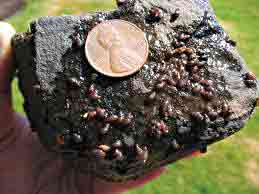
Sadly, a recent press release from the Nevada Department of Wildlife indicated that New Zealand Mudsnails were found in two locations in the Truckee River in the Reno area. The New Zealand Mudsnails are one of the species that are of great concern to area biologists. They are one of the subjects of boat inspections in the Lake Tahoe and its surrounding waters.
The two locations found were at the East McCarran Bridge and about a mile upstream in Rock Park. While the extent of the infestation is not known at this time, the Nevada Department of Wildlife says that the scope of the infestation is at least this 1-mile stretch.
The New Zealand Mudsnail is a tiny snail about the size of a grain of sand to about one-eighth of an inch in diameter. One of the main concerns of local biologists is that they could adversely effect the local trout populations. Under perfect conditions, the snails can be found in high concentrations crowding out existing macroinvertebrates.
The mud snail, native to New Zealand, first showed up in Idaho and Montana in the 1980s and then spread to California in the 1990s. It was first discovered in the Owens River Valley and has been found in the Consumnes River drainage and Putah Creek that run out of Lake Beryessa.
It is thought that the spread of these snails are a result of humans. Anglers and boaters can easily transport these snails without knowing it on their gear or boats.
Any anglers who fish in any water that has been infested with the New Zealand Mudsnail should treat their waders before fishing in another watershed. The California Department of Fish and Game recommends some of the following treatments to prevent the spread of the New Zealand Mudsnail.
- If you wade, freeze waders and other gear overnight (at least 6 hours).
- Have extra waders and boots that are used only in infested waters. Store them separately.
- After leaving the water, inspect waders, boots, float tubes, boats/trailers and any gear used in the water.
- Remove visible snails with a stiff brush and follow with rinsing. If possible, freeze or completely dry out any wet gear.
Personally, I put my gear into the freezer for a period well over the 6-hour recommendation. The state of Oregon recommends a drying time of at least 48 hours under low humidity is to remove all pockets of dampness. Gear must be completely dry for a minimum of 24 hours. New Zealand Mudsnails can survive with even the slightest amount of moisture.
The spread of Aquatic Invasive Species is an ongoing problem and includes other potentially harmful species such as Zebra Mussels and Didymosphenia geminata (also known as Didymo and Rock Snot). Zebra Mussels have been found in Nevada’s nearby Lake Lahontan. Didymo is a diatom, a form of algae, and is present in the Little Truckee River.
Please take the necessary precautions to prevent the spread of invasive species. While it may seem that we are fighting a holding action. We certainly owe it to future generations to try and prevent the spread of these dangerous species.
FISHING REPORT
Boca | Inflow is at 201 cfs and the outflow is 209 cfs. Try powerbait or nightcrawlers. Throwing lures from shore also has been working. Fly fishers have been catching some fish near the inlet mostly nymphing.
Donner | Fishing has been good. Nightcrawlers and Powerbait seem to be the main bait. Mackinaw and Kokanee fishing has been fair. Fly fishermen are catching some fish with streamers.
Lake Tahoe | Fishing has been fair to good for mackinaw. A guide is highly recommended if you are fishing for mackinaw for the first time. Toplining and shore fishing is fair. Most shore fishermen use inflated nightcrawlers.
Little Truckee River | The flow is now at 201 cfs. This is a much more manageable flow for this water. Small flies are generally the rule on the Little Truckee. Baetis and PMD imitations are doing well. Try PMD and Baetis nymph imitations and midge patterns as trailers. Keep an eye out for surface activity, as well.
Martis Lake | Zero kill. Catch and Release only with barbless artificial lures or flies. Some small cutthroats and an occasional large brown are rainbow can still be caught here. Smallmouth bass also have been introduced in this water. Try fishing here before mid-June when the water typically warms up for trout.
Prosser | The lake is fishing fair to good. Powerbait and nightcrawlers are the best bait. Lure and fly fishermen also are taking some fish from shore and near the inlets.
Stampede | Fishing has been fair to good from shore. Kokanee fishing has been fair. Mackinaw fishing has been good. Fly fishermen have been doing well near the inlets with nymphs and streamers.
Truckee River | Flowing out of the lake at 171 cfs at Tahoe City. The flows through Truckee are at 244 cfs as of June 9. Fish have been caught on nymphs, emergers, dries and streamers. The main hatches now are PMD and Little Yellow Stones. Green Drakes are showing, as well. Nymphs and dries imitating these hatches have been the most productive. Streamers also have been productive.
Other Waters | Davis and Frenchman have been fair to good. Damselflies are now beginning to show is good numbers with the recent warm weather. Fish also are being caught on blood midge patterns and Callibaetis imitations.
Bruce is a long-time area fly fisherman and past president of Tahoe Truckee Fly Fishers.


