


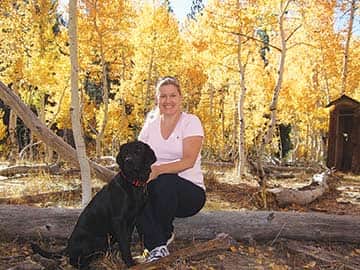
Robbi Rishel and Brynna ·
Robbi Rishel of Kings Beach was born with a hearing impairment. Without the use of hearing aids, life is difficult at best and potentially dangerous. In the event of an emergency, she may be unable to hear a fire alarm or other warning indications, however, with the help of Brynna, Rishel’s service dog, she is able to live independently.
Brynna is trained to alert Rishel to everyday sounds, a knock at the door, the phone ringing or the microwave beeping, as well as an alarm or siren in the event of an emergency. Rishel and Brynna were paired together as a hearing team through Canine Companions for Independence, a nonprofit that provides trained service dogs to people with disabilities at no cost.
Canine Companions
What sets Canine Companions for Independence apart from similar programs is the amount of research that goes into training the dogs and matching them with an appropriate partner, coupled with the support provided to teams after graduating from the program. It all begins with a closed breeding program. All Canine Companions dogs are Golden Retrievers, Labrador Retrievers or a cross of the two breeds as these dogs have proven to have the best temperament for the variety of environments that each dog will be exposed to.
Volunteer dog breeder caretakers raise the puppies in their homes for the first 8 weeks. The puppies are introduced to a family environment from the start and socialization begins from day one. The puppies also are introduced to their first basic commands before being paired with a puppy raiser.
The primary goal of the puppy raiser is to provide a safe, loving home for the next 18 months until the puppy is ready to go on to advanced training at a regional Canine Companion center. The puppy raiser teaches the puppy manners and basic commands, attends Canine Companion-approved obedience classes and works closely with Canine Companions for Independence to monitor the puppies’ progress. Kristen Trisko has volunteered as a breeder caretaker and puppy raiser since 1986 and is currently the president of the East Bay volunteer chapter of Canine Companions.
“One of the biggest questions people always ask me is how I could ever give up a puppy,” said Trisko. “It’s not about me, it’s not about the love I have for this puppy. It’s really about the people like Robbi who are going to get the dog in the future. It’s about the opportunity to change lives.”
Once the dogs are old enough, they are turned over to the nearest regional center for two weeks of team training with a potential partner. Individuals go through a phone interview and an in-person interview before team training to help ensure being matched with an appropriate dog.
Both the National Headquarters and the Northwest Regional Center are located in Santa Rosa; the closest facility for those on the West Coast. The Charles and Jean Schultz campus provides dorm-style lodging and food for both dogs and people.
“Canine Companions for Independence provides a great facility that encourages you to spend time with both classmates and the dogs,” said Rishel. Recipients spend the two-week training period learning how to properly handle the dogs. Families also are encouraged to attend training to learn how to communicate with the dogs.
“Canine Companions for Independence empowers you to train the dog to work for you, so you can go home and build on what you learned,” said Rishel.
For example, in the event of a smoke alarm during the night, the dogs are trained to nudge their partners awake. As a backup to the nudge, Robbi trained Brynna to jump on her.
Once a participant chooses a dog and completes the two-week training, a graduation ceremony is held, but the programs involvement doesn’t stop there. After six weeks, teams return to the Canine Companion center for final testing and fine-tuning. Throughout the working life of the dogs, graduate teams return to campus for workshops, seminars and reunions. Additionally, instructors remain in close touch with graduate teams. Rishel says she is impressed with Canine Companions and the continued support that they provide. Today, along with Brynna, intensive training and the use of a cochlear implant in her right ear and a digital hearing aid in her left, Robbi is able to function in the hearing world quite well.
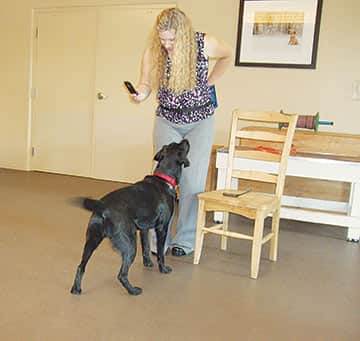
A change of career
Sometimes, after the rigorous training program, it will become obvious that a dog is not right for the program and Canine Companions believes in letting a dog choose its own path. The puppy raiser has first rights of refusal for a puppy who is released from the program. If the puppy raiser is unable to care for the puppy there is a long waiting list of people who hope to adopt a released dog. Most released dogs continue to work with people in a variety of settings.
Lin Nelson, a puppy raiser and Northwest regional board member at Canine Companions who owns a home in Carnelian Bay, has two dogs that changed careers after completing training with Canine Companions for Independence. They currently work as therapy dogs at Renown Health in Reno.
“The dogs have an amazing ability to help people relax, focus and smile. The hospital can be a daunting place. A lot of emotions go into being a patient and the dogs seem to cut through all that and allow people to forget their troubles just for a few minutes,” said Dinah O’Brien, the volunteer coordinator for the Pet Therapy Program at Renown Health. The program is in its 18th year at Renown and has been enormously popular. The dogs visit 13 units including four out of the five intensive care units.
Nelson’s dogs Durrell and Iowa visit neurosciences, the infusion center and the trauma intensive care unit.
Unlike Canine Companions, the Pet Therapy Program accepts a variety of breeds to become therapy dogs. The No. 1 priority is that each dog must love people. Dogs are required to go through a testing process and are carefully screened during observational visits to hospitals and other facilities before being accepted into the program. Additionally, handlers must complete a medical clearance and background check. Each dog and handler team is given specific assignments and follows a regular schedule. They wear a uniform and photo identification whenever they are on assignment.
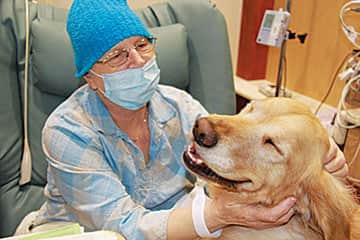
Durrell at work
Therapy & service dogs
It’s easy to confuse the difference between a service dog and a therapy dog, and sometimes the terms are mistakenly used interchangeably, however there is an important distinction between the kind of work performed. A service dog is individually trained to perform specific tasks for a person with disabilities, while a therapy dog is trained to provide affection and comfort for those in hospitals, nursing homes, schools and hospices, in disaster areas or to people with learning difficulties.
The online sale of fake service and therapy vests for people hoping to bring their pets to public places only adds to the confusion and discredit the works that service and therapy dogs are trained to do.
Getting involved
The closest Canine Companions for Independence chapter, the Gold Rush Champions, is located in Sacramento, however, Nelson hopes to bring more awareness to the program in the Reno and Tahoe region. Building a local chapter would bring more support to puppy raisers and graduates in the area.
The University of Nevada, Reno has partnered with Canine Companions for Independence to host DogFest Walk n Roll on Sept. 14 in Reno. The Walk n Roll is a community dog walk where teams raise money to support the mission of Canine Companions for Independence.
For more information on how to get involved, visit cci.org.


