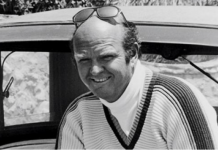
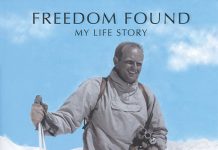
The 1950-60s marketing director for Pan-American Airways also was the inventor of a ski training, balancing board called the Bongo Board. Arguably, as many people got hurt trying to balance on that board as the number of weekend ski accidents in Vermont.
In New York City one afternoon, Stan Washburn suggested that I ride Pan-American Airlines around the world and take my skis along and call my next movie “Around the World On Skis.”
Stan backed up his offer with two free coach tickets, so all I had to lose was about a month of my life. With all of my ski equipment, my camera gear, tripod and wife, I set off from Los Angeles to stop in Honolulu to refuel. En route from Honolulu to Tokyo, we dropped 10,000 vertical feet in clear air turbulence and nearly lost the entire airplane, but that’s another story.
Once we got to Tokyo, it was a night in a hotel on tatami mats with a piece of 2 x 4 for a pillow. Not speaking a single word of Japanese and without a translator, somehow we managed to get to Shiga Heights. This was before double chairlifts had appeared in Japan and before snow grooming. Almost every skier I filmed or even saw had a small rucksack that contained their lunch and a round-trip, train ticket back to Tokyo.
On the scale of 1 to 10, I would call my cinematic efforts in Japan a 3 or 4 at best, but I did get some hilarious comedy and found out later that any of the people I had been filming had stood up for the many-hours train ride from Tokyo. The Japanese are nothing but passionate when they commit to something like skiing.
After Shiga Heights, we spent two days in Hong Kong and then it was the longest flight in my recorded history, Hong Kong to Munich, Germany. I have tried to erase the agony of that long, long journey in a coach seat because it seems like I spent 172 hours in a seat that was designed for an 8-year-old child.
Landing in Munich, my next job was to buy a Volkswagen Bug, put all the luggage in the back seat and under the hood, and drive from there to Grindelwald, Switzerland. Once we checked into the hotel, I spent the next three days in bed from exhaustion.
Luck was on my shoulder again, because that was the first time I saw Art Furrer. If I would credit anyone for inventing ballet and trick skiing, it would be Art. This was long before the snazzily attired, group of skiers representing K-2 were doing their amazing flips and mogul runs all over the world. Art paved the way for all the great skiers who later became the freestyle movement.
I did a lot of the photography of Art, set against the background of the fantastic North Face of the Eiger, a sheer granite wall that is more than 9,000 vertical feet high.
Across the valley from Grindelwald is Murren that can only be reached by a cog and cable railway. This was the first resort in Switzerland that stayed open during the winter months because Sir Arnold Lund had been running summer tours there for several years and was interested in skiing in the 1920s. He convinced one hotel to stay open and destination skiing was invented.
Since you had to pack down the snow with your skis, climbing up the hill and skiing back down got boring so Sir Arnold stuck some sticks in the snow and tried to make turns around them. In that simple process, he also was credited with the invention of slalom racing.
In today’s high-tech slalom racing, the two runs take only a couple of minutes and sometimes they are won by less than one-100ths of a second. That’s only about an inch or two at the speeds the slalom racers are going.
Winning an Olympic medal these days, that amateur Olympic medal is worth a couple of million dollars in advertising revenue to the winner, yet he is still an amateur.
Back to Grindelwald and Murren. That part of ski country, in my opinion, is probably the most beautiful ski country in the world and access on the fantastic Swiss national railroad makes it easy to get to and well worth putting on your calendar of places to visit.
By the time I spent three or four days filming Art Furrer, I had made up some ground that I lost by not getting good ski action in Japan at Shiga Heights. In those days, the primary marketing tool for my feature-length ski films was posters. Naturally, that year the title of the film was “Around the World on Skis.”
As I look at that poster today, I’m reminded that it was taken by Tom Kelly, who made Marilyn Monroe famous by taking her first nude photograph. The poster is of me standing in a sheepskin leather coat, with a globe of the world on a tripod, and I’m holding a pair of red Hart skis. It got enough customers so I could sell enough tickets with ski club sponsorship, to support three children with enough money left over to make my next ski film.
Those were the good old days when I selected the resorts to film, drove, flew or rode a bus or a train to get there and film them, come home and spent the summer editing the film, writing the script, and copying songs off of 33 1/3 RPM phonograph records.
In October, I would say goodbye to the family and then narrate every film presentation, live on the stage in about 100 different cities. n
Warren Miller is history’s most prolific and enduring ski filmmaker. Visit warrenmiller.net or visit his Facebook page at facebook.com/warrenmiller.