


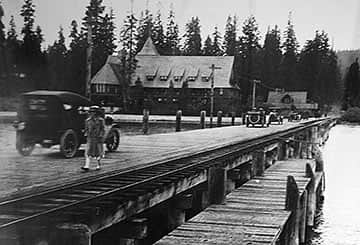
The Tahoe Tavern condominium properties near Tahoe City is celebrating its 50th anniversary this summer as the reincarnation of the original Tahoe Tavern Hotel & Casino built at the turn of the 20th Century. That commercial development not only shares a venerable name, it is part of our historic legacy.
Read Part I
The first Tahoe Tavern opened in the spring of 1902 as part of timber baron and railroad operator Duane L. Bliss’ grand scheme to elevate Tahoe Basin tourism. Bliss integrated a sleek, stylish passenger steamship and a narrow gage train system to cater to the comforts of well-heeled visitors heading to Lake Tahoe from the United States and Europe.
The luxurious hotel, designed by Duane’s son, architect Walter D. Bliss, was grand enough to be considered the finest hostelry between San Francisco and the Rockies. In addition to many landmark San Francisco buildings, Walter also designed the Hellman-Ehrman Mansion at what is now Sugar Pine State Park on Tahoe’s West Shore. Duane Bliss financed the project by mortgaging his short line railroad in order to acquire a $500,000 loan. It was a shrewd investment as the resort’s receipts repaid the borrowed money back many times over.
In 1905, a promotional pamphlet described the Tahoe Tavern as “a long rambling building of shingles the color of pine bark, with 20-foot porches and supports of rough-sawed native wood, all set in a primeval forest.” The top of the three-story building included many gables on a steeply pitched roof to shed winter snow. The interior featured beamed ceilings with elk horn chandeliers and simple rustic furniture. Rooms were furnished with “perfectly appointed baths, large closets, electric lights, steam heat and running water.” Diners were served the best foods available, including perfectly prepared Tahoe lake trout. For those conducting business or wishing to contact the outside world, telephone and Western Union Telegraph service was available. Hotel rates started at $3 per day.
Unlike the Bliss’ more formal Glenbrook Inn, which required shirt ties at dinner, the Tahoe Tavern was much more casual. In his 1915 classic “Lake Tahoe: Lake of the Sky” historian George Wharton James described life at the Tavern.
“It is not a fashionable resort,” he wrote, “in the sense that everyone, men and women alike, must dress in fashionable garb to be welcomed and made at home. Rather the Tahoe Tavern is the most wonderful combination of primitive simplicity with twentieth century luxury.” James added: “If one has taken a walk in his white flannels he is welcome to dance at the dining-room or social hall. If one comes in from a hunting or fishing trip at dinner time, he is expected to enter the dining room dressed as he is.”
By the 1930s, however, the resort’s dress code for lunch and dinner became more formal with a dress and heels required for women and coat and ties for men.
Testament to the myriad of outdoor activities available at Lake Tahoe, visitors were encouraged to “bring their old clothes so that they may indulge in mountain climbing, bicycle riding, rowing, fishing, horseback riding, botanizing in the woods or any other occupation where old clothes are the only suitable attire.” For those wishing a more relaxing experience, the large lawn between the hotel and the lake was peppered with swing sets and reclining chairs that looked out over Big Blue.
The Tavern was such a successful tourist magnet that in 1906 an 80-room annex was added along with a gambling casino, barbershops and spacious ballroom. On Dec. 23, 1907, family patriarch Duane Bliss died after a brief illness. The loss was felt well beyond the family as one obituary confirmed: “His death will be a profound loss to both Nevada and California, for his business interests were interwoven in both states and his sterling manhood was something to rest on.”
The Bliss tourism dynasty continued to grow after Duane’s death. More additions to the Tahoe Tavern complex included a physicians’ office, a laundry, as well as a modern steam plant and water system. Piped in potable water came from the Burton Creek drainage on the other side of Tahoe City because steamer and boat traffic on the lake polluted the shoreline water near the hotel. By 1909, the resort could accommodate 450 guests. Another wing was added to the hotel in 1925 for $250,000 and the casino acquired a well-stocked liquor bar.
Automobiles took the country by storm in the early years of the 20th Century. Eventually, the popularity of the new form of transportation would meaningfully impact both steamer and train traffic at Lake Tahoe, but in the spring of 1911 the Tahoe Tavern offered a large silver trophy for the first party to drive a car from California over Donner Summit to the hotel. Management hoped to ramp up its early season tourist business and to generate advertising headlines in the San Francisco newspapers. Although promoters at the Tahoe Tavern were calculating that their trophy would be won by a socially prominent person from the Bay Area, the primary contender turned out to be a group of men from the Grass Valley area led by Arthur B. Foote.
Foote’s group wasn’t the only one competing for the prize, but they took a commanding lead in the deep June snowpack. By June 9, they had reached Soda Springs near Donner Pass where they spent the day repairing various broken parts. Finally, on June 10, they pushed and pulled their vehicle over rock and snow down to Donner Lake where they had breakfast. Taking advantage of a clear road from Truckee to Tahoe City, they reached the Tahoe Tavern that day and claimed their handsome trophy.
The Bliss family sold the Tahoe Tavern to Linnard Steamship Lines in 1926 (a subsidiary of Southern Pacific Railroad) as the popularity of the automobile reduced traffic on their Lake Tahoe Railway that delivered tourists directly to the Tahoe Tavern lobby. The purchase by Linnard and the conversion of the narrow gage railroad to standard gage by Southern Pacific Railroad led to a new era for the exclusive summer resort. The new management decided to keep the hotel open during the winter months in hopes that the rapidly growing popularity of winter sports would add a new dimension to the Tahoe Tavern’s role in the community. It almost led to Lake Tahoe hosting the 1932 Winter Olympics. Stay tuned.


