


SnowFest!, North Tahoe’s annual winter carnival, is celebrating its 35th anniversary this year and organizers and sponsors are hoping that this popular mountain Mardi Gras will encourage locals and visitors alike to get outside and join in the fun and festivities. There’s no better time to celebrate winter then after fresh snow has cloaked the region in white and the March sun is rising higher in the sky, a harbinger of spring.
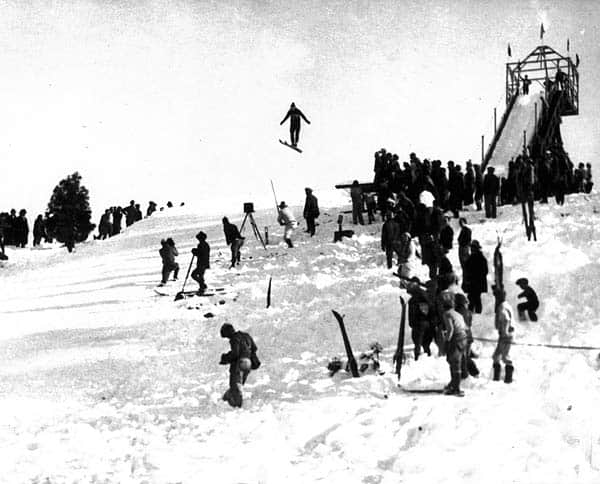
Ski jumper at Hilltop, circa 1930. | Courtesy Truckee Donner Historical Society
SnowFest! is now 35 years old, but winter carnivals and snow sports have been an important part of our history since the 1800s. People were tobogganing and ice skating near Truckee and Donner Lake by the 1860s, but the idea of a winter carnival was spawned by the need to jumpstart Truckee’s moribund winter economy three decades later. The demise of logging and commercial ice harvesting, along with the dying Comstock silver boom in the late 19th Century was devastating to the region.
[blockquote3]
“The ice palace covered an acre of ground in downtown Truckee. It blocked traffic and spooked horses, but it was an immediate success at drawing winter visitors.”
[/blockquote3]
From June through September, trains that passed through Truckee brought crowds of people. Tahoe-bound visitors purchased tickets for a ride on one of the many horse-drawn stagecoaches that operated over Brockway Pass or along the Truckee River until the establishment of a narrow gauge railroad in 1900. The summer season infused the region with cash, but by October colder weather and the threat of snow shut down the tourist trade. For many local residents and business owners, when snow began piling up along Front Street, the economy went into hibernation along with the bears.
Fortunately, Truckee had Charles F. McGlashan and other community leaders to help them develop a year-round economy through the development of winter sports. McGlashan was an intelligent and energetic jack-of-all trades. Among his many accomplishments, he practiced law, wrote the first authentic history of the Donner Party, and was editor and owner of the Truckee Republican newspaper for a time. He was also a scientist, inventor, legislator, astronomer and renowned butterfly collector.
McGlashan got the snowball rolling in 1894 by constructing a 60-foot tall, cone-shaped wooden frame on the hill near his house above town. The towering structure was wrapped with chicken wire. When temperatures fell below freezing, he sprayed water on it until it resembled a gigantic icicle. McGlashan really sparked everyone’s interest when he rigged up a powerful arc light on a nearby flagpole that bathed the sparkling icicle in bright light. At night, no one could take his or her eyes off the magnificent, glittering tower of ice. It certainly caught the attention of curious train passengers traveling the Southern Pacific line through Truckee.
It wasn’t long before McGlashan’s solitary icicle manifested into Truckee’s famous Winter Ice Carnival, a major tourist attraction for snow lovers in California and Nevada. McGlashan envisioned a massive ice palace containing a large indoor skating rink with bands playing music, food concessions and more. In the dead of winter, the town could stage dog-sled races, toboggan and horse-drawn sleigh rides, cross-country ski races, and moonlight skating parties on Donner Lake. The town’s leading businessmen listened with excitement as McGlashan outlined his concept of using excursion trains from Sacramento and Oakland to bring thousands of tourists up to Truckee. A town conference was held and it was agreed to form a stock company and commence operations the following year.
Despite some early skepticism about the project, residents constructed a large Ice Palace with the same wood and wire netting idea that McGlashan used for his giant popsicle. The ice palace covered an acre of ground in downtown Truckee. It blocked traffic and spooked horses, but it was an immediate success at drawing winter visitors. Crowds of skaters promenaded around the indoor oval rink, serenaded by musicians bundled up against the cold. The interior was lit by 20 arc lights while tall cedar and pine trees decorated the palace roof. Next door, daring tobogganers could climb a 75-foot high tower and then take an exciting ride 150 feet to street level.
By 1898, McGlashan was spending a lot of time in San Francisco promoting the ice carnival and organizing group excursions. Over the next 20 years, Truckee’s winter carnival attracted multitudes of tourists and set the stage for today’s booming winter sports economy in the Truckee-Lake Tahoe region.
Southern Pacific Railroad capitalized on the newfound excitement by establishing Snowball Specials, express trains that conveyed hundreds of tourists from the California lowlands to Truckee every weekend. Hilltop, the small hill with an open slope just south and across the river from downtown Truckee, provided an excellent place to sled and ski. In 1910, an old steam engine from an abandoned lumber mill on the Little Truckee River was hauled in by oxen-drawn wagon and converted into a pullback lift.
Most ski historians believe that this was the first mechanical lift of its kind in the United States. In the 1930s, when downhill skiing became popular in the United States, Truckee and Tahoe City were on the forefront of this new sport. Both communities had established ski clubs well before most of the country.
By 1928, ski jumps had been constructed at the Hilltop site (near present-day Cottonwood) and on Olympic Hill (Granlibakken) near Tahoe City. That same year, Tahoe City applied to host the 1932 Winter Olympics, but the European-dominated International Olympic Committee felt that California’s ski clubs lacked organization and a sufficient sporting background. The decision was also influenced by the erroneous perception that the Golden State basks in a year-round Mediterranean climate without snow. That would change in 1960 when Squaw Valley successfully hosted the Winter Games to international acclaim.
Truckee’s annual ice carnivals were the first in the West and a real boost to the town’s vitality. Charles McGlashan realized early on that tourism would be the main economic pillar for the Tahoe-Truckee community that he loved. Three months before his death on Jan. 6, 1931, McGlashan wrote a letter to the Truckee Chamber of Commerce: “I have always believed that the vast snowfields of the Truckee Basin, situated on a transcontinental railroad in sunny California, would annually attract tens of thousands of visitors.” He got that right.
The dream of the Truckee-Tahoe region as a Mecca for winter fun has succeeded beyond anyone’s imagination. Make sure you get out there and enjoy the timeless fun of winter sports and community activities during SnowFest!
Tahoe historian Mark McLaughlin is a nationally published author and professional speaker. His award-winning books are available at local stores or at thestormking.com. You may reach him at mark@thestormking.com. Check out his blog at tahoenuggets.com or read more at TheTahoeWeekly.com.


