


The snowpack from the Sierra Nevada provides crucial water for California and western Nevada each year as the snow melts. Skiers and boarders get fired up about the quality and depth of the snow. Hydrologists and anyone who relies on Sierra snowmelt are more concerned with how much water is in the snowpack — it’s called the SWE (snow water equivalent).
The Sierra range occupies only 12 percent of the state’s land area, but nearly 70 percent of the state’s population relies on its runoff.
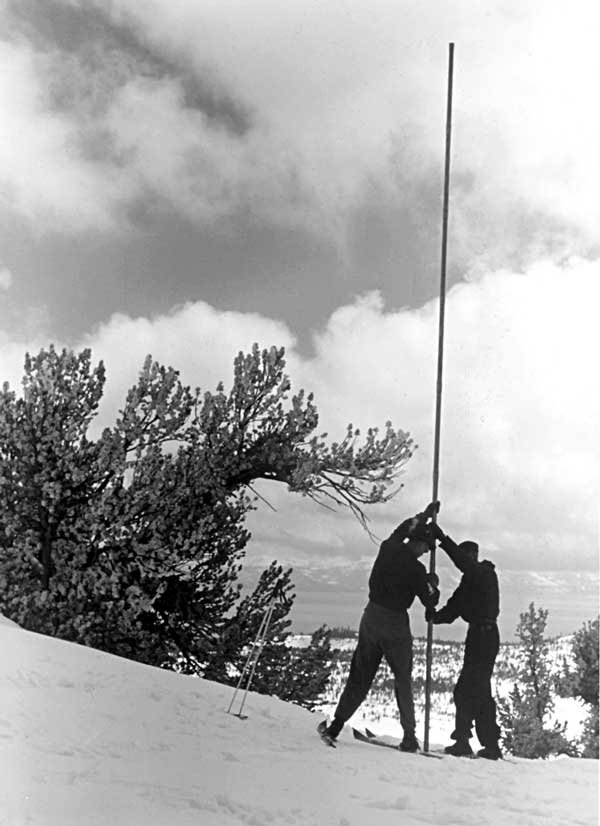
Many people are familiar with the media coverage of monthly snow surveys carried out each winter by California Natural Resources Agency and Nevada’s Natural Resources Conservation Service, where teams of surveyors manually force a hollow aluminum pipe deep into the snowpack to measure its all-important water content. Former California governor Jerry Brown made a point of attending the April snow survey at Phillips Station near Echo Summit each year to bring attention to the relevance of critical mountain water storage.
The Sierra Nevada snowpack is California’s most valuable natural resource and not because of the popularity of winter sports. When all that frozen precipitation melts it supplies more than half of the Golden State’s total water supply. The Sierra range occupies only 12 percent of the state’s land area, but nearly 70 percent of the state’s population relies on its runoff. The Sierra snowpack is a key asset that sustains one of the largest economies in the world by providing high-quality water to millions of people, as well as to industry, recreation, fisheries, ranchers and farmers.
The earliest studies of our regional mountain snowpack began with James E. Church, Ph.D., a Michigan native who was hired in 1892 by the University of Nevada, Reno to teach Latin and Greek. Ironically, Church nearly turned around after he stepped off the train in Reno and watched a man shot in a saloon gunfight die at his feet. Lucky for us, he gazed up at Mount Rose, which towers impressively above the city, and decided to stay.
Known as the father of snow surveying, Church was a pioneer in the field during the early 20th Century. In 1905, he established the first Sierra weather observatory atop 10,776-foot-high Mount Rose (southwest of Reno) and later developed procedures for measuring the depth of snow and its water equivalent. He learned that snow is an elastic substance and its depth does not indicate the amount of water in it.
Church got into the streamflow forecasting business by accident. His original research about the logging industry investigated forest influences on mountain snowpacks. That led him to design the Mount Rose Snow Sampler, a hollow metal tube that hydrologists thrust deeply into the snowpack to extract a core of snow. The sample core is then weighed on a specially calibrated, portable scale to determine its water content — a simple but effective system that is still used today.
Church conducted his first snow surveys in the Sierra Nevada in 1906. Lacking scientific training, he worked closely with Horace Boardman, Ph.D., a civil engineering professor at the University of Nevada, to develop the complex mathematical formula by which snow survey measurements are converted into streamflow runoff forecasts. Church made news in 1911 when he used his snow sampling system to accurately predict an exceptional seasonal (spring) rise in Lake Tahoe’s water level. Winter storms had dumped nearly 50 feet of snow that winter and Church’s data enabled Tahoe Dam managers to pre-release stored water and mostly avoid catastrophic flooding on the Truckee River that spring.
Ever since the first settlement, California and Nevada have fought over water rights on the Truckee River and its primary source at Lake Tahoe. In the early decades of the 20th Century, these two states that shared the same mountain watershed were in the midst of a bitter water war. By providing officials with streamflow forecasts to better manage reservoir storage in Lake Tahoe, Church’s new forecasting tools subdued the conflict. Expanding the snow surveys outside the Tahoe Basin dramatically improved the accuracy of runoff predictions for the Truckee River, Reno’s main water source.
Church made many important contributions to snow science, but as a liberal arts professor he didn’t have the equipment or academic training to delve more deeply into the complex physics of the snowpack’s structure. A major advance for scientific research in Sierra Nevada snow came in 1945 when U.S. Weather Bureau physicist Robert W. Gerdel, Ph.D., was directed to build the Central Sierra Snow Research Lab at Soda Springs. During World War II, government officials recognized the need to improve the management of the country’s precious western water resources. For several years, the Army Corps of Engineers had encountered problems determining spillway design for floods and the Weather Bureau was having trouble meeting its responsibilities for streamflow forecasting.
Gerdel’s path to studying snow on Donner Pass was convoluted, as well. Born in Missouri in 1901, Gerdel grew up in Michigan. When he was 12 years old, a botched surgical procedure left him clinically deaf. A country doctor had performed a successful tonsillectomy on the boy’s kitchen table, but an infection permanently damaged his ear canals. Losing your sense of hearing is a life-changing event, but Gerdel never let this physical handicap interfere with his plans to become a scientist. Although his high school principal tried to have him committed to the Michigan School for the Deaf, Gerdel successfully persuaded the administrator to give him a chance. He learned to lip-read and hand sign. He checked the lecture notes of his fellow students, studied voraciously and graduated with good grades. After high school, Gerdel attended Michigan State College of Agriculture and Applied Science. Not only was the coursework challenging, two of his college professors dropped him from their classes due to his lack of hearing. Undaunted, Gerdel went on to earn two doctorate degrees at Ohio State University.
In 1943, Gerdel moved to Sacramento where he spent two years designing the infrastructure of several snow laboratories. As construction got underway, Gerdel installed temporary weather instruments behind the Soda Springs Hotel on Highway 40 near Donner Pass. In the first year of the lab’s operation, Gerdel and his staff produced the nation’s first comprehensive reports on instrumented studies of heat and water dynamics in deep, high mountain snowpacks. Snow science has come a long way since then.
Read Part II https://yourtahoeguide.com/2020/07/the-science-behind-snow-surveying-part-ii/.


