


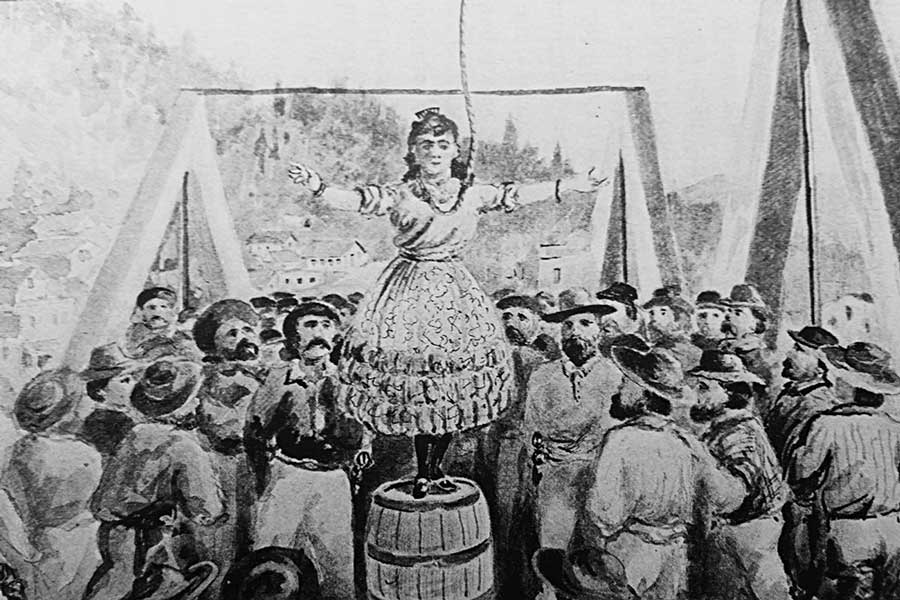
Two years into the California Gold Rush, the Sierra County town of Downieville had an estimated population of 5,000. The mining camp was dominated by hard-working, hard-drinking young men experiencing the adventure of a lifetime. They came from the United States, Mexico, Chile, England, France and China — all hoping to get rich.
This is an excerpt from Mark McLaughlin’s forthcoming book “Truckee & The 601, Vigilantes and Racism in 19thCentury California and Nevada” due out this fall.
On July 4, 1851, Independence Day in the United States, the saloons and gambling halls in Downieville were packed with celebrants ready to commemorate the holiday with drinks and festivities. A large platform had been built on Main Street where patriotic speeches were made to rousing cheers. Jack Craycroft’s Gambling Palace, where a Mexican national named José Loaiza dealt cards at the Monte table, was busier than usual due to the holiday excitement. Dealing at another card table was Josefa (her last name may have been Segovia), a 22-year-old woman from Sonora, Mexico, known for her striking beauty and quick temper if threatened.
The rare female — especially an attractive one perceived to be single — was always a target for unwanted sexual advances or worse in the gold camps.
The rare female — especially an attractive one perceived to be single — was always a target for unwanted sexual advances or worse in the gold camps. Josefa was also called Juanita or Pretty Juanita. She was either José’s girlfriend or wife and they lived together. During the Gold Rush and for years after, Juanita was a pejorative term used by white men to define any woman of Mexican descent.
There are conflicting accounts of the following events, but the tragic results of a racist mob are the same. Downieville’s Fourth of July celebration continued late into the night, with drunk men exiting the saloons and carousing in the streets. In the early morning hours of July 5, Jack Cannon was one of the rabble rousers. Jack was a popular but rambunctious miner afflicted with the all-too-common tendency for disorderly conduct when drinking alcohol. That night he and his inebriated friends were pranking the neighborhood by pushing open the front doors of various cabins. As the burly Cannon staggered down the street, he stumbled into the door of Josefa and José’s house, breaking it clean off the hinges. Apparently, José was still at work at the saloon and not home yet. Some versions of the story suggest Cannon forced his way in because he wanted sex for money from Josefa, as if she were a prostitute. Angry words were exchanged until Cannon’s friend pulled him back into the street.
Later that morning, José and Josefa demanded payment for the damaged front door. An argument ensued and the belligerent miner pushed his way into their cabin in a threatening manner. In the melee, Josefa plunged a knife into Cannon’s heart, killing him instantly. She protested that her actions were in self-defense, but word spread rapidly of the crime, as did demand for a quick lynching of the dangerous Mexican murderess.
An angry mob mindset intensified as the crowd swelled from 600 to about 2,000 people. More reasonable members in the throng appealed for a fair and legal trial for the young woman. Given the passion for revenge pulsing through the outraged American miners at the loss of one of their own by a foreigner, especially one from Mexico, a fair trial was impossible for Josefa.
Nonetheless, a judge and jury, along with a prosecutor and defense attorney, were recruited for a mock trial. In his 1891 book, “The Vigilantes of California, Idaho and Montana,” John W. Clampitt stated that Josefa was “seized and placed in the custody of guards while the Vigilance Committee of Downieville should determine her fate.” If that is true, to my knowledge it would have been the first such committee formed in the state. It seems unlikely in this case, however, given the speed with which the Downieville mining camp justice moved forward.
Josefa and her defense attorney were positioned on the speech platform, along with the bloody corpse of Cannon. The crowd surrounded them. When Josefa’s defense counsel stood on a barrel to loudly defend her rights to a legitimate trial, he was unceremoniously knocked down and thrown into the enraged mob that proceeded to kick and punch him.
The spontaneous kangaroo court quickly convicted Josefa of murder. She was sentenced to hang within two hours and denied the spiritual comfort of a Catholic priest. José Loaiza was ordered to leave town within the day, never to return. Desperate, Josefa claimed that she was pregnant, an assertion that was confirmed by Dr. C.D. Aiken. Three other frontier physicians examined her, however, and determined that she was not. Dr. Aiken was also ordered to leave town within 24 hours.
Josefa was escorted to a nearby wooden bridge where a rope had been hung from a crossbeam. Under the lanyard a crude plank swung out over the rushing river below. Eyewitness accounts reported that Josefa walked to the lynching rope with her head held high. She saw some friendly faces in the crowd, but they were outnumbered and could not protest this extrajudicial atrocity. Josefa herself calmly positioned the noose around her neck and her arms and legs were tightly bound. Her last words were: “I would do the same thing again, if I were treated as I have been.” Convinced of her innocence and the right to defend herself, Josef stepped off the plank into eternity.
On July 14, 1851, the Daily Alta California published the following article under the title: “Hanging a Woman”: “The occurrence which was published a few days ago, as having taken place at Downieville, proves to be no fiction as several papers supposed. John S. Fowler, Esq., who witnessed the frightful scene, describes the affair as reflecting infinite disgrace upon all engaged in it. The act for which the victim suffered, was one entirely justifiable under the provocation. She stabbed a man who persisted in making a disturbance at her house and had greatly outraged her rights.
“The violent proceedings of an indignant and excited mob led on by the enemies of the unfortunate woman are a blot upon the history of the state. Had she committed a crime of a really heinous character, a real American would have revolted at such a course as was pursued toward this friendless and unprotected foreigner. We had hoped the story was fabricated. As it is, the perpetrators of the deed have shamed themselves and their race. The Mexican woman is said to have borne herself with the utmost of fortitude and composure through the fearful ordeal, meeting her fate without flinching.”


