


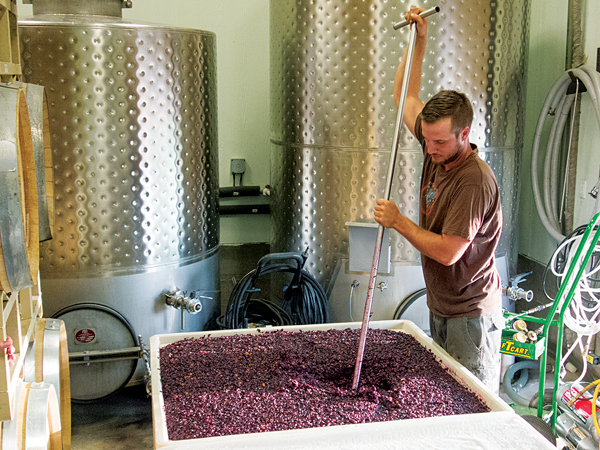
An auspicious observation would strike Larry Aderman every time he vacationed in California wine country, visiting its tasting rooms: “The people on the other side of the counter looked very happy doing their jobs.”
Raised in the Finger Lakes wine region of upstate New York, Aderman had a passing familiarity with viniculture, but his professional focus lay elsewhere.
That seriously started to change about a dozen years ago, when he and his wife Pamela bought an old house to rebuild in Calaveras County.
“We want to concentrate on our wines until they’re perfect, so we can sell them with a lot of pride.”
–Larry Aderman
By then they were living in the Bay Area, where they were working to build their business as manufacturer’s reps selling production equipment to electronics fabricators. On weekends in the Sierra Foothills, to take a break from construction the couple would venture down the hill to Murphys for Saturday afternoon wine tastings. Thus began their first foray into the wine business.
“We asked if they could use any help in the tasting room,” Larry recalls, proceeding to enumerate how their involvement expanded from special events to bottling to picking. Ultimately, the progression led to the opening of Frog’s Tooth Winery, which produced its first wines in 2005.
As Aderman originally suspected, the business is as people-driven as it is technical, a mix that’s a good match for his talents. He derives equal satisfaction whether explaining his innovations in the vineyard or discussing Frog’s Tooth marketing goals.
The wisdom of his approach proved itself in the first year the tasting room opened. “Between the reds we made in 2005 and the whites harvested in 2006, we opened with 750 cases. By the end of year, we had sold almost 550 cases.”
Today the winery with the fanciful name (a combined reference to Mark Twain’s The Celebrated Jumping Frog of Calaveras County and the frog colony inhabiting the vineyard’s spring-fed pond) is fine-tuning its offerings to build the brand for sustainable quality. The current vineyard plantings of Viognier, Sauvignon Blanc, Grenache and Petite Sirah will be supplemented with Syrah and Barbera.
“Flavors are different in the Sierra,” Larry comments, explaining his narrowing focus on the grapes that present a unique reflection of the local terroir. “Fruit sets the tone for the flavor of the wine, and we want our wine to pair very easily with food.”
For Frog’s Tooth, that means an emphasis on fruit-forwardness and avoiding an overpowering tannic finish. These targets are met by dropping fruit so the yield is about 3 tons per acre (compared to a natural yield of 7 to 10 tons per acre) and using high-quality French and American barrels to avoid an oak-heavy taste.
Still, there is the inherent challenge of working with a natural product.
“Sometimes you have an early harvest. Other times you worry about frost,” he relates. Even with the same vine-tending and basic barrel techniques, there can be “a light-year’s difference” from vintage to vintage.
“We want to concentrate on our wines until they’re perfect, so we can sell them with a lot of pride,” he attests. “We’re in this business really because we love people.”
The tasting room is located 380 Main St. Suite 5 in Murphys and is open Wednesday to Sunday from noon to 5 p.m.; check hours before visiting. | (209) 728-2700, www.frogstooth.com
Editor’s Note: This is an excerpt from the second edition of the popular guidebook “Wineries of the Sierra Foothills: Risk-Takers & Rule-Breakers” available on Amazon. All sales support Tahoe Weekly.


