


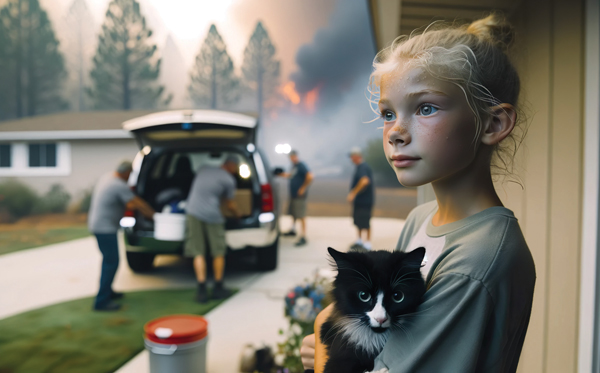
It’s important to follow local notices and heed them immediately. Always leave early during an Evacuation Warning, if possible, to give yourself plenty of time. | readyforwildfire.org
During an Evacuation Warning
Inside the house
- Pack a Go Bag or Emergency Kit, if not already prepared (details in this guide). Place in the car.
- Check that your Wildfire Action Planis up to date. Find details in this guide.
- Know your community’s emergency plan, evacuation routes and destinations.
- Close all windows and doors but leave them unlocked.
- Take down flammable window treatments like shades and curtains, and close metal shutters.
- Clear away light curtains.
- Move anything that burns easily to the middle of rooms, away from windows and doors.
- Turn off the gas at the meter and pilot lights.
- Charge devices and consider getting backup batteries in case power outages continue.
- Bring supplies such as water and non-perishable food for the car ride, along with what’s packed in a Go Bag.
- Leave lights on so firefighters can see inside your house in smoke.
- Switch off the air conditioning.
Outside the house
- Bring in flammable items from outside like patio furniture, toys, doormats and trash bins. Alternatively, place them in a pool.
- Shut off propane tanks.
- Move grills and other propane BBQ appliances away from the house.
- Attach garden hoses to outside taps for firefighter to use and fill buckets with water to scatter around.
- Do NOT leave sprinklers or water running as it can lower critical water pressure.
- Keep exterior lights on to make your home visible in smoky or dark conditions.
- Park your car in the driveway, facing outwards, loaded and ready, with all doors and windows shut.
- Have a ladder handy for firefighter roof access.
- Seal attic and ground vents with plywood or commercial seals.
- Fill up your gas tank and consider downloading a fuel app to check for outages along your evacuation route.
- Keep an eye on the fire situation and don’t wait for an evacuation order if you feel at risk.
- Check with neighbors to ensure they’re also prepared.
Animals
- Keep pets close and ready to go. Put a Pet Go Bag in the car.
- Plan for farm animal evacuation early, arranging transport and safe locations.
- Call the local animal control or humane society if you need assistance.
If you must leave pets
- Leave pets indoors, not chained outside.
- Use a safe room without windows and good ventilation.
- Leave dry food and fresh water in non-spill containers for several days.
- Fill a bathtub with water.
During an Evacuation Order
- Leave immediately and use the designated route.
- Download the FEMA app for a list of open shelters.
- Listen to a battery-powered radio and follow local instructions.
- Take your emergency supply kit.
- Take your pets with you but understand that only service animals may be allowed in public shelters. Plan how you will care for your pets in an emergency now.
- Let friends and family know before you leave and when you arrive.
- Leave a note telling others when you left and where you are going. Use the EVACUATION sign provided in this guide. Place in a plastic
- Wear sturdy shoes and clothing that provides some protection such as long pants, long-sleeved shirts and a hat.
- Check with neighbors who may need a ride.
- Follow recommended evacuation routes. Do not take shortcuts, they may be blocked.
- Stay off Forest Service roads, which may be blocked or in use by fire personnel.
- Be alert for road hazards such as washed-out roads or bridges and downed power lines. Do not drive into flooded areas.
- Avoid downed power or utility lines, they may be live with deadly voltage. Stay away and report them immediately or call 9-1-1. Never exit your vehicle if a downed line is over your vehicle.
If time allows
- Call or email the out-of-state contact in your family communications plan. Tell them where you are going.
- Unplug electrical equipment such as radios, televisions and small appliances. Leave freezers and refrigerators plugged in unless there is a risk of flooding.
- If there is damage to your home and you are instructed to do so, shut off water, gas and electricity before leaving.
After an evacuation
If you are returning to disaster-affected areas, after significant events prepare for disruptions to daily activities and remember that returning home before storm debris is cleared is dangerous. Prepare your Disaster Survival Kit in advance; find details in this guide.
- Only use generators outside and away from your home.
- NEVER run a generator inside a home or garage or connect it to your home’s electrical system.
Courtesy Cal Fire
Smell natural gas? See downed powerlines?
Leave the area and call 9-1-1
Follow the Six Ps for immediate evacuations
Find a shelter / encontrar un refugio
- FEMA app | fema.gov
- Red Cross 24/7 help | (844) 236-0153
Animal services
- Alpine County | (530) 694-2231, alpinecountyca.gov
- Douglas County | (775) 782-9061, communityservices.douglascountynv.gov
- El Dorado County | (530) 573-7925, edcgov.us
- Humane Society of Truckee-Tahoe, South Lake | (530) 542-2857, hstt.org
- Humane Society of Truckee-Tahoe, North Tahoe & Truckee | (530) 587-5948, hstt.org
- Nevada County | (530) 265-1471, nevadacountyca.gov
- Pet Network Humane Society, Incline Village | (775) 832-4404, petnetwork.org
- Placer County | (530) 546-1990, placer.ca.gov
- SPCA Northern Nevada | (775) 324-7773, spcanevada.org
- Washoe County | (775) 353-8900, washoecounty.gov
Download Tahoe Guide’s 5th Annual Wildfire Preparedness Guide


