


 The Donner Party story receives the headlines, but two years before that tragic event a teenage boy named Moses Schallenberger survived the winter of 1845 alone at Donner Lake, 170 years ago.
Moses was born in 1826 in Ohio to European immigrants. His parents died of cholera when Moses was a young boy, so his older sister Elizabeth and her husband, Dr. John Townsend, raised him as their own son. In 1844, the three Townsends joined the Stephens-Murphy party heading west that spring. No one had made it overland to California with wagons yet, but this small group of 23 men, eight women and 15 children with 11 wagons were going to try.
Read Part I: Moses Schallenberger | A Winter Alone at Donner Lake, Part I
After a harrowing 2,000-mile journey, they reached Truckee Lake (re-named Donner) in early November with all members alive and all 11 wagons. At this point, six of the party including Elizabeth Townsend and her servant, Francis, rode horses south along the Truckee River, becoming the first non-native people to reach Lake Tahoe. This splinter group then successfully rode over the Sierra on Tahoe’s West Shore reaching Sutter’s Fort in the Sacramento Valley on Dec. 10. It is still a mystery why Elizabeth would leave the security of the wagon train and her husband as Dr. Townsend remained to help push the wagons up the rugged mountain pass.
By Nov. 25, 1844, after tremendous effort, five of the 11 wagons had been hauled over Donner Pass. The Stephens-Townsend-Murphy party became the first to pioneer a practical wagon route over the Central Sierra, but three men, including 17-year-old Moses Schallenberger, agreed to stay behind to watch the remaining wagons stocked with valuable goods to sell in California. They didn’t expect to be there long, but built a small 12 x 14-foot cabin just in case. The crude hut was roofed with hides and pine boughs, and included a log chimney. That night it snowed 3 feet and Moses later recounted the tale to his daughter in 1885: “A week passed, and instead of any snow going off, more came. At last we were compelled to kill our cows, for the snow was so deep that they could not hunt. It kept on snowing continually, and our little cabin was almost covered. It was now about the first of December, and we began to fear that we should all perish in the snow.”
Moses’ companions, Joseph Foster and Allen Montgomery, were competent hunters, but the abundant game disappeared with the first flakes. Without webbed snowshoes, the men struggled helplessly in the deep snow. Their food supply consisted of a few provisions and two-half starved cows. They had barely enough for one man, let alone three.
Moses said, “Death, the fearful, agonizing death by starvation, literally stared us in the face.”
After lengthy deliberation, they decided to make a dash over the pass. Stumbling along in primitive snowshoes made with wagon wood and rawhide strips, they made 15 miles the first day before they collapsed from exhaustion. Moses suffered severe leg cramps throughout the ordeal and his legs trembled. Years later, he remembered: “Foster and Montgomery were matured men, and could consequently stand a greater amount of hardship than I, who was still a growing boy with weak muscles and a huge appetite.”
The following morning, Moses was so stiff he could hardly move. Foster and Montgomery reluctantly shook hands with a dejected Moses as he headed back to the cabin while they continued west toward Sutter’s Fort.
Moses recounted that moment: “The feeling of loneliness that came over me as the two men turned away I cannot express, though it will never be forgotten, while the ‘Goodbye, Moses,’ so sadly and reluctantly spoken, rings in my ears today.”
Back at the lake, Schallenberger discovered animal traps and baited a few with some of his precious cow meat. The following day, he was elated to find a scrawny coyote, but he could barely choke down the bad-tasting meat. On the third night, however, he snared two foxes, which he found delicious. From then on, he caught just enough game to hold off starvation.
Life in the dark, snowbound cabin was miserable for Moses. Howling wolves interrupted his sleep and he constantly worried that his meat would run out. He had enough coffee for one cup, which he brewed on Christmas Day. Fortunately, his brother-in-law, Dr. Townsend, had left behind his library of books, which Moses often read aloud to hear a human voice.
On Feb. 28, Moses Schallenberger spotted his Canadian friend, Dennis Martin, who had returned to rescue him. Martin had promised Elizabeth that he would save her younger brother if he was still alive. Martin explained that the bulk of the women and children in the party had spent the winter about 10 miles west of him snowbound on the South Yuba River, and were currently in the process of being rescued. He fashioned better snowshoes and helped a weak and emaciated Moses over the pass where they joined the others trudging out of the frozen Sierra, down to the warm and green, flower-studded Sacramento Valley. It was March 1, 1845, exactly one year from the day the pioneers had left their homes in Missouri.
Despite all the hardships, there were no casualties in the Stephens Party. Moses had spent three months alone at Truckee Lake, and lived to tell the tale. The women and children at the survival encampment on the Yuba River also had survived their ordeal during the winter of 1845. Not only were no lives lost, but two babies were born during the journey, which increased their number to 52. As a group, strong leadership and incredible perseverance enabled them to succeed against many of the same challenges that would devastate the Donner Party two years later.
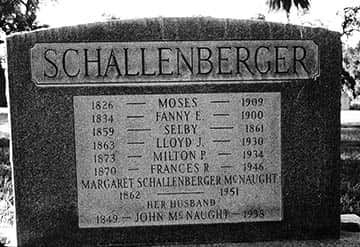
Unfortunately, pioneer physician Dr. Townsend and his wife Elizabeth both died of cholera while treating others with the disease in the epidemic of 1850. Moses Schallenberger became a leading figure in ranching, politics and education in Santa Clara County. He operated a 115-acre orchard and ranch and a South Bay school was later named after him. His remarkable experiences were published in 1886 by historian Hubert H. Bancroft as a narrative entitled “Overland in 1844.” Moses, who died in 1909 at age 83, is honored by a mountain ridge just south of Donner Lake, known as Schallenberger Ridge.


