


Editor’s Note: To read Part I of “Mark Twain’s Nevada adventures,” visit TheTahoeWeekly.com.
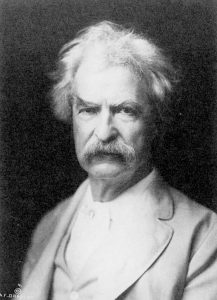
Samuel Clemens (Mark Twain) arrived in Carson City, Nevada Territory, on Aug. 14, 1861, with his older brother Orion, who had been appointed Secretary for the new Territory. Orion Clemens spent most of his time as acting governor, but Sam quickly caught gold fever and tried his luck as a miner without success. Out of sheer frustration, he wrote a few articles that he submitted to the Virginia City Territorial Enterprise newspaper. The short, humorous stories got him hired for $25 a week. Clemens’ writing style was a perfect match for that lusty time on the Comstock, and it launched his lifelong career as Mark Twain, a legendary American writer, lecturer and satirist.
Clemens teamed up with a young Enterprise staff reporter named William Wright, who wrote under the pseudonym Dan De Quille. De Quille penned serious political and mining news, but his real talent lay in writing ironic sketches and humorous hoaxes. The two young writers quickly became friends and roommates. Along with De Quille, editors Joe Goodman and Rollin Daggett helped Sam perfect his writing craft and story development; skills that he would employ to great success.
Writing under the pen name Mark Twain, he became the most popular writer on the Comstock. When questioned as to his writing style, he later stated, “The difference between the almost right word and the right word is really a large matter—‘tis the difference between the lightning-bug and the lightning.”
As Sam Clemens, he had worked in isolated Nevada mining camps and even tried to establish a timber claim at Lake Tahoe — now as Mark Twain he was ready for the bawdy excitement of Virginia City. He had a roof over his head, 15 restaurants to visit and 51 saloons to drink in. The newspaper staff regularly enjoyed restorative libations at John Piper’s Corner Saloon in Virginia City.
Although mark twain is a riverboat pilot term to indicate water depth, Nevadan’s like to point out that when Clemens sported for a drinking buddy he would tell the bartender Piper to “mark twain” on the chalkboard, thereby adding two drinks to his account. The name stuck.
Daily gunfights or robberies made headlines. Legend says that that murdered men occupy the first 26 graves in the Virginia City cemetery. Hordes of American and foreign miners, gamblers, toughs and prostitutes made for an interesting social dynamic. The principle industries were hard-rock mining, boisterous saloons and shady brothels. The colorful excitement and wild recklessness suited Clemens fine. His years as a riverboat pilot had toughened him and the Comstock’s robust lifestyle fed his spirit.
The end of Mark Twain’s career in Nevada came suddenly. The American Civil War was raging and emotions on the Comstock were running at a fever pitch. In May 1864, Enterprise editor Joe Goodman was away and Twain was acting as editor. Twain’s ego had grown mightily since his miserable mining days and now that the boss was gone, it was time to stir the pot. Twain accused the staff of the rival Virginia Daily Union newspaper of failing to honor their pledge in donating money to the Sanitary Commission. Money collected by the Commission was earmarked for medical supplies for wounded Union soldiers fighting in the Civil War. In retaliation to that accusation, James Laird, editor of the Union, called Twain a “vulgar liar.” In an editorial response in the Enterprise, Twain retorted, “I denounce Laird as an unmitigated liar.” He then sent a personal note to Laird; “If you do not wish yourself posted as a coward, you will at once accept my peremptory challenge.”
Suddenly the newsprint warfare had escalated into the challenge of a duel, with loaded pistols, not empty words. Reacting to the spat under the heading, “The Duello in Virginia,” the editor of the San Francisco Morning Call wrote, “It is well, perhaps, that only ink instead of blood has been shed in this affair, but it would have appeared better if neither had been spilt. The day has gone by when duels can give any man credit for bravery or honor, wisdom or truth.”
In the meantime, Twain’s unfettered pen also had stirred the ire of Carson City’s women society. Twain had alleged that the money that the women raised for wounded Union soldiers was instead being sent to the St. Louis Exposition. The women were furious at his irresponsible remarks and called them a “tissue of falsehoods, made for malicious purposes.” Mark Twain was now in serious trouble in both Virginia and Carson cities.
Stories of a gunfight between Twain and his editorial adversary on the Virginia City Union still persist today, but in reality the Laird-Twain duel never materialized. Nevada had recently passed a law making it a felony to send or accept a challenge to a duel. Threatened with a possible arrest, Twain quietly stole away from the diminishing excitement on the economically depressed Comstock. Accompanied by his friend, Steve Gillis, they arrived in San Francisco in late May.
With a population of more than 130,000 people, cosmopolitan San Francisco had numerous daily newspapers, opera houses, fine hotels, restaurants and other amenities. In March 1866, Twain sailed for the Sandwich Islands (Hawaii) and upon his return, he became an established literary figure and celebrity lecturer.
When Twain revisited his old Comstock stomping grounds in November 1866, thousands came to hear his entertaining lectures in Dayton, Virginia City, Gold Hill and Carson City. After his last lecture in Gold Hill, Mark and his agent, Dennis McCarthy, walked back to Virginia City. On the way, they were robbed by five highwaymen. The bandits took $125 in coin and Twain’s favorite gold watch, which was worth about $300. Twain was livid, but he put an advertisement in the morning paper offering to negotiate for the watch. He received no response.
Two days later, Mark Twain boarded the Pioneer Stage for his return to San Francisco via the Donner Lake route. Just as the stage was about to leave, a small package was handed to the sullen celebrity. In it he found his watch and money that had been stolen from him. He also discovered the five masks that the highwaymen had worn that night. And, then the robbers revealed their identities by shaking Twain’s hand. They were old friends from the Virginia City days, but Mark Twain, the prankster, could not take the joke, and everyone could hear him yelling profanities as the stagecoach rolled out of sight. Such was Mark Twain’s exit from the Silver State.
Tahoe historian Mark McLaughlin is a nationally published author and professional speaker. His award-winning books are available at stores or at thestormking.com. Mark may be reached at mark@thestormking.com. Check out Mark’s blog at tahoenuggets.com.


