When Averill Harriman was skiing in St. Anton in 1933 and 1934, he became aware of how Hannes Schneider and his ski school was able to keep the Post Hotel and several other smaller pensions open all winter to house his many pupils who came there from all over the world to learn how to ski.
Averill also saw the dark scepter of Hitler and his inevitable war not far over the horizon. Harriman made these observations and discoveries while he was wrestling with trying to control 7-foot, 6-inch or longer, stiff skis without metal edges. His best-that-money-could-buy ski boots were hardly more than soft hiking boots that offered little lateral control. Ski poles were made of bamboo or willow trees with a large diameter and heavy baskets. Ski clothes were heavy wool and when he fell, the snow clung to them like glue.
When he executed the occasional turn without falling, the one-week trip from New York on an ocean liner was worth it. That’s one-week each way on a slow boat to ski in Europe. And, no one had yet invented the ski lift.
While Harriman was climbing for every turn he would make, he was wondering when Hitler would make his move and skiing as he knew it would end.
A few years later, a young house painter in St. Anton named Franz Gabl was beginning to win junior ski races. Harriman once again went back to his job as President of the Union Pacific Railroad and Gabl was conscripted by Hitler and forced to fight on the Russian Front for 3½ years.
Harriman put his money where his dream was and financed the building of America’s first destination ski resort in Ketchum, Idaho, and named it Sun Valley.
Harriman’s engineers, in his railroad yard in Omaha, Neb., where given the assignment of finding a better way to get people up a hill than with an arm-stretching, exhausting rope tow. In the process, they invented the worlds’ first chairlift in July 1936. They had it designed, engineered, built and shipped to Sun Valley where it was erected on Dollar Mountain and made operational by Dec. 15; only five months from coming up with the world-changing idea.
World War II seemed as though it lasted forever for everyone, but especially for those of us in the Army or Navy. Gabl was wounded on the Russian front and went back home to recover in St Anton. He was then sent back to fight in Stalingrad.
In 1948, in St. Moritz, Switzerland, Gabl became the first Austrian skier to win an Olympic Gold medal when he won the downhill.
By this time, Sun Valley had become the outstanding ski resort in America. Harriman had done everything right. Seven chairlifts, two large, hot water swimming pools, accommodations for as low as $2 a night with a shower down the hall, 30 ski instructors and Baldy Mountain, arguably to this day, the best developed ski mountain in America.
Over the years, Harriman was able to find refuge in America for many of Hannes Schneider’s ski instructors including Hannes himself who barely escaped Hitler’s’ Gestapo. Those instructors spread the gospel of skiing across North America. Men such as Freidl Pfeiffer, who helped develop Aspen and Buttermilk in 1946-47. I worked for Otto Lang when I was a ski instructor in Sun Valley in 1948-49. And for a couple of those early years before he took over the Squaw Valley Ski School, Otto directed the Mt. Hood, the Paradise and the Mt. Baker Ski Schools, and then went on to become a successful and famous Hollywood motion picture director. We remained lifelong friends until we lost him at age 98.
In 1948, Ward Baker and I were spending our second winter living in the perfect spot in the Sun Valley parking lot in a 8-foot long, crowded, cold, teardrop trailer.
In January of 1948, we tried to get the Sun Valley Ski Club to buy us a couple of tank’s full of gas to go on the Idaho, Utah, California racing circuit, but they laughed at how we were dressed and didn’t think we could place. So, we raced as the Parking Lot Ski Team and I placed second in Bogus Basin and first in a field of more than 120 in Ogden. Ward was in the top five in both races, as well. Still no sponsorship, but I know it helped that the men’s Olympic team was still in Europe racing against Gabl, so we didn’t have that much competition.
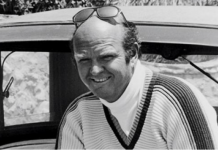
Two years later, Gabl would come to America and race in the World Championship in Aspen while I was teaching at Squaw Valley and producing my first feature-length ski movie. After a winter at Sugar Bowl, Franz went on to Banff and eventually to Bellingham where he owned and managed a ski shop and taught skiing at Mt. Baker. (Mt. Baker amazingly owns the world’s record for snowfall in a single ski season at 99 feet). Fortunately for Gabl, he was retired by that record-setting snowfall.
Last January when Laurie and I were busy enjoying winter in Montana, Gabl succumbed to those war wounds he received in World War II and more than 60 years of standing on the side of a hill teaching other people to enjoy skiing.
Fortunately, those early pioneers gave so many of us a chance to get hooked on the freedom that skiing has to offer, including men such as Harriman who build ski resorts and the men and women who taught the rest of us how to enjoy what they have built. We honor them.
Warren Miller is history’s most prolific and enduring ski filmmaker. Visit warrenmiller.net or visit his Facebook page at facebook.com/warrenmiller.