


By Mark McLaughlin ·
Editor’s Note: Part I may be found at TheTahoeWeekly.com
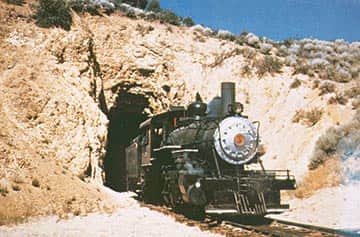
Arguably the most famous short line railroad in the American West, the Virginia & Truckee Railroad is back on track this summer with weekend excursions from Carson City to Virginia City, Nev. The locomotives and rolling stock of the original railroad were sold off to Hollywood film studios during the 1940s, and the line itself abandoned in 1950, but thanks to years of community fundraising efforts to reconstitute the operation, rail fans can once again enjoy a ride on the “Yankee Princess.”
The V&T was the brain child of the executives at the Bank of California in San Francisco, which was heavily invested in the mining and milling operations during the Comstock era. Without a railroad, the high cost of freighting ore to the stamp mills on the Carson River cut deep into mining profits. The river current was essential to the ore milling process because water power cut ore reduction costs by half when compared to stamp mills with pistons driven by cordwood-fueled steam engines. The freight companies were big business; they employed 2,000 men and used between 12,000 to 15,000 mules, horses and oxen to pull huge wagons loaded with ore down to the river.
The bull whackers had a strangle hold on Comstock operations; there was no other way to move the ore. William Sharon, manager of the Bank of California’s Virginia City branch, knew of only one sure way to break the teamster’s paralyzing grip. If the bank built a short line railroad from the Comstock to the Carson River, they could cheaply transport ore to the reduction mills. For the return trip, the empty cars could be loaded with cordwood and lumber from the Tahoe-Sierra for fueling boilers and shoring up shafts and tunnels. This shrewd business plan ultimately proved highly profitable. From 1874 through 1879, more than a million cords of fuel wood and 301 million board feet of lumber were transported by the V&T. Comstock operations at that time consumed more than 80 million board feet of Sierra Nevada timber each year as the Tahoe Basin was denuded.
The bank’s initial intent was to run track from the Comstock mines to the large mills on the Carson River, but eventually extending the route to Reno on the transcontinental line made good business sense. With a rail connection between the Comstock and Central Pacific, the bank would control western Nevada transportation and commerce. On March 5, 1868, the Virginia & Truckee Railroad Company was incorporated and work began immediately.
Challenged by steep ravines, rocky ridges and hulking mountains, engineers relied on trestles, tunnels and curves to “wrap the railroad around the mountain.” The V&T right-of-way was built without earth moving machines; all excavation and grading was accomplished by the sweat and muscle of man and beast. The construction work in the mountains was backbreaking — for the most part the road was cut through solid rock. The 21-mile route described enough curvature to equal 17 complete circles in a distance of 13.5 miles, and inspired journalists to quip that the V&T was the “crookedest railroad in the world.”
On Sept. 28, 1869, V&T Superintendent Henry Yerington kicked off the track-laying ceremony by driving a silver spike into the first rail at Carson City. Work began immediately and three hours later, the V&T’s first locomotive was in operation helping crews pin iron track to pine wood ties. It was estimated that workmen could lay track here at the rate of half mile per day, but the hard-driving Yerington forced the daily pace to 1½ miles. On Oct. 28, a Mr. Treadway shipped the first freight on the partially completed V&T line — two sacks of potatoes.
As each section of track was finished, local townsfolk took great joy in riding the construction trains. The Carson City Nevada Appeal reported, “Some ladies adorned the cowcatcher, the caboose was adorned by some of our fairest fair and we and some other handsome boys and girls sat on the tender.”
An editor at the Territorial Enterprise also penned his enthusiasm after an exhilarating ride on the iron horse: “… nature is everywhere better when palpitating engines snort in steam across her acres. There was nothing as beautiful as that grand creation of genius, wealth and toil which went plunging madly onward, breathing into the nostrils of the inanimate scene the breath of life.” Despite the local population’s infatuation with hopping aboard the work trains, the rides were soon prohibited for being too dangerous.
The railroad construction crews made rapid progress, completing the route from Carson City to Gold Hill on Dec. 21, 1869. At Gold Hill, Virginia City-bound passengers transferred to a horse-drawn omnibus for the remaining distance. Exuberant crowds turned out in force for the Virginia & Truckee’s inauguration run. The first passenger coaches were simple flatcars with benches and spittoons, but the cheering residents of Washoe were perfectly satisfied with their “Sagebrush Shortline.” The newly painted Crown Point Trestle was decked out in red, white and blue bunting, children waved flags and cannons boomed loudly. There were patriotic speeches and much drinking of beer, whiskey and champagne. Two months later, on Jan. 29, 1870, the first scheduled passenger train roared into Virginia City amongst great fanfare. Just 11 months after groundbreaking, Sharon and the Bank of California had the V&T in full operation — at a cost of $1.7 million, not including rolling stock and buildings.
The Virginia & Truckee Railroad was an immediate success and Chief Engineer Isaac James was congratulated for his brilliant work. He had put a railroad where few believed it was possible. Freight and wood prices on the Comstock fell 30 percent, and the cost of transporting ore from the mines to the Carson River mills dropped 40 percent.
Sharon added extensions to the main line that accessed huge lumberyards south and west of Carson City where elaborate water flumes 10 to 25 miles long delivered enormous quantities of lumber from the mountains around Lake Tahoe. Passenger traffic on the V&T was greater than expected and, on the weekends hundreds, of work-weary residents boarded special Saturday and Sunday excursions for day trips and picnics. The train ride from Virginia City to Gold Hill cost 25 cents while the full fare to Carson City was $2. In those days, 20 cents could buy a steak dinner complete with all the trimmings.
Tahoe historian Mark McLaughlin is a nationally published author and professional speaker. His award-winning books are available at local stores or at thestormking.com. You may reach him at mark@thestormking.com. Visit Mark’s blog at tahoenuggets.com.


