


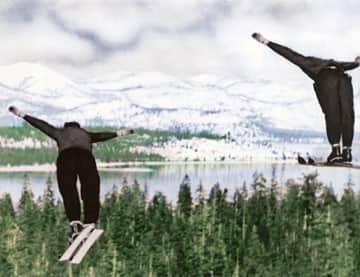
Most of us take it for granted that the Tahoe-Truckee region will be well represented by local athletes at virtually every top-tier, international ski or snowboard competition. North Tahoe has sent more top competitors to the U.S. National Team than any other area in the United States.
Recent champions include Bill Hudson, Edith Thys, Julia Mancuso, Marco Sullivan, Daron Rahlves and Travis Ganong. You can thank the Lake Tahoe Ski Club, formed in 1929, for establishing the roots of this great legacy. The nonprofit Lake Tahoe Ski Club Foundation continues this effort and is dedicated to promoting and supporting young ski racers. With the community’s help, there is great hope that this remarkable legacy of Tahoe-based champions will continue to grow.
Editor’s Note: Part I may be read at TheTahoeWeekly.com
About the time that the Lake Tahoe Ski Club got started, California bid to host the 1932 Winter Olympics, which they lost to Lake Placid, N.Y. In their reasoning for denying California the venue, the International Olympic Committee pointed out that the Golden State had no history or experience with competitive winter sports, and also because of the perception that it had no mountains or snow to speak of.
The rejection inspired the State Chamber of Commerce to start promoting California’s winter sports, as well as its beaches and mild climate, while local ski clubs began hosting high-profile ski jumping and cross-country competitions. (Without mechanical uphill transport, there was no competitive downhill skiing yet.) With more aggressive promotion, Tahoe City was awarded the 1932 National Ski Association Championship Tournament.
The 1932 competition, along with the 1931 tryouts, would showcase Tahoe-Truckee talent to the nation and the world. In order to help house the visitors, organizers managed to get Tahoe City’s bankrupt Tahoe Tavern hotel open for the event.
In the weeks before the tournament, powerful winter storms blasted the region with heavy snow that high winds whipped into monumental drifts. In January, the Sierra snowpack was 7 feet deep and piling up fast. By Feb. 5, nearly 23 feet of snow had fallen in Tahoe City where residents dug tunnels to their homes under drifts that reached 20-feet deep. At Donner Summit, an incredible 454 inches had fallen so far.
The week before the Feb. 26 opening of the three-day tournament, 5 feet of fresh snow still buried the railroad right-of-way between Truckee and Tahoe City. Southern Pacific dispatched a rotary snowplow from Truckee to clear the line to the lake, and trains were back in service in time for the opening day ceremonies.
Skiers and officials arriving from the Winter Olympics at Lake Placid could hardly believe their eyes. Conditions in New York had been so poor that jumpers were landing on a mixture of snow and straw, but in the mountains of California, the white gold was piled to the eaves. The deep snow, big blue lake and mild temperatures weren’t wasted on the athletes, journalists and spectators that attended the nationally publicized contest. After the event was over, word spread across America and Europe that California may be known for sunny beaches and orange groves, but it also possessed a mountain climate and ski conditions superior to most other winter resorts. Skiers went home to tell their friends, “For great skiing, go to California.”
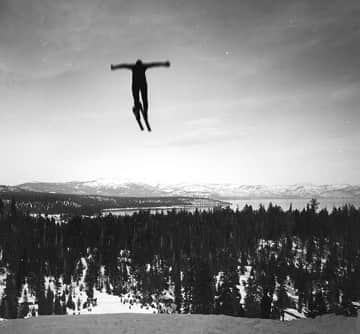
Newspaper owner and State Sen. Bert Cassidy attended the Tahoe City ski tournament. He described the weekend excitement at Lake Tahoe with grand hyperbole: “The 28th National Ski Tournament goes down as one of the best exhibitions of good sportsmanship, one of the most thrilling meets, one of the most spectacular events ever held in the United States under the auspices of the National Ski Association. It was a colorful affair when on Sunday afternoon some 3,000 spectators, garbed in highly colored coats and sports suits, seated and standing along the ski course, the ‘Sky Riders’ came one after another, hurtling through the air at breakneck speed.”
Hollywood celebrities like movie star Buster Keaton and the glamorous actress Anita Page were there, as well as California Gov. James “Sunny Jim” Rolph. Crowds cheered the charming starlet and popular governor as they traveled by train together through Roseville, Auburn, Colfax and Truckee, on their way to Tahoe City.
The Dauerlauf cross-country ski race was billed as the first national-level contest of its type held west of the Rockies, but portions of it were so poorly marked that racers found themselves lost in the woods. Several skiers didn’t make it back until just before dark, and one contestant went so far off trail that he was returned to Tahoe City by boat.
An estimated 120 professional and amateur competitors from around the country traveled to Tahoe City to strut their stuff, but young locals were ready to go for it, too.
Earl Edmunds from Truckee captured first place in Class C with leaps of 69 and 74 feet. Not only was Edmunds the region’s first nationally acclaimed skier, but he would go on to become an intercollegiate ski great in all events, and an instructor at Sugar Bowl. Third place was taken by 16-year-old Wayne Poulsen of the Reno Ski Club, an up and coming ski champion who later developed Squaw Valley.
The competition for daredevils younger than 12 was captured by Karl Kielhofer of Truckee, followed by Maxwell McGuinn, also from Truckee, and Al Henry Jr. from Tahoe City. Kielhofer went on to become a 1st Sergeant in World War II with the 10th Mountain Infantry Ski Troop Division. Tahoe City’s Robert Pomin, Jack Starratt, Douglas Smith and Donald Cowell, as well as two other local youngsters, Carl Bechdolt Jr. and David Renner, also competed, but none placed. These individuals, and others, represent the deep roots of our skiing community.
If you’re interested in learning more about the fascinating story of our region’s impressive impact on winter sports, visit the Museum of Sierra Ski History and 1960 Winter Olympics.


