


By Mark McLaughlin ·
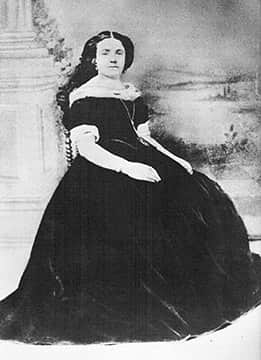
Eilley Bowers, circa 1863. | Courtesy Nevada Historical Society ·
When Alison “Eilley” Oram was a young girl growing up in the Highlands of Scotland during the 1830s, she already sensed that she was destined for more than the dreary life of farming. Born in September 1826 in the Royal Burgh of Forfar, Scotland, Eilley was bright eyed, spirited and had an enthusiastic zeal for life.
As itinerant farmers, the Oram family moved frequently, but Eilley was optimistic about her own fate. She had a secret peep stone that she believed could tell her the future. And, the future looked bright indeed to this passionate and adventuresome teenager. When she looked into her crystal ball, it prophesied great wealth and life in a mansion, but little else. No solutions were forthcoming on how to acquire that promised fortune.
The first step came when 15-year-old Eilley married Stephen Hunter with a ceremony in the Church of Scotland. Hunter was four years older than Eilley but did not seem like an adventurer and he certainly wasn’t rich.
Six years later he met Mormon missionaries who were proselytizing for their faith. Hunter became an ardent believer and was baptized into the new Church of Latter Day Saints. When her husband decided to immigrate to America, Ellie agreed to travel with him and several hundred converts who were sailing for the rapidly growing Mormon enclave of Nauvoo, Ill.
When Mormon Church founder Joseph Smith was murdered by a mob in 1844, virtually all the religious converts fled for the safe haven of Salt Lake City, Utah Territory. By the time the Hunters reached Utah in 1849, their relationship was on the rocks. The couple had no children and after eight years of marriage they divorced in 1850.
In 1853, Eilley entered matrimony again with Alexander Cowan, a devout Mormon farmer also born in Scotland. Mission work took them to remote Mormon Station (present-day Genoa, Nev., just east of Lake Tahoe) before they relocated to Franktown in nearby Washoe Valley. This area was the far western frontier of the proposed State of Deseret that the Mormon Church hoped to settle.
The couple purchased 320 acres of good farmland that included a house and corral. In 1857, the U.S. Federal Government sent troops to Salt Lake City in a conflict known as the Utah War. To protect his acolytes, the new Mormon leader Brigham Young recalled all the church’s colonists back to defend the core community at Salt Lake City. Alex Cowan heeded Young’s command to return, but Eilley refused. She divorced Cowan and headed for a small mining camp in Gold Canyon (near present-day Virginia City) where she opened a boarding house for prospectors and miners.
The following year, Ellie ordered a new crystal ball that was delivered by none other than the legendary skiing mailman Snowshoe Thompson. Soon she was making money as a psychic and fortuneteller in Virginia City in addition to her boarding house enterprise. According to local lore, Ellie was given 10 feet of mineral vein by an impoverished miner who couldn’t pay for his room and board. The claim was next to one owned by Lemuel Sanford “Sandy” Bowers, a hardworking, but illiterate and unrefined muleskinner from Missouri.
In 1859, substantial deposits of silver and gold were discovered in the region and news of the discovery spread like wildfire. Investors and financiers flocked to the new Comstock Lode and most of the impatient miners sold out their claims quickly with little profit. But not Ellie and Sandy, who ended up getting married and quite rich when they combined their claims. Ellie was 33-years-old and Sandy 29. They erected a stamp mill to extract silver and gold from the bulk ore and soon realized $500,000 in profit. At times, the mine was paying $18,000 per week. Ultimately, the couple’s fortune peaked at $4 million.
Their wealth didn’t console them, however, when their first born child died at 2 months of age. Tragedy struck again when the couple lost their next baby while he was still an infant. Beginning in 1861, Sandy and Eilley built the Bowers Mansion for $400,000 in Washoe Valley south of Carson City. Doorknobs were made of solid gold. They hosted a public banquet at the International Hotel of Virginia City where fine food and champagne were given away in abundance. In his toast, Sandy Bowers said, “I’ve been in this country amongst the first that came here. I’ve had powerful good luck, and I’ve got money to throw at the birds.”
For Eilley, it seemed that her psychic predictions were all coming true. Eilley and Sandy Bowers traveled to Europe where they spent $100,000 buying furniture and other luxury items for their mansion. They visited her aging parents in Scotland where Eilley gave them money for a comfortable retirement. Eilley tried to meet Queen Victoria of England, but her highness did not receive divorced women. On their return to the United States in 1863 the Bowers adopted an infant girl whose mother had died in childbirth on the ship. They named the baby Margaret Persia after the ship they were on.
Upon their arrival back in Nevada, the Bowers discovered that their mine was depleted and its operation compromised by unscrupulous shysters. Despite Sandy’s unrestrained financial generosity, even his own miners were lining their pockets at his expense. In his “History of the State of Nevada,” Myron Angel wrote, “Without any good missionary to instruct, or any strong friend to advise and direct he continued to throw money at the birds with the approval and encouragement of flatters, sycophants and robbers, and his princely fortune was wasted.”
Over the next few years, Sandy Bowers’ health declined and in 1868 he died of lung disease. Eilley was crushed and depressed at the loss of her husband and their fortune. The death of her adopted daughter Persia in 1874 was another emotional blow.
After the loss of her family and wealth, she lost the mansion, too. (Today the mansion is a park in Washoe County.) With nothing else to fall back on, Eilley returned to using her crystal ball as a clairvoyant and fortuneteller in Nevada and San Francisco.
Eventually Eilley went deaf and blind, which ended her career as a psychic and she died impoverished in 1903. Eilley’s peep stone had teased her with wealth and fame, but the Seeress of Washoe couldn’t predict the tragic side of life.
Tahoe historian Mark McLaughlin is a nationally published author and professional speaker. His award-winning books are available at local stores or at thestormking.com. You may reach him at mark@thestormking.com. Check out his blog at tahoenuggets.com or read more Sierra Stories at TheTahoeWeekly.com.


