


By Mark McLaughlin ·
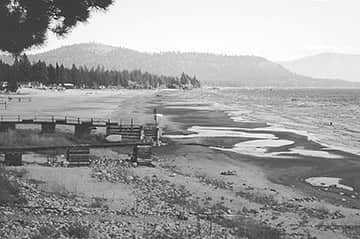
In 1992, Lake Tahoe’s water level fell to 6,220 feet, the lowest on record. | Courtesy Mark McLaughlin ·
There’s no doubt about it, California has been hit hard by the current four-year drought, with much of the state suffering exceptionally dry conditions. In the Sierra, streams, lakes and reservoirs are languishing, with some dried up completely. At Lake Tahoe, many boat access ramps are closed and people are claiming this drought is the worst on record. But are water levels at Big Blue the lowest in history? No, not even close.
Lake Tahoe’s current water level is at 6,222.83 feet as of July 17, that’s below its natural rim of 6,223 feet. When the lake’s water level drops below that rim, there is no surface flow at the Lake Tahoe Dam into the Truckee River. That is why there is no commercial rafting on the river this summer between Tahoe City and River Ranch. Today’s media seems to make a big deal out of it whenever this happens, but it is not a rare occurrence. Since the completion of the dam in the fall of 1913, the lake has fallen below its rim more than 20 times. These low water conditions can last for years at a time.
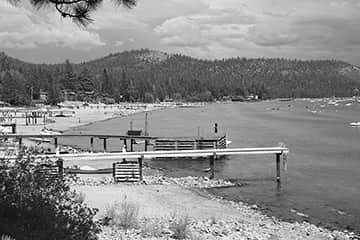
In July 2015, Tahoe’s level is nearly 3 feet higher than 1992. | Courtesy Mark McLaughlin
During the Dust Bowl era in the late 1920s and early ‘30s, Lake Tahoe dropped below its rim at times for six years in a row. Truckee Meadows farmers in Nevada threatened to dynamite the rim of the lake to allow water out. In 1930, Nevada agricultural interests attempted to dig a trench past the dam in order to drain water from the lake. A steam shovel escorted by a Reno police force was deployed to dig around the dam and a diversion ditch begun.
Tahoe sheriff’s representatives and Tahoe City locals formed a posse to prevent the digging until a judge ordered an injunction to halt the operation. The steam shovel was shut down and the trench backfilled. Large pumps were then installed to draw water out of Big Blue for Nevada farmers.
Dramatic climate swings
More recently, water releases from Lake Tahoe dried up for much of the time between 1988 and 1995. During the worst of that extended drought, there were four consecutive years where the lake was below its rim for all but 114 days. That prolonged dry spell in the late 1980s into the 1990s still remains the worst in the modern era for Lake Tahoe. (In the not too distant past, there have mega-droughts in the region that endured for more than a century.) By 1992, Tahoe’s surface elevation had fallen to 6,220 feet. That’s nearly 3 feet below what the lake is now and the all-time record low since the dam was built.
At the time, hydrologists warned that it would take 10 to 15 wet winters to bring water levels back to normal, but in an epic meteorological turn around, a series of massive winters pumped the lake up to its maximum legal capacity in just a few years. Water managers couldn’t dump water out of the lake fast enough and when a powerful atmospheric river of moisture invaded the region in late December 1996, it generated the most destructive flood on the Truckee River in history. This dramatic swing between desiccating drought followed by overwhelming precipitation is a classic example of natural climate variability in the Tahoe Sierra.
Indicative of how our Western climate swings radically between wet and dry periods, the exceptionally dry conditions 25 years ago began after a major flood on the Truckee River in February 1986. Between Feb. 11 and Feb. 20, 1986, more than 17” of rain fell at the Truckee Ranger Station. That’s about half of Truckee’s normal winter’s precipitation in just 10 days.
Observers at Blue Canyon on the Sierra west slope tallied nearly 34 inches of rain in the same time frame. Above 8,000’, storm total estimates ranged from 15’ to 20’ of new snow with 20” to 30”of water content. The resulting flood caused $17 million in damage across the region and five western Nevada counties were declared Federal Disaster Areas.
After that deluge, the Storm King turned off the spigot and six out of the next seven years saw below normal precipitation. At one point, the upper stretch of the Truckee River stopped flowing for more than two years. One of the only bright spots during this extended dry period was in 1991 when the so-called Miracle March dumped from 14’ to 20’ of snow on Tahoe-Truckee resorts. Donner Summit picked up 25” of water in the first three weeks of that month. It salvaged the remainder of an otherwise bleak ski season, but the storms didn’t break the drought. The lake was still at its lowest level in history and never reached the rim that spring.
The turnaround began during the winter of 1992-93 when 83” of precipitation soaked the Central Sierra. That is the ninth wettest winter of record and it boosted Lake Tahoe’s water level nearly 3.5’. In the spring of 1993, water finally started flowing through the gates of the Lake Tahoe Dam for the first time in more than two years. It would take much more than that to alleviate the drought, but over the next few winters the Storm King would deliver in a big way. Stay tuned for Part II.
Tahoe historian Mark McLaughlin is a nationally published author and professional speaker. His award-winning books are available at local stores or at thestormking.com. You may reach him at mark@thestormking.com. Check out his blog at tahoenuggets.com, and read more Sierra Stories at TheTahoeWeekly.com.


