


By Mark McLaughlin ·
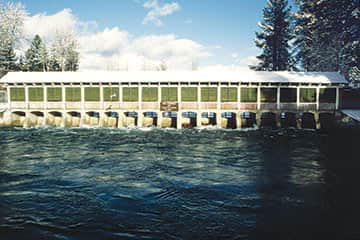
The peak release from the Tahoe Dam in January 1997 was a record 2,690 cubic feet per second. | Courtesy Mark McLaughlin ·
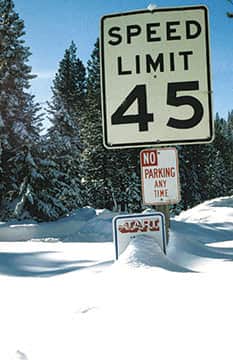
A heavy dump of snow in late December 1996 set the stage for flooding one week later. | Courtesy Mark McLaughlin ·
Editor’s Note: Parts I & II may be found at TheTahoeWeekly.com.
A prolonged Western drought has dropped Lake Tahoe’s water levels below the natural rim again and cut off surface flow into the Truckee River. While it does impact the vital river and can be a hassle for boating enthusiasts, it is not a rare occurrence. Since the completion of the dam in the fall of 1913, the lake has dropped below its rim more than 20 times. It’s part of the Tahoe Sierra regional climate pattern where hydrologic conditions swing between desiccating drought and heavy, wet winters. It’s been going on for at least 4,500 years.
In the early 1990s, Big Blue was a record-breaking 3 feet lower than our present water level of 6,222.67’, but a pair of extremely wet winters (1994-95 and 1995-96) dumped 15.5 feet of water on the region and broke the drought.
By May 1996, Tahoe’s water level had surged up to 6,229 feet, the maximum allowed by law. The heavy precipitation also generated abundant water storage in the rest of the Truckee-Tahoe reservoir system. Garry Stone, Federal Water Master at the time, was the man responsible for implementing the Truckee River Operating Agreement, which controls the complicated Truckee River system. Stone gambled that after two back-to-back winters of such epic proportions, 1996-97 was likely to be dry. Going into that winter season, Lake Tahoe had about 1 foot of storage available, a marginal amount.
Stones’ calculus failed, however, when an incredibly wet December 1996 quickly took that cushion away. Wet storms doused the Tahoe Basin with nearly 19 inches of precipitation that month, which forced Stone to partially open the gates at the Tahoe Dam on Dec. 11. It didn’t help.
A cold Gulf of Alaska snowstorm roared in 10 days later and dumped between 6 and 7 feet of powder, also adding to the rapid water rise. That was quickly followed by a warm Atmospheric River from the sub-tropics that spilled water like a fire hose. In just over a week, from Dec. 26 to Jan. 3, a series of successive moist storms pounded the region. Tahoe City was hit with nearly 14 inches of rain in that time frame, while Blue Canyon on the Sierra west slope was deluged with more than 3 feet of rain in just nine days.
By New Year’s Day, the onslaught overwhelmed the Truckee-Tahoe reservoir system. Although all 17 gates in the Tahoe Dam were open full bore, the lake’s water level exceeded the legal limit, reaching 6,229.3’, the highest since 1917. Nearly every residential bridge along Highway 89 between Tahoe City and Truckee was destroyed or seriously damaged. Economic impacts to homes and businesses in that stretch of river exceeded $11 million.
The New Year’s Flood of 1997 was much worse in western Nevada, where damage reached $1 billion. Reno took the brunt of it with many of its largest casinos closed during one of the busiest tourist holidays of the year. All major highways in and out of the city were shutdown due to high water or mudslides. Even the airport closed when the runways were submerged.
The Truckee River flood of January ‘97 was caused by several factors. First, the two previous years (1995 and 1996) had been extremely wet in the Sierra and western Nevada, and, in late 1996, Lake Tahoe had little room for additional storage. Second, a major winter storm in late December left an above-average snowpack for that early in the season. Third, a vigorous pineapple express weather pattern developed at the end of the month, bringing extremely heavy rain into the mountains, with snow levels as high as 11,700’. An incredible amount of rainfall and snowmelt runoff poured out of the Sierra Nevada from Dec. 30 to Jan. 6, 1997. Storm total precipitation in the Feather River drainage north of Truckee exceeded 35 inches.
Stone’s bet that the winter of 1997 would be a dry one and that Tahoe lake levels could be kept high, turned out to be a major miscalculation. In defense of Stone’s decision, no one could have anticipated such an extreme precipitation event. From Dec. 1, 1996, to Jan. 30, 1997, Tahoe City set a new precipitation record of 36.53 inches, more than a year’s average in just 60 days. They are still the two wettest, consecutive months on record for the Northern Sierra, with an average total of nearly 48 inches of precipitation.
In ironic contrast, the following two months, February and March 1997, were bone dry. In fact, it was the third driest winter period since 1922. Only 2.02 inches of precipitation fell in Truckee in that timeframe. In retrospect, without the exceptional flood-producing precipitation early in the season, the winter of 1997 would have been a drier than average and Stone would have appeared as a prescient genius for storing the extra water. As it turned out, the calculated gamble was a bust and Stone’s office took a lot of heat from California and Nevada residents and businesses. Five years later, Big Blue was again flirting with water levels near the rim as another dry spell took over. No matter who’s in charge of policy, water management in the Tahoe Sierra is a tough, risky business.
A strong El Niño is currently forecast for the beginning of this upcoming winter season, but despite the locals cheering no one can say with certainty what that means for the snowpack in the Tahoe Sierra. Odds are pretty good though that it will be better than last year, the least snowy winter since records began in 1879.
Tahoe historian Mark McLaughlin is a nationally published author and professional speaker. His award-winning books are available at local stores or at thestormking.com. You may reach him at mark@thestormking.com. Check out his blog at tahoenuggets.com, or read more Sierra Stories at TheTahoeWeekly.com


