


Strong El Niño’s like the one brewing in the Pacific now pump enormous amounts of heat and moisture into the lower atmosphere through evaporation. The process provides fuel to the atmospheric heat engine, speeds up tropical jet stream winds and provides the raw material for increased storminess and rainfall, particularly in the Western Hemisphere.
Editor’s Note: Part I may be found at TheTahoeWeekly.com
[blockquote2]
“Blizzard conditions raged in the mountains and Donner Pass picked up 7 feet of new snow. On Dec. 23, the snow depth there reached a solid 11 feet.”
[/blockquote2]
El Niño events occur on a regular basis, but since 1950 there have only been six that have reached the highest level of anomalous ocean warmth — 1957-58, 1965-66, 1972-73, 1982-83, 1997-98 and this year. Out of the previous five, only one was drier than normal.
The winters of 1983 and 1998 are the only two seasons to date that were driven by rare “very strong” El Niño conditions. Both were exceptional when it came to snowfall and precipitation in Northern California, but 1983 proved to be a monster.
The incessant storm activity and heavy snowfall brought financial hardship to local businesses and inconvenience to Truckee-Tahoe residents. Frequently that winter it was nearly impossible for visitors to reach their favorite resorts hoping to ski some of the deepest powder in decades.
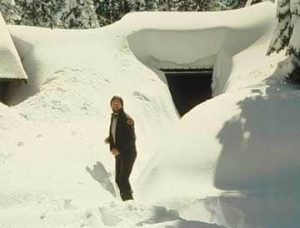
Like most big winters, 1983 started early. By Dec. 1, more than 6 feet of snow already covered the ground near Donner Pass, compared to an average of 11 inches for that time of year. Most ski resort operators had never seen anything like it for so early in the season.
December started off quiet until mid-month when a Pacific storm with record low barometric pressure slammed Central and Northern California with rain, snow and wind gusts exceeding 90 mph in the San Francisco Bay Area. The extreme winds closed the Golden Gate Bridge for only the third time ever.
Blizzard conditions raged in the mountains and Donner Pass picked up 7 feet of new snow. On Dec. 23, the snow depth there reached a solid 11 feet. The brutal storm had hit just before the economically vital Christmas-New Year’s holiday period.
Despite all the holiday traffic trying to get over Donner Pass, the California Highway Department was forced to shut down Interstate 80 for two days due to frequent wrecks including one fatality.
High winds crippled the electric grid as power lines were ripped down by falling trees. The tempest knocked out electricity to nearly every subdivision in the Truckee area, as well as a good portion of Donner Lake and Donner Summit neighborhoods. Three of the six emergency generators operated by utility company PG&E failed, which forced Lake Tahoe communities to endure rolling blackouts for days.
A spokesman for Pacific Gas and Electric said, “We’re suggesting to people to prepare for the worst and be aware that they may be out of power for three or four days.” Some customers in the Truckee area were without electricity for 13 days while temperatures plummeted to 7 degrees below zero.
By New Year’s Day, mountain highways were clear again for everyone to enjoy some of the best holiday ski conditions in memory. Alpine Meadows reported a base of 10 to 15 feet while Sugar Bowl boasted 12 to 18 feet of white gold.
A strong ridge of high pressure dominated for the first half of January, blocking the Pacific storm track. Sunny days and warmer temperatures gave locals hope that the destructive storms had abated. But heavy snowstorms returned during the third week of January dashing all hopes for some relief.
Snowboarding comes to Tahoe
On Jan. 21, 1983, another juiced up Pacific storm barreled onshore, pounding California with heavy rain and snow, high winds, and massive waves and surf along the coast. Santa Cruz was inundated with an incredible 25 inches of rain in 36 hours and up to 10 feet of new snow immobilized Lake Tahoe. By early February, the snowpack at Sugar Bowl ski area had reached 26 feet deep.
The bottomless snow along the Mt. Rose Highway got rave reviews from participants indulging in the hottest new winter rage at the time – snowboarding.
Southern California resident Steve Cathey, a former surfing and skateboarding champion, had begun manufacturing his patented Slicker Snowboard in 1980. His prototype snowboard was about 3-feet long with two plastic straps running from tip to tail on the top of the board. Riders placed their feet beneath the straps and then attached nylon safety straps to each foot.
Cathey, whose parents were Incline Village residents, was in the Tahoe area to help set up the first championship competition for snowboarding in the region. He said, “Lake Tahoe is the nicest place I’ve found for snowboarding. The terrain is great, the weather perfect and the lake beautiful.”
Avalanche danger increases
By the end of January, Alpine Meadows ski area boasted a thick base of snow ranging from 12 to 16 feet deep. As the snow piled up, avalanche danger increased throughout the region. Tahoe resorts along the Sierra crest control avalanches with explosives that trigger smaller, controlled slides. Despite their efforts, a large avalanche at Alpine Meadows swept over Jay Cotton of Kings Beach.
Fortunately, the slide spit him out as it stopped; his two buddies eluded the rumbling mass by skiing away from it. “It was like body surfing and getting sucked into a 10-foot wave, only thicker,” said Cotton. “It buckled me over, knocked me over and rolled me down the hill, flowing over the stop.” The slide measured 1,000-feet across and occurred in the vicinity of where a lethal avalanche the year before had killed seven at the resort.
As storms continued to roll in from the Pacific, buildings began to collapse from the weight of moisture-laden snow. Deteriorating road conditions and frequent wrecks stranded thousands of cars on Interstate 80 and local roadways. The California Highway Patrol reported lines of vehicles stretched for “miles and miles” along the snowy roads.
Hazel Beck, a cashier at the Wagon Train Coffee Shop in downtown Truckee, said, “It’s real awful. Cars are stuck all over the place and people are stranded. I haven’t seen Truckee this bad for a good many years.” Stay tuned.
Tahoe historian Mark McLaughlin is a nationally published author and professional speaker. His award-winning books are available at local stores or at thestormking.com. You may reach him at mark@thestormking.com. Check out his blog at tahoenuggets.com or read more at TheTahoeWeekly.com


