


Nevada boxing promoters proclaimed it the “Fight of the Century.” The highly touted 1897 bout between America’s reigning heavyweight champion “Gentleman Jim” Corbett, and lanky Australian challenger Robert Fitzsimmons promised to bring a much-needed economic boost to the Reno and Carson City economies. Both communities were suffering from a 20-year financial depression due to the decline of Virginia City’s Comstock Lode.
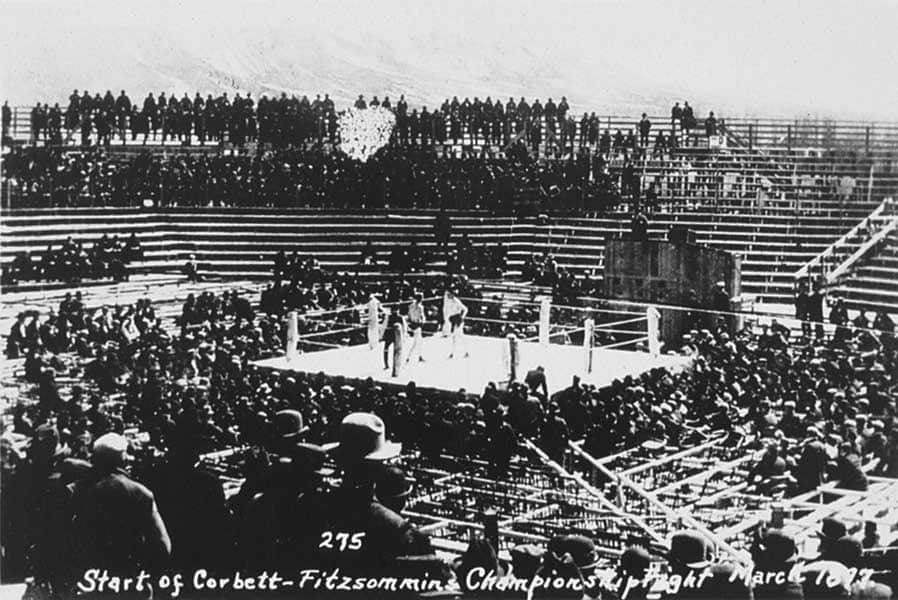
The United States’ first legal prizefight was held in Carson City, Nev.
| Courtesy Nevada Historical Society
This nationally advertised fight between these two popular pugilists promised to bring thousands of boxing fans to Western Nevada, and the economic boost of tourist money was the driving force behind the Nevada Assembly’s January 1897 decision to legalize prizefighting. The decision came at a cost, however, since the controversial fight drew attention to Nevada’s other unique sin solutions (legalized prostitution and gambling, sale of liquor, and by the 1930s, easy divorce) that the state legislature had also implemented for economic reasons.
The prizefight had nearly been aborted when Texas authorities followed California officials rejected the fight at the last minute on legal grounds. In response, Nevada quickly passed legislation legalizing boxing. Despite a strong tide of dissent by many Nevada residents, many of them female, the State Senate narrowly passed the bill by a 9 to 6 vote. The law was then sent to Governor Reinhold Sadler, who signed it on Jan. 28, 1897, just in time to host the March bout.
[blockquote3]
“The March 17, 1897, prizefight between Corbett and Fitzsimmons was the first licensed, sanctioned fight ever held in the United States.”
[/blockquote3]
Immediately, civic boosters from Reno, Carson City and Virginia City were bidding feverishly for the Corbett-Fitzsimmons match. Virginia City businessmen reportedly raised $10,000 to host the extravaganza, but there were worries that the fighters could not train and perform at an altitude of more than 6,000 feet. In addition, Virginia and Truckee Railroad officials said Pullman sleepers could not negotiate the tunnels west of Gold Hill. Ultimately, Carson City earned the privilege to host the fight.
The event was scheduled for the afternoon of March 17, 1897 on Saint Patrick’s Day. Since the promoters intended to film this championship fight utilizing the primitive movie technology of the day, the bout was scheduled for anytime between 11 a.m. and 4:30 p.m., depending on when the sunlight was best for the cameras. (This was the first on-site location film ever shot in Nevada and the beginning of a lucrative business for the Silver State. Today, Nevada is the most popular U.S. movie location site, bringing in millions of dollars in annual revenues.)
The month of March along the Sierra’s eastern slope can be downright wintry, but the promoters of the fight wouldn’t wait. Only if the weather did not cooperate and clouds ruined the natural lighting needed to film the match, would the fight be postponed. At first the odds for success looked bleak. On March 16, the day before the fight, a journalist for the Reno Evening Gazette wrote, “This morning was dark and gloomy and there was a heavy snow storm up in the mountains all day, and the clouds hang heavy over the valley.” That night, the weather was bitterly cold, the sky overcast with snow flurries in the air. Nevada residents who opposed the new legislation legalizing prizefighting in their state quietly enjoyed the inclement weather and the possibility of a canceled match.
But at dawn on fight day, the Carson City Morning Appeal noted that “while the air was cool and sharp, there was not a cloud to be seen anywhere. There was a noticeable moderation in the temperature and it could readily be predicted that when the sun was a few hours higher, the day would be perfection.” The luck of the Irish had held. The sun would shine on this Saint Patty’s Day.
Southern Pacific Railroad had scheduled extra trains out of San Francisco for the hundreds of fight fans traveling to Reno. Pugilist James J. Corbett had been born in San Francisco in 1862 and therefore attracted a large crowd of supporters from Northern California. Corbett had won the heavyweight championship in 1892 by defeating famed fighter John L. Sullivan, who had held the title for 12 years, decisively beating him in 21 rounds.
The public called Corbett “Pompadour Jim” because of his dandified ways; Corbett preferred to call himself “Gentleman Jim.” In those days, many boxers made a living not from fights, but as actors, and Corbett had starred in a play called “Gentleman Jack” in 1894. Boxing purists were disappointed that the handsome Corbett was a “boxing artist,” not a man of power and brawn like John L. Sullivan. But knockout victories by Corbett in 1894 and 1895 resolved any questions about his right to hold the title.
Challenger Robert Fitzsimmons was also born in 1862, in Cornwall, England, but he was a resident of Australia at the time he fought Corbett. While Corbett may have been considered a “Fancy Dan,” Fitzsimmons was described as “a fighting machine on stilts.” He was tall, knock-kneed, skinny and balding. However, Fitzsimmons was known as “a master of ring strategy, using quick maneuvers, shifty footwork, and feigns of grogginess to set up rivals for a knockout.” Corbett and Fitzsimmons had signed contracts for the fight with the winner receiving $15,000 and the proceeds of side bets worth $5,000 to $10,000. The loser would get $9,000.
When it came time to set up their training camps, Corbett chose Shaw’s Hot Springs, now known as Carson Hot Springs, while Fitzsimmons selected Cook’s Grove, three miles east of town. Journalists swarmed in from every media market in the U. S. and abroad. Veteran lawman Bat Masterson, covering the fight for the New York Post, was joined in the crowd by ex-champ John L. Sullivan and the noted boxer Marine Tom Sharkey (both there to challenge the winner), as well as famed gunmen Wyatt Earp and Luke Short.
The March 17, 1897, prizefight between Corbett and Fitzsimmons was the first licensed, sanctioned fight ever held in the United States. Corbett was heavily favored, the odds running 10 to six against Fitzsimmons. Most visitors attending the fight supported the champ fiercely, but locals in Carson City soon discovered that Corbett was aloof and haughty, and not at all the “Gentleman Jim” he called himself. By contrast, Australian Robert Fitzsimmons was friendly and easygoing, and by fight day local residents favored him over Corbett.
Stay tuned for part two of “Fight of the Century.”
Tahoe historian Mark McLaughlin is a nationally published author and professional speaker. His award-winning books are available at stores or at thestormking.com. Mark may be reached at mark@thestormking.com. Check out Marks blog at tahoenuggets.com.


