


This year the National Park Service is celebrating its 100th anniversary. Many of America’s most scenic and historic places have been set aside and protected as national parks. The concept of a national park is an American innovation that grew out of the conservation movement that began in the 19th Century.
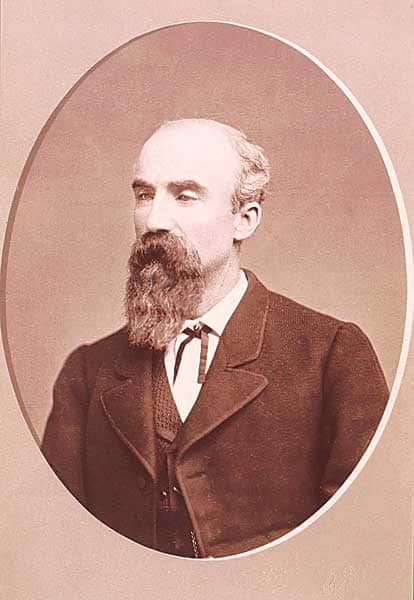
Timber baron Duane L. Bliss supported a Tahoe Forest Preserve. | Nevada State Museum
Yellowstone became the first national park in 1872, but due to lack of a coordinated policy and leadership at the federal level, the National Park Service was not established until 1916. The mission of the NPS is to preserve natural and cultural resources and provide the services needed for the enjoyment, education and inspiration of park visitors, for this and future generations — honorable goals indeed.
[blockquote3]
“By 1880, mounting damage to the Tahoe Basin forest
was drawing protests from visitors, newspaper editors
and politicians and a movement toward mitigating
exploitation of Tahoe’s remaining timber
gathered popular support.”
[/blockquote3]
In the 1870s and 1880s when the Tahoe Basin was being decimated by logging companies to provide lumber and fuel wood for Nevada’s booming silver mining industry, there was growing public pressure to protect some of the Tahoe forest from destruction. Even Duane L. Bliss, a timber baron who owned the most land in the region, understood the value of scenic beauty at Big Blue. Bliss ordered loggers on his timber tracts to spare all trees under 15 inches in diameter in order to protect the forest and accelerate its eventual regrowth.
Initially, however, nothing could stop the juggernaut of the Comstock. In the 1870s, most Truckee-Tahoe locals were enjoying an economic boost from the logging industry and related business opportunities so they supported the acquisition of land for profit rather than for protection under government control. But, by 1880, mounting damage to the Tahoe Basin forest was drawing protests from visitors, newspaper editors and politicians and a movement toward mitigating exploitation of Tahoe’s remaining timber gathered popular support.
In 1883, California’s state assembly declared that it was the state’s duty to “preserve natural scenery for the health, pleasure and recreation of both residents and tourists.” Much of the Nevada side of the Tahoe Basin had already been logged, but most of the forest on the California side was still relatively intact. The assembly recommended that the federal government acquire the unspoiled land owned by Central Pacific Railroad in the northern portion of the basin “for the purpose of California holding and preserving it as a state park or state forest.” Unfortunately, the resolution never gained political traction and died in the state senate.
Before Bliss died in 1907, he contacted noted California environmentalist John Muir and proposed the establishment of a Lake Tahoe Forest Reserve. Muir, a writer and naturalist, had actively supported the creation of a Sierra Forest Reserve to protect timberland in Northern California. Muir is best known for his leading role in the fight to save the Yosemite Valley from commercial exploitation and for co-founding the Sierra Club.
In 1899, President William McKinley approved the establishment of more than 136,000 acres in the southwestern part of the Tahoe Basin as the Lake Tahoe Forest Reserve. Today, the bulk of that reserve is known as the Desolation Wilderness, one of the most beautiful and heavily visited portions of the Tahoe Sierra. It was the beginning of federal efforts to protect and manage land at Lake Tahoe, but logging in the basin continued.
That same year, Nevada Sen. William M. Stewart proposed a Lake Tahoe National Park that would include the whole of the Tahoe Basin. Stewart’s plan was somewhat disingenuous because he wanted a large dam built at Tahoe City with all surplus water stored behind it available for Nevada farmers, as well as the development of hydroelectric power. Nevada’s agriculture industry was elated, stating that the only limits on the potential expansion of farming in the Truckee River district would be the height of the dam. Stewart was hoping for a dam that could hold back 12 feet of Tahoe water, compared to the current limit of 6 feet, 1 inch.
California interests complained that although Stewart’s proposal would protect about 1,300 square miles, it also included 80,000 acres west of the Sierra crest and Tahoe watershed, well into El Dorado and Placer counties. Stewart also enjoyed a close relationship with Bliss and the Central Pacific Railroad, both of which would stand to gain immensely from the proposed land exchange. Muir and others warned of a “gross fraud” by the lumber companies against the public interest and the proposed national park bill died.
Meanwhile, supporters of expanding the Lake Tahoe Forest Reserve renewed their efforts. Unlike a national park that required an act of Congress, forest reserves could be established by presidential decree. More importantly for local Tahoe residents and businessmen, a national park excludes commercial development, while a forest reserve permitted livestock grazing and logging.
After President McKinley’s assassination in September 1901, Vice President Theodore Roosevelt took command. Roosevelt soon demanded the expansion of the forest reserve system. An aggressive conservationist, Roosevelt assisted in adding 147 million acres to the nation’s forest reserves, created 18 national monuments and used his influence with Congress to establish five national parks. He also established the U.S. Forest Service to better manage the nations’ wild lands.
By this time, Lake Tahoe’s forestland was in a deplorable condition. Civil engineer and conservationist professor Marsden Manson wrote, “Around Lake Tahoe the timbered areas have been entirely swept off, with the exception of a few thousand acres around Tallac, and some at the north end, reserved by the owners for later use.” The landscape was so barren near Brockway and along the East Shore of Big Blue that large tracts were being sold for 50 cents per acre.
Over the next two decades, more efforts to establish a Lake Tahoe National Park were initiated, but none ever made it to the congressional level. In the 1920s, Stephen Mather, the first director of the newly formed National Park Service and a longtime California resident, had visited Lake Tahoe many times. The forest had grown back robustly, but Mather was concerned about the increasing construction of roads, homes and businesses, all of which lowered the region’s chances for national park status. Finally in 1931, another representative of the NPS visited the lake and determined that its “extremely altered” landscape and widespread private ownership precluded the area from being designated a national park and the book was closed. Today, more than 70 percent of the land area in the Lake Tahoe Basin is designated as state park and national forest.
Book signing
July 28 | 5-7 p.m. | Truckee Thursdays
Mark McLaughlin will be signing copies of his new book, “Snowbound” at The Bookshelf booth.
Historic Bus Tour
Aug. 5 | 9 a.m. | Local historical sites
$50 | Tickets (530) 583-1762
Tahoe historian Mark McLaughlin is a nationally published author and professional speaker. His award-winning books are available at local stores or at thestormking.com. You may reach him at mark@thestormking.com. Check out his blog at tahoenuggets.com or read more at TheTahoeWeekly.com.
READ MORE


