


As Lt. John C. Frémont and his men crossed the Tahoe Sierra in February 1844, they were plagued by snowstorms and bouts of snow blindness. On Feb. 6, Charles Preuss, the expedition’s cartographer, wrote in his diary: “The snow is so horribly deep, and we can cover only a few miles each day. I am walking almost barefoot. This surpasses all the hardships that I have experienced until now.”
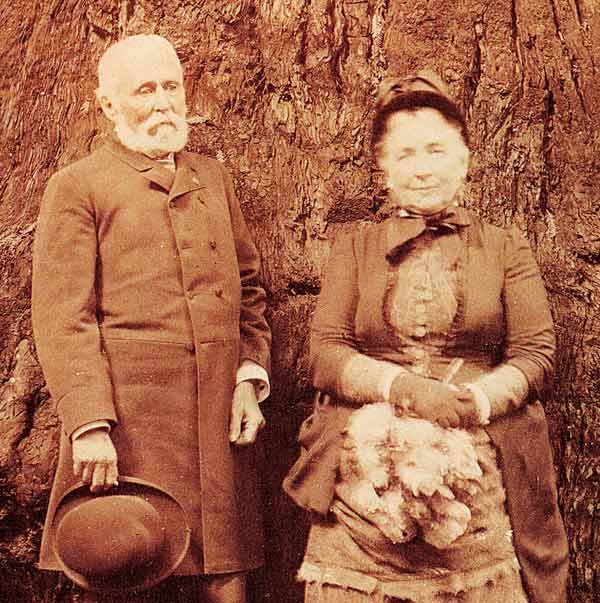
John & Jessie Fremont, circa 1889. | Courtesy Library of Congress
Two days later, they got their first view of the Sacramento Valley, about 30 air miles away. Army scout Kit Carson recognized Mount Diablo, 100 miles distant, from his exploration of California 15 years before via the Mohave River. The promise of reaching the lush green valleys of California buoyed everyone’s spirits and it came just in time. The pack animals were dying at an alarming rate and their food supply was dwindling rapidly. In fact, on Feb. 13 Frémont wrote, “We had tonight an extraordinary dinner — pea soup, mule, and dog.”
The next day Frémont and Preuss trudged up to the Sierra crest from where they saw Lake Tahoe, about 20 miles to the north. History records them as the first Euro-Americans to see the magnificent lake, but celebrated trapper, Stephen C. Meek, claimed to have been the first Caucasian to see the Truckee River when he set traps on it in 1833. It seems unlikely that Meek would not have followed the relatively short Truckee River to its source at Lake Tahoe.
[blockquote3]
“Both were uncompromising abolitionists and socially progressive
in an era when either stance could be a social and political liability.”
[/blockquote3]
Frémont’s expedition reached Sutter’s Fort in Sacramento in March. After the men rested, they rode south into the San Joaquin Valley before heading east via Walker Pass and the Santa Fe Trail.
Frémont was ecstatic to finally see his lovely wife Jessie again after nearly a year exploring the Western frontier. He had journeyed 3,500 miles, circumnavigated the Great Basin, which he named, mapped part of the western Sierra watershed and the San Francisco Bay. In 1846, Frémont christened the entrance to the bay, “Chrysopylae” or Golden Gate. He compared it to the Golden Horn, a beautiful harbor in ancient Byzantium, which is now Istanbul, Turkey.
Considered the preeminent explorer of the uncharted American West, Frémont enjoyed incredible popularity in the 19th Century. Much of his fame was based on the official reports that his talented wife Jessie wrote up after each expedition. The salary of a second lieutenant did not permit the luxury of a secretary, so Jessie Frémont collaborated with her husband in producing a compelling narrative from the field reports. She breathed life into characters from the explorations: Kit Carson, American Indians, mountain men, fur traders and scouts, as well as marveling at the sheer beauty of the Western landscape.
Jessie turned out such splendid prose from her husband’s highly detailed notes that the reports were published as books and widely distributed. Newspapers nationwide ran excerpts and literary critics compared the tale to “Robinson Crusoe.” Her dramatic renderings of John’s various expeditions became bestselling books among an American public enthralled with the Wild West. In Jessie’s hands, Frémont’s scientific observations became literary classics. This influential collaboration between husband and wife would last nearly 50 years.
John Frémont and Jessie Ann Benton had met and fallen in love in February 1840. Daughter of Senator Thomas Hart Benton, one of the most politically powerful men in Washington, D.C., Benton had told Jessie, “Lt. Frémont has no family, no money and the prospect of slow promotion in the Army, we think him no proper match for you. And you are too young for marriage in any case.” His opposition to the union fell on deaf ears and Jessie eloped with John. They were married in October 1841.
As a socially powerful and influential couple, the Frémonts encountered many political and military hurdles. In 1847, despite Jessie’s intense efforts to mitigate it, John was court-martialed during the Mexican-American War after getting caught in a power struggle between an army general and navy commodore. Due in part to Jessie’s entreaties, President Polk quickly pardoned Frémont, but the pair felt betrayed by the government. John resigned his army commission and the family moved to Monterey.
Rich gold deposits were discovered on land John acquired through a land grant and the Frémont’s grew wealthy. With Jessie in the lead, their home became the headquarters for antislavery delegates writing the California Constitution. When California gained statehood in 1850, John Frémont was elected senator.
The couple would have five children and face challenges in the years ahead, but the Frémonts firm commitment to their principles never wavered. Both were uncompromising abolitionists and socially progressive in an era when either stance could be a social and political liability. During the 1850s, the United States was careening toward war with itself over the issue of slavery. At the start of the Civil War in 1861, Frémont was in command of Federal (Union) forces in the West, an area that included Missouri, a deeply divided state teetering toward anarchy over the issue of slavery. Secessionist guerrilla forces were terrorizing the population.
As military governor of Missouri, Frémont believed his orders to quell insurrection gave him authorization to declare martial law. In August he issued a proclamation declaring that slaves within the state were “forever free.” Not only did he not have the authority to make such a declaration, he didn’t tell President Abraham Lincoln beforehand. The war was not going well for the Federal Army and Lincoln, concerned about losing the vital support of several slave states that had not seceded, was forced to revoke Frémont’s proclamation. Within weeks, Major General Frémont was relieved of his command.
John Charles Frémont ran as the Republican Party’s candidate for president of the United States in 1856. The Californian was strident in his opposition to slavery, and therefore only carried 11 states with 33 percent of the popular vote. He lost to democrat James Buchanan, who endorsed “popular sovereignty” that allowed new states to make their own choices about slavery.
Jessie led the movement to secure state park status for the Yosemite region, which she achieved in 1864 when President Lincoln signed the Yosemite Grant Act. It was the first time the federal government had saved scenic lands for future generations. That protection enabled John Muir to push for the larger Yosemite National Park. Without Jessie’s efforts to establish the first park, there might not have been a Yosemite National Park. In its 1902 obituary for Jessie Frémont the L.A. Times wrote: “Brilliant and beautiful … now only a memory is left of her wit, her gracious use of power, her influence for good.”
Tahoe historian Mark McLaughlin is a nationally published author and professional speaker. His award-winning books are available at local stores or at thestormking.com. You may reach him at mark@thestormking.com. Check out his blog at tahoenuggets.com or read more at TheTahoeWeekly.com.
READ MORE


