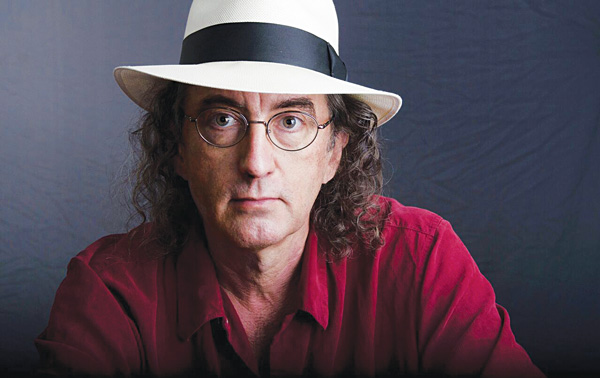
One-of-a-kind country songwriter James McMurtry was at his home in Austin, Texas, passing time before his upcoming Rocky Mountain and Pacific Coast summer tour when he talked to the Tahoe Weekly. He spoke of the influence — or lack thereof — of his famous father on his unique approach to songwriting.
Growing up in a series of rented ranch houses in 1970s northern Virginia, he was the son of the then-unknown, but now much-celebrated, Western author Larry McMurtry, who wrote“ Lonesome Dove,” “The Last Picture Show” and “Terms of Endearment,” among others.
Aug. 5 | 8 p.m. | $32.50-$35 | 18+
Cargo Concert Hall | Reno, Nev.
“I would go to sleep to the sound of the typewriter, but Larry didn’t have a best seller until 86 by which time I was long out of the house” he says.
Instead, his father made his living as a screenwriter and bookstore owner while writing book reviews for the Washington Post at $100 a week.
“Back in those days rent was only $250, so that was a pretty good deal,” says McMurtry. “He eventually got fired and was so mad he went to work for the Washington Evening Star for free.”
James took a rebellious stance from early on regarding his ambivalent relationship with his father’s work.
Watch James McMurtry perform “Choctaw Bingo”
“Well, I didn’t want anything to do with his books,” he says. “I had to move so many of ‘em over the years that I hated the damn things. For a writer, I sure didn’t like to read all that much. I never wanted to be a prose writer and I still don’t.”
Instead, James made it clear that he was going to be a poet and a songwriter. McMurtry recalls the grandiose front-porch stories his father would tell with family and friends on the warm Virginia evenings.
“The story will change according to rhyme and meter, but you have to let a song have its head. … Sometimes happy accidents of mixed-up words can be your best friend.” – James McMurtry
“Larry McMurtry was and is a storyteller,” his son says. “He is one of the last generations with that tradition. It’s an oral tradition that was passed on to me. And that’s where I got a lot of the details that shaped my imagination.”
It was McMurtry’s mother who taught him a few chords on the guitar and actively encouraged his innate interest in music.
“When I was a kid, I wanted to be Johnny Cash,” he says. “Then somebody turned me on to Kris Kristofferson. It was the first time I really thought of songwriting as something that people could do. I liked Cash for his voice and spare production, but when Kris came along I sat up and paid attention.”
McMurtry’s mother and stepfather took him to see his two early heroes perform live at age 9 — first to a Cash show and then to Kristofferson around the time of his “Jesus was a Capricorn” album in 1972.
“I noticed that he and the band seemed to be having a really good time and I decided I wanted to do that,” he says.
He started scribbling down verses in his teens, but McMurtry didn’t finish a song he would play live until his mid-20s with “Talking at the Texaco” from his 1989 debut album “Too Long in the Wasteland.”
McMurtry’s method of songwriting is by his own admission a haphazard affair. Fortunately, he was generous enough to share a few of his trade secrets.
“My dad used to write every day, but I do mine in fits and starts,” he says. “I start with a couple lines and a melody and I think to myself, ‘Who says that?’ Then, if I keep going I can envision a character who may have said those lines.”
Part of his practice involves allowing songs to breath naturally and take on a life of its own.
“You have to listen to the song you started to write and see where it’s going,” he says. “You never force it where you want it to go. If you try to push your opinion on a song, you’ll come out with a sermon. Sometimes it can take years to get a song right.”
According to McMurtry, a hook is key, even if it doesn’t quite say what you originally thought you were writing about.
“The story will change according to rhyme and meter, but you have to let a song have its head,” he says. “You always go with the line that sounds better and sounds cooler even though it doesn’t make the point you set out to make. Sometimes happy accidents of mixed-up words can be your best friend.”
For more information or to purchase tickets, visit cargoreno.com.