


In 1848, news that gold had been discovered in California spread quickly around the world. Tens of thousands of people answered the siren call of the Gold Rush. The surge became the largest voluntary migration in human history. Among the masses that rushed to California were many talented and skilled Jewish pioneers. Most were recent arrivals to America from Germany and Central Europe.
Unlike traditional Jewish communities in Old Europe where family ties and institutions were so important, the primitive cultural landscape of early California offered little support to new immigrants. The Jewish entrepreneurs who moved into towns and opened mercantile businesses helped expand growth in the mining districts. In fact, historians have pointed out that to a significant degree: “The credit for the settlement of urban areas in the mining regions of the West belongs to the Jewish merchants and not to the romantic miner or transient prospector.”
“The credit for the settlement of urban areas in the mining regions of the West belongs to the Jewish merchants and not to the romantic miner or transient prospector.”
Despite a long history of religious persecution, during the California Gold Rush there was little overt anti-Semitism. One contemporary noted: “The mines put all men for once upon a level. Clothes, money, manners, family connections, letters of introduction, never before counted for so little. Social and financial inequalities between men were together swept out of sight.”
In his book, “Three Years in America,” Jewish travel writer Israel J. Benjamin wrote about early San Francisco: “Nowhere else are they [Jews] accorded as much esteem by their non-Jewish brothers and nowhere else are they so highly valued in social and political circles.”
California historian Hubert H. Bancroft agreed: “Never since the great Egyptian exodus have the Hebrew race found a soil and society better suited to their character and taste.”
Jewish merchants served on civic committees and were also active in California’s earliest entertainment societies and amateur theatrical performances. During the 1860s, the provocative Jewish actress Adah Isaacs Menken performed in New York City in the play “Mazeppa,” based on a narrative written by English poet Lord Byron in 1819. At the climax of the play, the Russian hero Ivan Mazeppa is stripped of his clothes by his captors and bound to the back of a wild horse, which dashes away and disappears off stage.
Traditionally a stuffed dummy was tied to the barebacked horse. Adah Menken, however, decided that she would ride the horse herself, dressed only in flesh-colored tights. Her seductive performance and skimpy attire so shocked the audiences in New York City that Ms. Menken said, “I’ll go to the one place where the audience demands real art. I’ll go to San Francisco.”
After her two-month engagement in San Francisco where she was paid a record sum of $500 per night, Menken took her act to the Nevada Comstock where she appeared at Maguire’s Opera House in Virginia City. Adah had already gained international fame for her striking beauty, artistic talent and scandalous, tempestuous love affairs. She was also the highest earning actress of her time. Nevada miners had been dreaming of “La Menken” ever since her arrival in California and they showed their appreciation by showering the stage with bags of gold dust. Menken’s extraordinary beauty, her flamboyant style and daring display of her shapely figure made her the sensation of the staid Victorian Age.
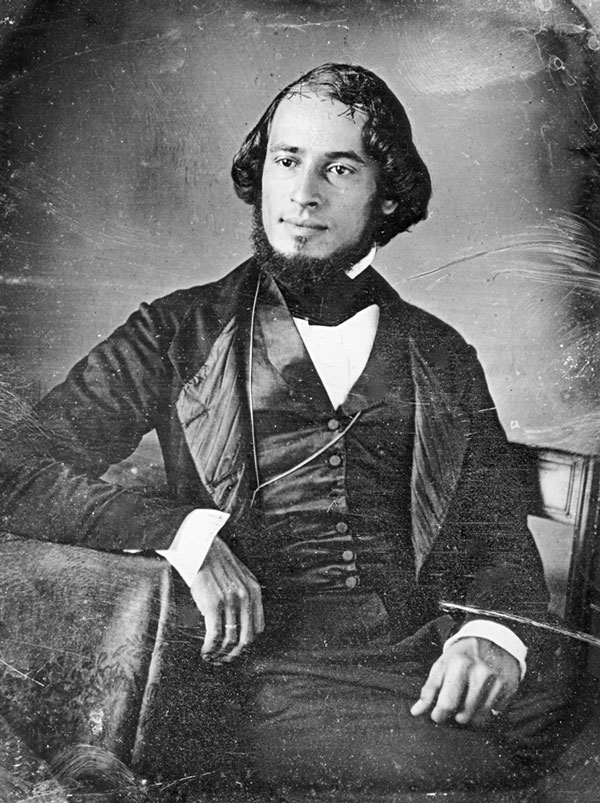
Another memorable Jewish sojourner was Solomon N. Carvalho, an oil painter, photographer and daguerreotyper, who spent the year 1853-54 in a treacherous expedition documenting the Far West with Col. John C. Frémont. Frémont, a celebrated American explorer credited with being the first white person to see Lake Tahoe in 1844, planned his fifth and final expedition in the West to demonstrate the feasibility of a year-round transcontinental rail route along the 38th parallel.
Frémont had heard of Carvalho’s expertise with the paintbrush and daguerreotype camera and invited him along to chronicle the expedition. Frémont interviewed Carvalho, a Sephardic Jew whose family included rabbis, teachers, writers and merchants. As testament to the colonel’s powers of persuasion, young Solomon wrote, “After a short interview with Col. Frémont, I accepted his invitation to accompany him as artist of an exploring expedition across the Rocky Mountains. A half hour previously, if anybody had suggested to me the probability of my undertaking an overland journey to California, I should have replied that there were no inducements sufficiently powerful to have tempted me. I know of no other man to whom I would have entrusted my life under similar circumstances.”
In September 1853, Carvalho said goodbye to his wife and children and joined Frémont’s 22-man pack train. Carvalho’s book, “Incidents of Travel and Adventure in the Far West with Colonel Frémont’s Last Expedition,” is based on his diary and letters from the trip. It describes many hardships, but also offers insight into the dedication Carvalho brought to his assignment. To make daguerreotypes in the open air, in freezing temperatures and without any protection from the elements was nearly an impossible task, but Carvalho persevered by utilizing his scientific and practical knowledge of chemicals and theory of light.
A harsh winter set in and food supplies ran dangerously low. By the time the half-frozen group stumbled into Mormon-settled Utah, Carvalho weighed only 100 pounds, 50 pounds less than when he started. His feet and fingers were frostbitten from working camera equipment in the frigid cold, he suffered from diarrhea and scurvy, and his clothes were in tatters. Yet his precious daguerreotype plates were still safe and secure.
Carvalho spent three months recuperating in Salt Lake City, the only Jew in a city of Mormons. He did not approve of polygamy but possessed a deeply felt philosophy of religious tolerance. He wrote: “The religious teachers of Mormonism preach ‘Christianity in its purity.’ With their perfect right to imbibe new religious ideas, I have no wish to interfere, nor has anyone. All religions are tolerated, or ought to be, in the United States, and I offer these remarks as an apology for the masses of honest men that they were ignorant of the practice of polygamy before their arrival in the Valley. Surrounded as they are by hostile tribes of Indians and almost insurmountable mountains of snow, they are precluded from returning home, but live among themselves, practicing as well as they know how the strict principles of virtue and morality.”
Jewish pioneers in the Far West brought a love for education and knowledge of the religious practice of their parents and elders. Once settled, Jewish immigrants gave much to their communities and helped provide the economic stability needed by so many new towns thriving on the Pacific Coast.


