


Free open spaces, clean streams and lakes, and the scarcity of ticks and fleas conspire to make the Tahoe Sierra a dog’s paradise. For more than 150 years, canine superstars have accomplished many impressive achievements in this region, including mountain transportation, search-and-rescue missions and sled dog racing.
By the early 1860s, sled dogs were common in the mountains along with horse-drawn sleighs. Horses were sometimes outfitted with specialized snowshoes made of metal and leather. When the legendary skiing mailman John “Snowshoe” Thompson started a winter express service for freight and an occasional passenger, he utilized muscular breeds like Malamutes and Huskies to pull his sleigh through the Sierra after the snow settled. When the dogs couldn’t make it, the indomitable Thompson jumped on his skis and carried as much cargo as he could in a backpack that weighed up to 80 or 90 pounds. Thompson’s father had taught him to ski when he was growing up in Norway. After his arrival in California in the early 1850s, “Snowshoe” went on to become America’s first freestyle alpine skier.
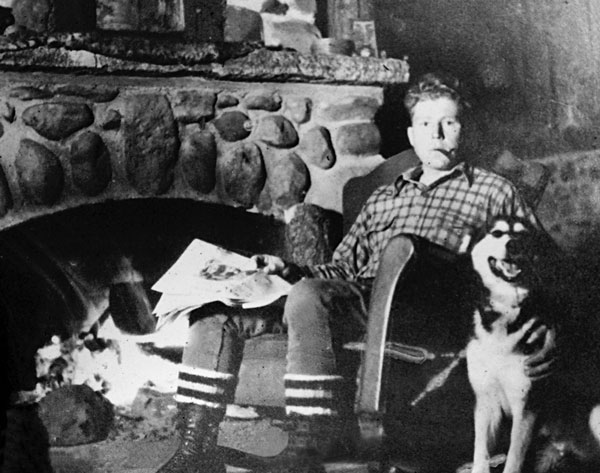
During the 1930s, Tahoe City’s Constable Harry Johanson wouldn’t have been able to patrol his far-flung district during winter months without his trusty sled dogs. Johanson arrived in April 1932 with no intention of settling in Tahoe permanently, but he immediately fell in love with Big Blue and its snow-covered mountains. It reminded him of his homeland of Sweden.
Residents found the Swedish newcomer polite and well versed in the skills necessary for travel and survival in their snowbound environment. In December 1934, Johanson received his U.S. citizenship and two months later he took the oath as Tahoe City’s second official constable.
Harry Jo wasted no time in taking charge of his new role as the region’s sole law-enforcement officer. He usually covered his beat of 200 square miles by horseback during summer while riding his favorite mount, a handsome Palomino named Viking. During the snowy winter months, he traveled by dogsled. Harry Jo loved his dogs more than anything else in the world, especially his best lead dog, Kazan. One of his favorite quotes was: “A man’s best friend is his dog, better even than his wife.”
Johanson kept up to 15 dogs at a time, most of them Malamutes, to pull his sled. Despite severe storms that buried the region in deep snow, Johanson regularly made his rounds to check on year-round residents who were trying to tough it out during the harsh winter months.
He occasionally sold dogs that he raised and trained to neighbors, including a partially tamed wolf and two Huskies named Sitka and Baree that wealthy eccentric George Whittell needed for use on his Thunderbird estate on Lake Tahoe’s East Shore. Sadly, in October 1937, Harry Jo’s favorite dog, Kazan, died after eating a poisoned chipmunk. Apparently, Kazan was the accidental victim of an ill-advised effort that summer to eliminate the pesky rodents from Tahoe City homes and businesses.
During the 1930s, Johanson and his canine team performed in many adventure movies. Hollywood directors enjoyed filming action flicks at Lake Tahoe and Big Bear in the southern Sierra. Harry Jo often performed as a stunt double and had gigs in such epics as “The Call of the Wild,” where Harry stood in for Clark Gable; “White Fang” and “Rose Marie,” in which he doubled for leading man Nelson Eddy. Johanson preferred the devoted companionship of his dogs over any commitment to a woman. After one broken-hearted relationship Harry said, “The more I see of women, the more I love my dogs.”
In the early decades of the 20th Century, Truckee thrived as the sled-dog-racing capital of the United States, attracting thousands of spectators each winter. Contestants traveled from as far away as Montana, Canada and Alaska to compete for cash awards and the prestigious national title. The International Sled Dog Racing Association claims that the first sled dog race in the lower 48 states was staged in 1917 in Ashton, Idaho. Ashton’s ongoing American Dog Derby calls itself the “oldest dog sled race in the United States,” but the town of Truckee actually held the country’s first sled dog competition in 1915. These canine-driven events were an integral part of the community’s annual Ice Carnival to promote winter sports and bring tourists and their money to the mountains.
Among the many spectators to cheer on the dogs in that historic 1915 race was none other than noted novelist Jack London, author of “The Call of the Wild,” a popular novel he wrote in 1903. London spent nearly a year in Alaska during the 1890s Klondike Gold Rush after which he penned his fictional story about a sled dog named Buck who struggled to survive abusive humans and an extreme winter environment. The book became an instant classic and brought London fame as one of America’s favorite authors. Three years later London wrote “White Fang,” a companion dog-centric novel that thematically mirrors his first.
Truckee’s winter sports industry started in 1892 when resident Charles McLellan built a 450-foot-diameter ice rink in front of Truckee’s Commercial Row storefronts to attract skaters. Within two years, several of the town’s leading businessmen and residents formed a private company to build and operate a massive indoor ice-skating rink on Front Street in downtown Truckee. They were convinced that developing and expanding winter tourism could boost revenue with year-round activity. Their pioneering efforts resulted in the construction of the town’s first ice palace, which became the cornerstone of the earliest winter carnivals.
Activities such as toboggan runs, horse-drawn sleigh rides and moonlit ice-skating parties on Donner Lake attracted residents in San Francisco and Sacramento. Skijoring, where a person on skis is pulled by dogs or horses, and later by motorcycles, was wildly popular. By 1930, entrepreneurs were running sled dogs to launch and tow glider planes with a paying tourist or two on board.
Today, winter sports generate nearly $1 billion in annual economic benefits in the Sierra Nevada. Stay tuned for Part II in the next edition and at TheTahoeWeekly.com.


