


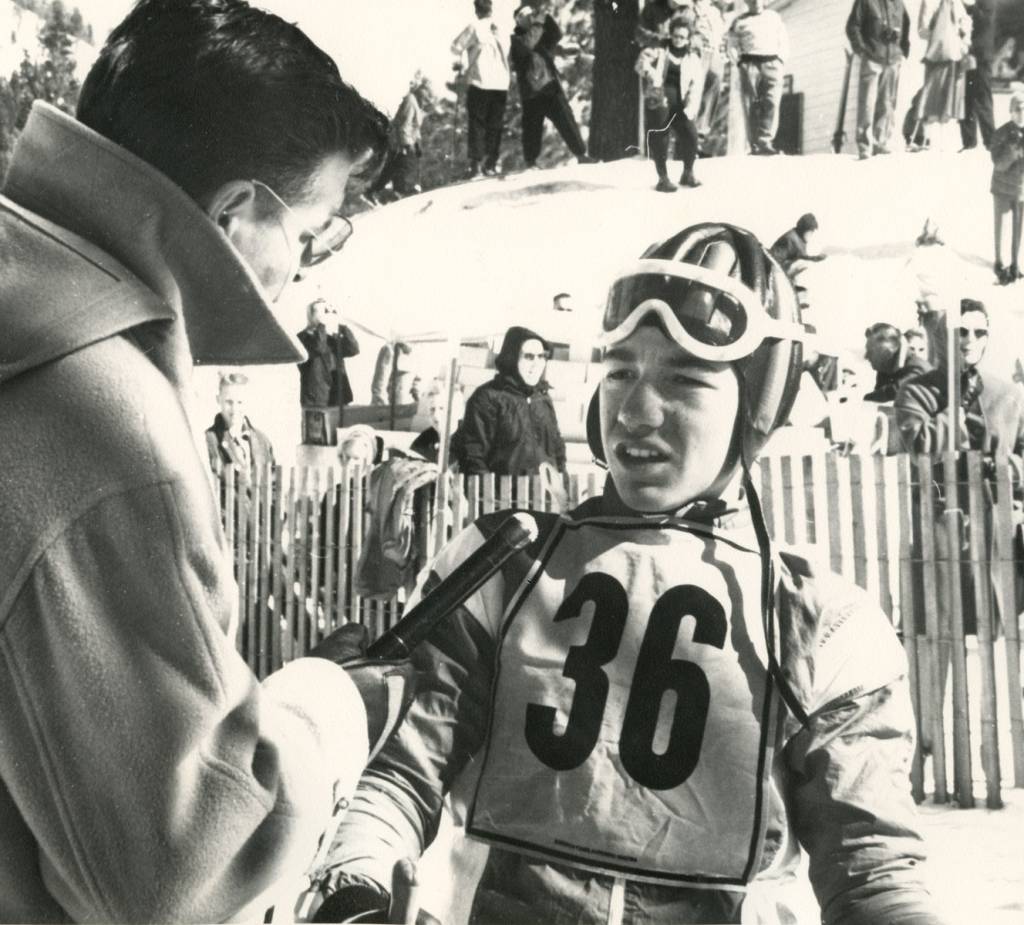
After a late start, the winter of 1959 roared to life during February, just as Squaw Valley was preparing for the highly-anticipated North American Championships, a multi-sport tournament billed as practice for the upcoming 1960 Winter Olympics. On Feb. 13, a warm Pacific storm soaked the snowpack with nearly 3 inches of rain. An Olympic spokesman described the rain as both a blessing and a curse, “It’s a financial blessing because it eliminates much of the snow packing that would have been necessary to get the racecourses in shape, but it’s a danger if the rain continues much longer.” There were still seven days left to manage the slush before the Feb. 21 tournament got under way, but more trouble lurked in the Pacific Ocean.
The National Weather Service warned that a massive weather system — now called an Atmospheric River — had migrated northeastward from the Hawaiian Islands and briefly stalled in the eastern Pacific. On Valentine’s Day, this seething subtropical air mass surged into northern California. Torrential rain flooded the lowlands while blizzard conditions prevailed at the highest elevations. The slow-moving storm guaranteed that bands of heavy precipitation would continue to lash the Tahoe Sierra for several days. Fortunately, freezing levels slowly dropped and the rain turned to snow above 5,500 feet in elevation.
Avalanche danger, however, compelled organizers to cancel training runs on Squaw Valley’s upper slopes and forced frustrated racers back to the lodge. Avalanche expert Monty Atwater and his squad shelled the overloaded slopes with large-caliber, recoilless rifles and hand-thrown charges, but the mountain remained extremely hazardous.
Alpine racers were understandably frustrated with the lack of practice. Some skiers had been in the valley for three weeks at their own expense and were losing patience with the long wait for suitable conditions. One female Chilean racer complained, “If I can’t ski, I can’t race. I’ve skied half a day since I arrived.”
The unstable snowpack near the summit of Squaw Peak forced officials to switch the men’s downhill from there to the women’s lower elevation course on KT-22. The unwelcome change effectively nixed the male athlete the opportunity to train on the official Olympic downhill run that a lucky few would take on in 1960.
The heavy snow didn’t bother Austrian Friedl Wolfgang, the official observer for the International Skiing Federation. “What I have seen of the courses is better than what I had heard,” he reported. “The slopes and whole layout are excellent. It’s varied terrain, not just a steep slope.” Wolfgang did warn that at least 400 course workers would be required for the Olympics, which came as no surprise to the 40 overworked and exhausted people currently ski packing the runs. Farther north, snowfall tallies reached the extreme. At the Mount Shasta Ski Bowl at 7,841 feet in elevation, 178 inches fell in just six days, setting a record single-storm total of nearly 15 feet.
Potent Pacific storms had buried the Squaw Valley Village under nearly 9 feet of snow in 10 days, with even more on the upper slopes, but that didn’t stop thousands of spectators from driving in to cheer on the Olympic hopefuls as the weather cleared right before opening day. Among the hordes was noted ski film pioneer Warren Miller, who captured some of the action in his 1959 film “Let’s Go Skiing with Warren Miller.”
Once the racecourses were sufficiently packed, the alpine and Nordic skiers finally got down to business. As expected, American Buddy Werner took first place in the men’s downhill, but ultimately came in second to Sun Valley instructor and former Austrian champion Christian Pravda in the combined overall standings. The new 400-meter skating oval lived up to the hype that artificial ice was superior to the natural product and more than one speed record was broken. Although a handful of jumpers were injured on their landings and an influenza epidemic sickened nearly half the personnel staying in the valley, most attendees gave the Squaw Valley Olympic venue a hearty vote of approval.
American athletes did surprisingly well at the North American Championships. Born in Reno and raised at Zephyr Cove near South Lake Tahoe, the University of Nevada’s Dick Dorworth didn’t place in the top 10, but his illustrious career as a champion American skier and future world record holder in speed skiing was just beginning. In 1962, Dorworth was named to the All-American Ski Team, and in 1963, he set a new record of 106.8 miles per hour at Portillo, Chile.
Linda Meyers, from Mammoth Lakes, won the women’s downhill and slalom at Squaw Valley, while New Hampshire’s Joan Hannah took first in the giant slalom. Beverly Anderson, from the University of Washington, was the women’s downhill/slalom combined champion. Notably, the United States took first and second place in the biathlon, with enlisted Army soldiers Lawrence Damon and Dick Mize displaying only adequate skiing but excellent marksmanship. Tahoe City local Jimmie Heuga, a 15-year-old member of the Lake Tahoe Ski Club, was one of the youngest competitors at the Championships. Small in stature, but big in heart and quick in his turns, Huega’s impressive season-long performances at Far West Ski Association races had earned the feisty teenager a chance to try out for the U.S. Olympic team. He didn’t make it that year, but in 1964 he became the second American male to win a medal in Olympic alpine skiing when he scored a bronze in the slalom at Innsbruck, Austria.
The 1959 dress rehearsal enabled Olympic planners to discover flawed procedures that would need correction before the 1960 Winter Games, but everyone was confident that Squaw Valley would be ready. The Russian contingent admitted that they had nothing to complain about and “they were most impressed by the hospitality of the American people.”
The stormy weather had been a problem leading up to the event, but for the 10 days of competition, skies were mostly clear and temperatures mild — classic Sierra conditions. Despite their lack of practice and patience, the competitors quickly rebounded and went on to thrill the crowds with Olympic-caliber performances. Arne Harsheim, Norwegian team manager, spoke for most when he said, “The North American Championships were much better than we expected.” There was no doubt that Squaw Valley was on its way to world-class status as one of America’s premier winter resorts. The 1960 Winter Olympics would change the valley forever and catapult the Lake Tahoe region into an internationally recognized winter sports destination.


