


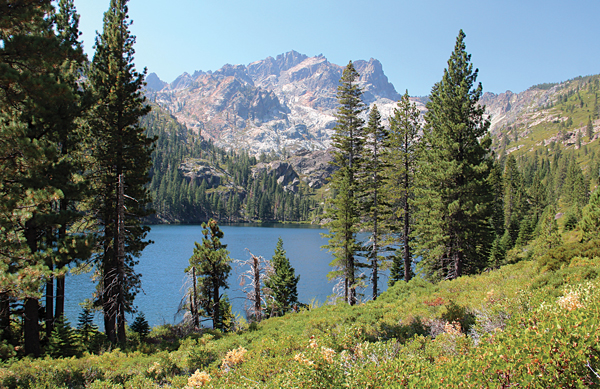
Is there a lake in the Tahoe Sierra lined with gold? Humans have been seduced by that precious metal since antiquity. This rare element has changed the course of history; instigated war, inspired colonialism and generated countless world-changing events.
The 19th Century California Gold Rush itself instigated humanity’s largest voluntary migration ever. Beginning in 1849, tens of thousands of adventurous gold seekers traveled to the former backwater province of Mexico to claim their overnight fortunes. No matter how bad the news about danger and hardships in the foothill mining camps, gold fever drew the hopeful like moths to light. Prospectors explored every ravine looking for “color.” Some got rich; most went bust.
The miners listened intently as Thomas Stoddard claimed that on reaching the water’s edge, he saw that the shoreline and lake bottom were lined with large nuggets of pure gold.
The rainy season arrived early in the fall of 1849 and it wasn’t long before high water forced miners working foothill streambeds to call it quits until the following spring. Most headed to San Francisco to wait out the winter storms. In November, just before heavy snowfall buried the Sierra in a deep mantle of white, a man named Thomas Stoddard stumbled into a tiny mining camp on Frenchmen’s Bar, located several miles from the small town of Washington near the Yuba River. Stoddard’s clothes were tattered and torn, testimony to days lost in the mountains. After he rested and wolfed down several plates of grub, Stoddard told the curious miners his amazing story.
Stoddard had been traveling with an emigrant wagon train, but he got lost one day while hunting game for the group. He spent hours searching for his friends and calling for help, all to no avail. After crossing a boulder-strewn granite ridge near Yuba Pass, Stoddard observed a small lake in the valley below. He needed water and a place to camp for the night, so he made his way closer. The miners listened intently as Stoddard claimed that on reaching the water’s edge, he saw that the shoreline and lake bottom were lined with large nuggets of pure gold. He jubilantly filled his pockets and gathered up all the gold he could carry. Unfortunately, he was attacked by Indians and forced to abandon most of his treasure as he ran for his life. The miners were rightfully skeptical of the story, but Stoddard showed them a hefty pouch of high-quality gold claiming it was evidence of his discovery.
Stoddard’s tale about his strike spread like wildfire throughout the mining district. Many of the men were dead broke and all were tired of working endless hours standing in cold streams of frigid snowmelt. Most of the miners considered the story so outlandish that many believed Stoddard a victim of gold fever. But others pointed out that Stoddard’s golden nuggets provided convincing argument. The prevailing theory at the time was that the source of California’s gold lay farther up in the mountains. Prospectors noticed that gold became coarser as they ascended streams and naturally assumed that there was some location in the High Sierra from where it all originated. Maybe Stoddard had really found the true mother lode.
Stoddard wanted to organize a company of miners and immediately return to the lake of gold, but snow was beginning to pile up in the mountains and none of the men were willing to risk a search party during a Sierra winter. Skis had yet to be introduced to the region, without which travel was impossible. For seven long months, the anxious miners waited for the Sierra snowpack to melt and open up the back country to exploration. In early June 1850, a select company of 25 men accompanied Stoddard in search of the fabled body of water. Following right behind them were hundreds more men, all determined to keep Stoddard in sight.
Stoddard led the party to the divide between the North Yuba and the Feather River’s Middle Fork. He scrambled over the rugged terrain, confident that the lake was in the upper reaches of the watershed. Right behind him streamed a riot of rowdy miners, all anxious to get their fair share. But soon Stoddard began to wander, less sure of his direction. At one point, he led them to a large lake that he claimed was the spot, but there was nothing there except disappointment.
Exhibiting their characteristic sense of humor, the miners named the pond “Gold Lake,” a designation it holds to this day. It now became evident that Stoddard was incapable of leading the mob to the elusive lake. The journey had taken its toll on the men, mules and horses following the wayward Stoddard. Many of the pack animals were weak from crossing snowfields and climbing steep trails. Others had slipped and fallen to their deaths into the precipitous canyons.
The original company of 25 selected men was now badly organized and overwhelmed by hordes of camp followers. Soon there was open rebellion. It’s easy to imagine Stoddard shaking in his boots as a miner’s court of mountain justice was convened. Tempers were running hot and a decision was reached to hang the man who had made fools of them all. The sentence was suspended for one day, however, because there were still some among them who believed that the mythical lake existed. Some considered Stoddard crazy, others concluded that he had never visited the lake and a few believed his story true but thought his sense of direction worthless. Nevertheless, Stoddard was informed that he had been given a last chance to locate the lake or be hanged from the nearest tree limb. Today the location of Stoddard’s reprieve is known as Last Chance Valley.
Crazy or not, Stoddard had enough wit to slip quietly away during the night and retrace his steps to the relative safety of the mining camps below. Meanwhile, the story of Gold Lake was still raging throughout the mining district. Thousands more closed their businesses and abandoned towns such as Nevada City and Maryville. It was a virtual human stampede into the mountains, everyone searching for the fabled basin heaped with gold.
The wild excitement gripped the miners for about two months, but after fruitless exploration in what is today Lakes Basin Recreation Area of Plumas County, the throngs of disheartened men headed back, prospecting along the way. Ironically, the so-called Gold Lake fiasco led prospectors north of the early diggings, which resulted in a series of rich first strikes at Nelson Point, Spanish Flat, Rabbit Creek and other locations in the northern Sierra.


