


The Tahoe Sierra is one of the snowiest regions in the United States, but timing is everything when it comes to ski season. Getting enough natural snowfall by Thanksgiving has always been a challenge for our regional resorts, but colder temperatures usually provide ski areas an opportunity to pump out a man-made base with energy-efficient snowmaking equipment. In the last decade or two, snowmaking capability has advanced in leaps and bounds, and Lake Tahoe resorts have invested heavily in state-of-the-art technology.
Located between sun-drenched California and bone-dry Nevada, it is simply amazing that the higher terrain west of Lake Tahoe is blessed with an average of 35 to 40 feet of snow each winter. Boasting the greatest concentration of ski resorts in North America, the Tahoe Sierra is a relatively close by car, train or plane from major urban centers. Its picturesque winter beauty has lured snow-starved flatlanders since the 1800s.
Upon completion of its train tracks over Donner Pass in 1868, Central Pacific Railroad started selling tickets for winter excursions into the snowbound Sierra. The rowdy party town of Truckee was a primary destination. Automobiles showed up around 1910, but it wasn’t until 1932 that the road over Donner Summit was plowed during winter months. Prior to that, the only alternative was to load vehicles onto Southern Pacific flatbed cars and ship them over the mountains to Reno or Sacramento.
The state began plowing Highway 40 (pre-cursor to Interstate 80) at the behest of the Auburn Ski Club in Placer County, an organization supported by influential businessmen and politicians. The cleared road translated into abundant crowds of people anxious to sled, ice skate, toboggan and cross-country ski. Ski jumps large and small always attracted an audience.
Across the United States, the 1930s was the breakout decade for modern downhill skiing. Open highways helped, but the principal catalyst for the surge in its popularity was the development of the uphill rope tow. Early versions used an automobile engine to power a revolving rope that pulled Alpine skiers up the slope quickly and effortlessly. The ride could be tricky, however, as some churlish tow operators were known to suddenly boost the speed of the rope by giving the engine a bit more gas. Before the advent of automated tows and chairlifts, powder seekers had to climb for their turns and only the most fit and dedicated pursued the sport. During this period, European ski instructors arrived and began teaching Americans a new, dynamic parallel turning style known as the Arlberg technique, first developed in Austria.
Ski equipment evolved, too. Wooden skis got shorter, lighter and easier to turn. Metal edges were screwed in and boot bindings improved. It was a huge advancement over the previous era of an arduous climb up a steep mountain slope for one long schuss back down. Now a descent was filled with turns. The thrill of Alpine skiing captured the imagination of California and the nation. Family-run downhill ski areas sprouted up along Highway 40 in the Sierra snowbelt. Lodges were built and rope tows installed. Hollywood celebrities mingled with average Joes during busy weekends and social class distinctions were routinely ignored. Despite the economic crash of the Great Depression, these were the glamour years of skiing before World War II — at least for those who could afford it.
In 1933, Governor James Rolph proclaimed the first week of January 1934 as Winter Sports Week for California. He stated, “In recent years the people of California have come to realize the value of this winter recreation to the point that winters sports are being developed in this state to a higher degree than in any other part of the world. In the promotion of this new industry for California, it is my sincere wish that all the people of the state participate in this healthful recreation.”
The announcement inspired the Auburn Ski Club, the largest ski club west of the Mississippi River with many members from Sacramento and the Bay Area, to organize a ski jumping tournament on the campus of the University of California in Berkeley. Under the joint auspices of the ASC, the San Francisco Winter Sports Club and the Winter Sports Committee of the State Chamber of Commerce, a jumping exhibition was scheduled for early 1934.
To prepare for the Berkeley competition, 43,000 cubic feet of snow were shoveled into six Southern Pacific boxcars and then hauled down from the mountains. The extraordinary event, held at the head of Hearst Avenue, attracted more than 50,000 spectators and some of the best ski jumpers in California and Nevada. High schooler Earl Edmunds represented the Truckee Ski Club, while University of Nevada, Reno freshman Wayne Paulsen, the future co-founder of Squaw Valley ski resort, competed for Auburn.
The novelty of ski jumping in the verdant Berkeley hills captured media attention, but the tournament ended in disarray when a riot broke out just as the first jumpers poised at the top of the 200-foot-long slide. An estimated 5,000 college students, many who had never seen snow, stormed past fences and police barriers. The event soon turned into a massive snowball fight with paying spectators in full retreat. Another sizeable crowd without tickets had clambered up “Tightwad Hill” to watch the entertainment.
“Tightwad Hill” earned its moniker because thrifty spectators climbed it to watch Cal football games for free. Dismayed tournament officials estimated the number of paid admissions at only 500, and organizers charged Berkeley police with incompetence and insufficient protection.
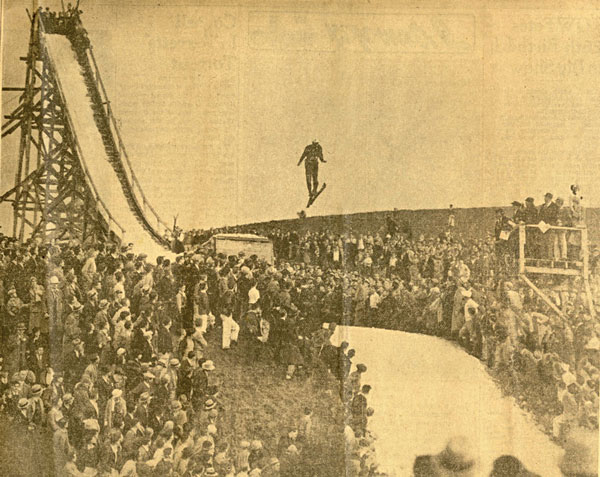
Despite the fiasco, a second Berkeley tournament was scheduled for Jan. 13, 1935. As promoters of the jump, the Auburn Ski Club again received support from the Chamber of Commerce and other like-minded organizations that hoped to make the spectacle an annual affair. This time volunteers erected a scaffold 85 feet high on the crest of a grassy hill just north of the Greek Theater. The 170-foot-long ramp was angled at a steep 45 degrees, which enabled jumpers to reach speeds in excess of 60-miles-per-hour. Snow from Donner Pass was spread over straw bedding to create an expanded landing zone that allowed for jumps of more than 150 feet.
Daring athletes from around the country launched themselves with grace and skill into the sky, high above the audience. Norwegian immigrant and former U.S. ski jumping champion Roy Mikkelsen of Auburn took first place with a soaring leap of 139 feet. The good-natured Mikkelsen laughed after sliding into the encroaching throng following his landing. “I guess we can’t stretch the jumps too long here,” he said, “You might land down in the Berkeley shopping district.”
Stay tuned for the 1939 San Francisco ski jumping extravaganza on Treasure Island in the Feb. 9 edition and at TheTahoeWeekly.com.


