


Read Part I
The 1848 discovery of gold in California sharply increased the demand for passenger transportation and freighting between the newly acquired Pacific territory and points east. During the 1850s, there was strong public and political pressure in the Golden State to improve overland travel, immigration and communication with the rest of the country. In 1853, the U.S. Congress ordered a survey to determine the best route for a transcontinental railroad into California. Five routes were considered feasible, but ironically no serious discussion was given to Donner Pass or the Henness Pass Road, both of which would later be used for rail traffic.
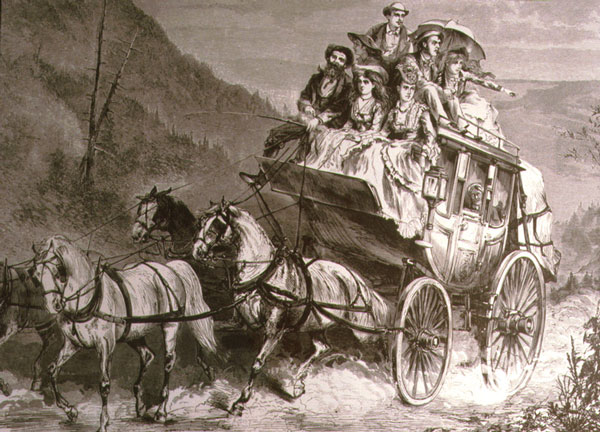
Everyone’s safety relied on the gloved hands of the grizzled “whip” holding the reins, and accidents often occurred when exuberance got the better of his judgment.
California’s citizens and businessmen were desperate for the railroad and willing to help finance at least part of it, but there was a Civil War looming over slavery and its expansion in the West. Politics were in play. In the 1850s, the future president of the rebellious Confederacy, Jefferson Davis, was Secretary of War for the United States. Sec. Davis’ report recommended a railroad route that arced down to the Mexican border and back up to San Francisco. This trajectory appealed to Southern slave states, but it was hundreds of miles longer than a line across Nevada and the Sierra. Californians were furious but realized that the political environment preceding the Civil War would make any Congressional agreement on a transcontinental route impossible.
To appease impatient voters, in 1855 California’s State Legislature authorized the construction of a primary wagon road from the Sacramento Valley over the mountains into the Carson Valley of what was then Utah Territory. In 1859, legendary skiing mailman John “Snowshoe” Thompson started the short-lived Pacific Stage Company. Next came two enterprises providing service to the newly discovered Comstock Lode in Virginia City, Nev. The California Stage Company operated over Henness Pass, north of Truckee, and the Pioneer Stage Company via Johnson’s Pass south of Lake Tahoe.
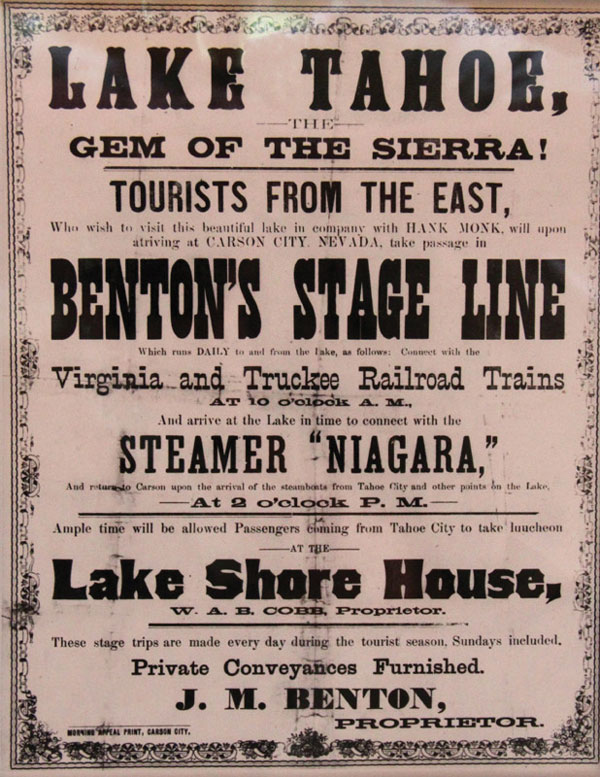
Noted stagecoach driver J.B. Crandall’s Pioneer Stage Line ran three times a week between Placerville and Carson City. In addition to passengers, the stages carried U.S. mail and express deliveries. Lucrative postal contracts made stage lines one of the first transportation industries to receive federal financial aid. The average speed for a stagecoach was between 3 and 5 mph, slower in bad weather. On a short run over a good road, a seasoned driver could attain an average 9 mph.
A journey over the Sierra involved day and night travel. Initially, the minimum required time from Virginia City to Sacramento was 24 hours, later reduced to 18. The fastest recorded time for this route occurred on June 20, 1864, when three time-pressed businessmen chartered a special coach with frequent horse replacement. Their trip took just 12 hours and 23 minutes.
One wild ride
A stagecoach ride was expensive, but safer and less tiring than walking or riding a horse or mule. Stages were well-built to handle the rough terrain, but sometimes the carriage bounced around so wildly that the passengers ended up in a pile on the floor. Everyone’s safety relied on the gloved hands of the grizzled “whip” holding the reins, and accidents often occurred when exuberance got the better of his judgment. On July 22, 1863, the Henness Pass stage rolled down a steep hill into the Truckee River with 15 passengers on board, nine inside and six outside. A few managed to jump to safety, but the majority were injured and one man killed. Newspapers did not blame the driver for the tragedy.
One month later, a vehicle traveling the Johnson Pass route toppled over an embankment but was miraculously caught in the spreading arms of a large pine tree below. While the bruised passengers stared into the deep canyon looming below, they could barely believe their good fortune to have survived. Again, no criticism against the driver was apparently ever raised. In May 1864, a large grizzly bear charged across the road in front of a team of horses pulling a stagecoach. The terrified steeds reared up, breaking the harnesses and scattering the startled passengers in every direction.
At the mercy of highwaymen
Stage robbery was also a constant danger in the days before law and order arrived in the West. Bandits employed various strategies to acquire the element of surprise to ambush a coach. Road agents usually hid behind trees or boulders while they waited in the shadows. As the stage approached, highwaymen concealed their identity using empty flour sacks with holes cut for eyes. When the time was right, they jumped out with guns drawn. If the driver failed to stop at their command, a bullet to the lead horse ended the argument. Passengers meekly faced a line of shotguns while the thieves searched their persons for money, watches and jewelry.
“Gentlemen Jack” Davis was the slickest of all the local highway robbers. (Davis was also the ringleader of the West’s first train robbery near Verdi, Nev., in 1870.) During one stage hold up, Davis spread buffalo robes on the ground and served champagne and hors d’oeuvres to passengers while his men blew up the Wells Fargo moneybox. One saloon owner saved his valuables by passing his whiskey bottle around among the desperadoes.
Not all road agents were so convivial. In 1872 the stage running between Carson City and Steamboat, Nev., was stopped by three masked men who ordered the driver to throw out the Wells Fargo security chest. The Virginia City Territorial Enterprise published the particulars: “The men were armed with revolvers and made no attempt to molest the passengers, but when one or two of them leaned out the window to watch the proceedings they were ordered to take them in or they would have them blown off.” Stagecoach robbers were rarely unnecessarily cruel and passengers were often safe if they quietly cooperated.
In the so-called “Era of Good Stealing” during the Gilded Age, Wells Fargo’s corporate moneybox was considered fair game by anyone with guts and a gun. After dark on June 30, 1864, two coaches were held up simultaneously at Bullion Bend, just east of Placerville. Confederate guerrillas raising money to help support the Army of the South executed this rare double robbery. The rebel bandits made off with a substantial haul of money, jewelry and the contents of the treasure chest for their impassioned cause. But by then men with a badge were taming the West. James B. Hume, Wells & Fargo’s first chief of detectives and one of its greatest lawmen, tracked the Southern rebels all over California before arresting the elusive gang in San Jose.


