


If you look closely enough, the trees within Tahoe’s forests tell a story — about their past, their present and their future. Their rings tell how old they are, its scars and budding leaves proving how they’ve overcome adversity. Trees are valuable in providing oxygen, shade and a safe refuge for local wildlife, and are instrumental in making the Tahoe Sierra what it is.
“You can read the landscape history in trees and I started thinking about that and all the different perspectives between trees and people. Those two things came together literally in the project.
–Todd Gilens
That is why, in a collaboration with the National Forest Foundation, Lake Tahoe West Restoration Partnership (Lake Tahoe West) and the U.S. Forest Service, a new interactive exhibit called “Reading Forest” by Todd Gilens was developed to share concepts with the public about the forest’s resilience and the ecological change happening in the Tahoe Sierra. Located at Taylor Creek Visitor Center in South Lake Tahoe, “Reading Forest” is a literary art piece comprised of 38 circular drawings adhered to the paved walkway leading to the visitor center. “Reading Forest” spans about 10,000 square feet, taking people on a journey along a quarter-mile section of the Lake of the Sky trail.
“Reading Forest”
Through November | Taylor Creek Visitor Center
South Lake Tahoe
The tree sections of different circular shapes and sizes are marked with phrases (in both English and Spanish) from poems, anthropology studies, science papers and other sources within the rings. San Francisco-based artist Gilens has an extensive history of doing site-specific projects related to the environment; he started working with ecologists in the Tahoe Sierra in 2014 at Sagehen Creek Field Station. It was through that relationship that Gilens became connected with Lake Tahoe West Restoration Partnership and National Forest Foundation, and how “Reading Forest” came to fruition.

“The Lake Tahoe West Restoration Partnership is a program of the USDA Forest Service that supports local projects. They have been working on restoring 59,000 acres of the West Shore’s landscape and working diligently about how to support the resilience of the forest over time,” says Gilens.
They wanted to communicate to the public in less technical terms the work that forest management entities were doing to restore the local environment and hired Gilens to create something that visitors and residents could understand and interact with.
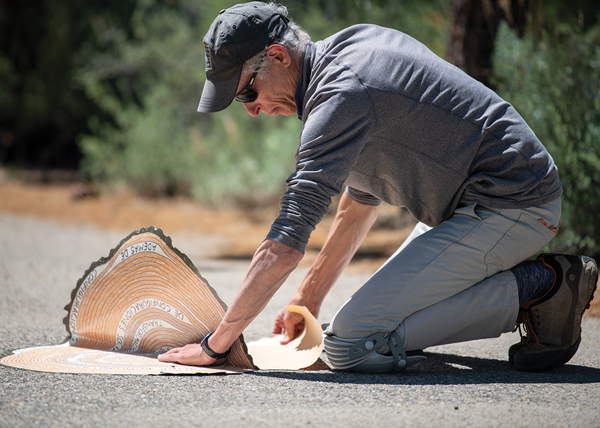
Gilens started by spending a year doing interviews with people in the Tahoe community, reading scientific papers about forest management and learning all he could about Tahoe’s culture and the people, animals and plants that live here.
“I went with Lake Tahoe West on field trips and saw demonstrations, controlled burnings, cabling techniques. I’ve been learning all this stuff about the destructive clear-cutting in the 1800s, its recreational uses and the layers of value that the forest adds to the land,” Gilens says.
He wanted to take a historical perspective by finding out how the forest ecology developed into what it is today and depict the future of what’s possible and how we get there with the land’s uses.

“Time is a central topic, so I thought about implementing the tree rings. The fancy term for it is dendrochronology, which means reading time in trees. You can read the landscape history in trees and I started thinking about that and all the different perspectives between trees and people. Those two things came together literally in the project,” Gilens says.
To create the installation, Gilens took a sheet of paper and drew circles over time, trying to build the story of a tree’s life. He made the tree sections different sizes, depicting a healthy population of young, middle-aged and old arbors. Coincidingly, he prepared 100 phrases from his various sources and worked with Tahoe West to make sure they were accurate.
It took him three weeks to create the drawings, using earth pigments in pastel sticks to create different colors.
Gilens then took a digital file of the drawings, measuring 65 feet long by 53 inches wide, and printed it on a roll of special floor graphics paper. It took a couple of hours to print and a couple of days to cut. Then, he came up to Lake Tahoe in May and spent two days installing “Reading Forest.”
“The collaboration with Lake Tahoe West was very important to have the work evolve. This was a really important opportunity for me to learn from the community and its relationship with nature. Between the trees and the animals and the people they introduced me too, it’s the people that make the artwork richer in that way, understanding what is important,” Gilens says. | nationalforests.org, toddgilens.com


