


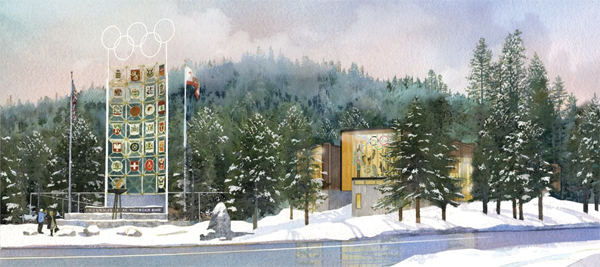
When the 1960 Winter Olympics came to a close 62 years ago, 20,000 spectators in Blyth Memorial Arena and many thousands more around the world, knew they had witnessed an event like none other in Olympic history, one still remembered by athletes and spectators as the best.
With that in mind (50 years later), Russell Poulsen, the youngest member of Olympic Valley’s pioneer Poulsen family, invited local ski-history enthusiasts to establish a foundation to build a unique, one-of-a-kind museum where the stories of those seminal Olympics and the 100+ years of Sierra ski history that preceded the event, would be preserved and displayed for locals to enjoy and the world to see.
In 2015, after eight years of analysis and input from consultants and community members, a site was chosen at the soon-to-be-renamed Squaw Valley Park at the entrance to Olympic Valley. As an Olympic and ski history museum, it would be close to the site of the games and the iconic center of winter sports in the West.
Generations of local skiers and loyal supporters have waited years for a modern, accessible facility where the evolution of Western skiing, with its rich history, adventurous entrepreneurs and athletes can be studied and shared with future generations. Their donations, along with grants from Placer County and local foundations, have made it possible for the museum foundation to hire consultants and staff, create and maintain a website to submit an application for official designation as an Olympic museum and to complete branding studies, which resulted in a new name: Sierra Nevada Olympic and Winter (SNOW) Sports Museum.
Generations of local skiers and loyal supporters have waited years for a modern, accessible facility where the evolution of Western skiing, with its rich history, adventurous entrepreneurs and athletes can be studied and shared with future generations.
As every nonprofit in the country knows, 2021 was a difficult year in which to keep the public informed on progress, raise funds and maintain enthusiasm. The year 2022 will be a pivotal year for SNOW Sports Museum. Placer County has partnered with the museum to complete the environmental impact report, which will enable the museum foundation to begin a capital campaign to build the museum.
In January, a collection program, funded by Auburn Ski Club, will begin the process of collecting, identifying and recording memorabilia and artifacts. In addition to donations from the public and private collectors, the collection will include artifacts stored at Auburn Ski Club’s Western SkiSport Museum on Donner Summit, followed by the Stan and Maryann Batiste Collection at Gatekeeper’s Museum in Tahoe City and the Olympic collection at the top of the tram at Palisades Tahoe. This program will inform exhibit designers and allow museum planners to determine where there are gaps in the collection. More information on this program and preservation workshops for volunteers are on the website.
With or without a pandemic, the.
As well, the SNOW Sports Museum will be collecting and sharing the stories of local athletes participating in the XXIV Olympic Winter Games in 2022.
The Museum recently released its 2021-22 Vision Report with more information on the Museum’s goals and exhibits available online. | thesnowmuseum.org
Documentary on 1960 Olympics
“Magic in the Mountains” a feature-length documentary that tells the remarkable story of how Squaw Valley, a little-known ski area in California (now called Palisades Tahoe), won the bid for the 1960 Winter Olympics, recently premiered to benefit the SNOW Sports Museum.
The film, which also examines how Walt Disney helped to change the ways in which the Games were presented was produced by Coolfire Productions in partnership with Palisades Tahoe and the Museum. Directed by Cody Stokes, the documentary features never-before-seen archival footage from the 1960 Olympic Games and interviews with participating athletes and attendees, according to a press release from Coolfire Productions.
Production started in February 2019 and continued to shoot interviews until the pandemic hit. Interview subjects included participating athletes, historians, former Disney executives, family members of the Squaw Valley Founders and volunteers from the games. Coolfire relied on archival footage, as well as partnering with Walt Disney Archives and the Walt Disney Family Museum archives, according to the release.
“There was a tremendous amount of footage to go through from all of the found footage, to archival footage and then the interviews we shot. It’s incredibly challenging, but creatively rewarding,” stated Stokes in the release.
For updates about the film and where it can be streamed, rented or purchased in the future, visit magicinthemountainsfilm.com.


