


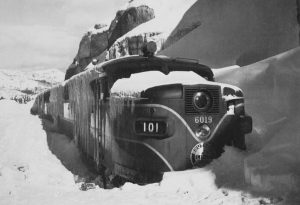
At its champagne-infused inauguration on Jan. 2, 1938, Train No. 101, the “City of San Francisco,” was deemed the “world’s most superlative train.” The sleek streamliner consisted of deluxe sleepers, coaches and dining cars loaded with amenities, with motive power supplied by six 900-horsepower engines. A technological marvel in engineering, she was proclaimed the “largest, fastest, most beautiful, powerful, and luxurious streamliner ever designed.” The “City of San Francisco” represented state-of-the-art engineering for 1938, but a series of dramatic events would prove the limitations of man and machine against nature or sabotage.
Among the superlatives unique to the “City of San Francisco” were its six giant engines, the most powerful diesel locomotive engines ever built. The motors were 20-feet long and weighed 18,000 lbs.; together they generated 5,400 horsepower as compared to 2,400 in Southern Pacific Railroad’s smaller passenger trains. The power units that propelled this behemoth made up the longest locomotive in the world at 210 feet. The new streamliner pulled 17 coaches instead of the normal 11, and was still capable of speeds in excess of 100 mph. The elegant streamliner took transcontinental travel to a whole new level in speed and comfort, making five round trips each month between Oakland and Chicago, hurtling the distance between the Windy City and Golden Gate in only 39½ hours. In its first run, the hi-tech train cut 19 hours from the fastest previous time on the route.
Like the pioneers and emigrant wagon trains before it, the transcontinental railroad followed the Humboldt River as it meanders west across Northern Nevada. But, instead of a wooden farm wagon hitched behind plodding oxen, the “City of San Francisco” raced over the high desert at speeds averaging between 75 and 110 mph. On Saturday evening, Aug. 12, 1939, the setting sun glinted off the streamliner’s silver metallic skin as it streaked across the Nevada desert. Residents in Northern Nevada were in the middle of a sweltering heat wave, but passengers aboard the air-conditioned train took no notice as they enjoyed dinner, cocktails or cards. Chief Engineer Ed Hecox, one of SP’s top locomotive engineers, confidently manned the throttle of this ultra-modern behemoth, a virtual luxury hotel on rails.
Engineer Hecox was at the throttle when his train derailed at 70 mph just east of Harney, Nev., at 9:33 p.m. The forward locomotives slid off the steel rails, barreled across a bridge over the Humboldt River, and then plowed through the wooden track ties and rock ballast before coming to a stop upright. Hecox escaped unscathed because momentum had forced the forward power units over the bridge safely. He was among the lucky few to survive the accident unhurt. In the desert darkness, much of the train was a tangled mess of crushed and twisted metal. Derailed and out of control, the luxury coaches had snapped their connections with the engines and slammed into the old iron bridge. Five cars were destroyed: coffee shop/kitchen car Presidio, diner Mission Dolores, dormitory club Embarcadero, Pullman sleeper/drawing room Twin Peaks and the Pullman sleeper Chinatown. The violent destruction lasted less than a minute, but the worst train wreck in Nevada history killed 24 passengers and crewmembers, and injured 121 others. Only 31 escaped unhurt.
Southern Pacific officials blamed sabotage to the track for the tragic wreck and launched a massive manhunt, but no one has ever been charged with the crime. The railroad company was able to restore the locomotives, which were mostly undamaged, outfitted the train with new coaches and dining cars, and put the “City of San Francisco” back into service. But, bad luck continued to stalk the train.
Ten years later, in January 1949, the streamliner and its 270 passengers and crew were stranded in remote Kimball, Neb., where the train was caught in the tight grip of a blizzard, complete with 10-foot snowdrifts, gale force winds and temperatures near zero. For three and a half days passengers had to take turns sleeping on floors, tables and couches in a local hotel before a railroad snowplow finally cleared the tracks and enabled the westbound train to proceed on its journey from Chicago to California.
The entrapment by a Nebraska snowstorm wouldn’t be the “City of San Francisco’s” last battle with overwhelming winter weather. Exactly three years later, the legendary streamliner ran was rendered powerless again while trying to cross the Sierra during a vicious January storm. The winter of 1952 is known for huge snow accumulations in the mountains, but despite the violent weather Southern Pacific crews had kept the line open. Even as the storm raged, snow-streaked trains were still rumbling through the mountains, carrying passengers and freight. Miles of wooden snow shed, long granite tunnels and an armada of snow removal equipment helped make safe passage possible. The snow on Donner Summit was 17 feet deep on Sunday, Jan. 13, 1952, when the “City of San Francisco” rammed into a deep snow slide near Yuba Gap, west of Donner Pass. Three 2,250-horsepower engines powered the 15-car train, but when engineers threw the train into reverse to escape the avalanche, the steel wheels slipped on the icy tracks. Nobody panicked. After all, the $3 million train was more powerful and better equipped than any on the line. No one really expected to be there long.
Snow was falling at a rate of an inch per hour and wind gusts estimated between 80 to 90 mph drifted snow onto the tracks and over the train. Mid-day on Monday, 30 hours into their ordeal and with no rescue in sight, the supply of diesel fuel ran out. When the power quit, the passenger compartments were pitched into a cold, eerie darkness. The howling wind and furious snowfall hampered the extensive relief efforts, dubbed “Operation Rescue,” now under way. On Monday night, a dozen Sierra Club volunteers arrived in two snow-cats laden with 400 pounds of canned food. Four critically ill passengers were evacuated by a Pacific Gas & Electric Co. snowcat. By now, the wire services had the story and the snowbound streamliner was national news. When the storm finally broke on Jan. 16, relief parties rushed in for the rescue. The cold, weary passengers hobbled to safety along the tracks while the sick and weak were tobogganed or carried in stretchers. Miraculously, all the passengers and crew survived their three day ordeal snowbound in the Sierra.
Tahoe historian Mark McLaughlin is a nationally published author and professional speaker. His award-winning books are available at local stores or at thestormking.com. You may reach him at mark@thestormking.com. Check out Mark’s blog at tahoenuggets.com.


