On a below zero, December day in Montana, it is just too cold to ski, and I have been thinking about the other end of the thermometer.
(But, before I go there I have to tell you a good way to help keep you warm while you are skiing. Under the turtle neck of your T-shirt, wrap a small face towel tightly around your neck. It is an old skier’s formula to get the most out of your $20, one-week lift ticket. You will be warmer due to the friction on your neck. Try it. What have you got to lose?)
On a blazing hot day in July 1969, I was about to be introduced to the wonderful world of electronics. I had spent the day at San Onofre riding shoulder-high, perfect waves in unusually glassy conditions. In short, I had spent a perfect day enjoying perfect surfing conditions.
The cook stove had been put away and most of the people on the beach had gathered around the Hut for the Saturday night guitar, ukulele and sing-along song fest. There was a full moon shining brightly when a friend invited me to the tailgate of his station wagon to view something on his TV that no one on earth had ever seen before. It was a small TV set that ran on his 12 volt car battery.
I sat in the sanctuary of the still warm sand from that July day watching men landing on the moon. I knew from my astrophysics class in college that I was seeing the impossible happening in my lifetime. I could sit there and watch the small TV and look up at the full moon in a mental state that was nearly impossible to believe.
I learned many years later that the computer capability of that entire space craft and lunar landing module had far less capability than your cell phone has today. It is truly amazing that they could fire the rocket from earth containing the space vehicle and the landing module.
Once in lunar gravity, the vehicle would orbit the moon and at the exact moment discharge the landing module that settled gently on the moon’s surface.
The two astronauts climbed out in their low-bidder-made space suits and walked around for awhile for the ultimate photo op. Then, they climbed back into the landing module and blasted off to reattach to the rocket that would bring them back to earth. The mathematical probability of all of this working is so remote and complex that it is impossible to write the formula on a single piece of paper.
I never did invest in a 12 volt television set so that I could watch TV from remote the places where I traveled. I could never figure out how to get the signal. Now, it’s so amazing that anywhere you can get cell or Internet service, you can get just about anything.
In retrospect, I doubt that I would have watched it even when I was home. I would rather spend the time with my kids learning from them and teaching them old stuff that I knew. Important stuff, such as beach erosion and how it affects breaking waves or how it can snow frozen crystals on a bright sun-shiny day while riding the chairlift together on Baldy at Sun Valley. I was still shooting 16mm Kodachrome film with a hand-wind Bell and Howell, three-lens turret movie camera. I was recording my narration on 16mm magnetic tape with sprocket holes that matched those on the film. Then I would feed the sound track and the film through a synchronizer and match the words to the images.
My film editor would cut out all of the bad narration and get it ready for me to put it where it belonged in the film. This single process in a film’s creation took about 80 to 100 man hours. Eventually, when we sold enough tickets to see the film, I would get paid for my long addiction to film making. I know how precise narration has to be on the format in which I created my ski films.
I know I missed tucking my kids in bed at night a lot of times when I worked all night long to make sure the film was done right by my ever-increasing standards. I wished I had some of the electronic wizardry of today to make those films better, but it had not been invented yet.
Amazing what can be done these days just with an iphone. Yesterday, I did a video shoot using just a cell phone. This century is already passing me by.
An iphone with a camera that is the same thickness and dimension as half of a deck of cards has more computer capability than those astronauts had with them when they blasted off for the moon that July in 1969.
I realized the next morning that nothing had changed in my surfing and movie-making world. You still had to scramble for a good spot on a wave, I still used wax on my surfboard and I still paid all of the bills of raising three young children.
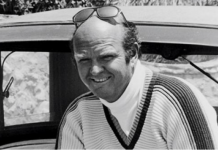
Warren Miller is history’s most prolific and enduring ski filmmaker. Visit warrenmiller.net or visit his Facebook page at facebook.com/warrenmiller.