


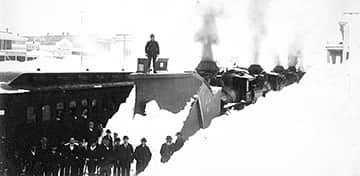
In contrast to a common spring weather adage, March came in like a lamb this year, not like a lion. And, at this time it doesn’t appear likely that our lamb-like winter is going to turn itself around and start to roar with precipitation. When it comes to Top 10 snowiest winters in the Tahoe-Sierra, winter 2014 won’t come close. One that did, however, was the winter of 1890 when a total of 65 feet of snow blasted Donner Pass and generated the worst railroad blockade in Sierra history.
In December 1889, deep snow on Nevada rangelands had cut off free-roaming livestock from natural forage in the high desert, and by January 1890 ranchers were shipping their starving cattle by rail to California. On Jan. 15, cattle cars rumbling through a snowshed west of Donner Pass derailed. The lurching train ripped out support posts and the wooden structure came crashing down. The destruction created an insurmountable barrier to Central Pacific Railroad’s crews struggling to keep the line open; the Great Snow Blockade of 1890 had begun.
The spinning blades of the newly invented rotary snowplow were useless against the formidable combination of wood, ice and train wreckage. Central Pacific hired 3,500 men from Sacramento and Reno to help dig out the buried tracks in the mountains. Fear became the constant companion of the workmen as avalanches roaring down from cloud-shrouded peaks threatened to sweep them to instant death.
Day after day, slate-gray skies laid a smothering blanket of snow on the struggling shovelers. The men worked rotating eight-hour shifts, 24 hours a day, trying vainly to keep up. The snow grew so deep that it became impossible to throw it over the canyon-like snowbanks bordering the tracks. Three tiers of wooden planks had to be built into the sides of the berms. A shoveler at the bottom would pitch snow up to a second, who would toss it higher to a third, who would finally throw it over the top.
Working in numbing cold under such physically demanding conditions, the hard-pressed workmen consumed enormous quantities of food. Central Pacific shipped the vital supplies up from Sacramento. Abandoned passenger trains imprisoned in the mountains by snowdrifts and avalanches blocked the supply trains, so stout mountain men were hired to haul the food to the workers. Wearing oversized snowshoes and carrying heavy packs, they floundered through bottomless drifts to reach the hungry shovelers; all for a fee of $1 a mile. Like the mountain men, the snow shovelers were a breed apart. Augmenting regular railroad crews, these flatlanders risked their lives and toiled heroically for $2 a day.
Winter money was hard to come by in the farmlands of the Sacramento Valley, and the wild and woolly shovelers would overrun local saloons on payday. The hotelkeeper at Towle’s Station had contracted with CP to feed 120 shovelers a day. Wildly misjudging their dining habits, he set cloth napkins on the dinner tables only to lose them all. The ill-mannered, but resourceful, workmen took his linen and wrapped it around their feet, necks and faces to protect them from the storm’s fury.
The snow continued to fall heavily on an almost daily basis. Indeed, it wasn’t until the end of January that the weather cleared over the mountains. Residents of Emerald Bay at Lake Tahoe recorded fresh snow every day from Dec. 2 to Jan. 30, with an incredible total of 40 feet at lake level. On Jan. 31, the shovelers were able to clear the final stretch of track and break the snow blockade. Shrieking train whistles were heard all over Truckee and Reno, Nev., as locomotives rolled west for the first time in two weeks. Some 1,000 stranded passengers cheered the blue skies and heroic efforts of the workmen as the trains headed into the Golden State.
The record snowfall had taken a severe toll on man, animal and machine; unfortunately the Sierra Storm King was finished. On Feb. 16, another ferocious storm whipped snow into the freshly plowed train cuts at the rate of 5 feet every two hours. Thousands of men were still working in the mountains to remove the wind-sculpted cornices over-hanging the tracks, but the new storm quickly overwhelmed them. Soon the exhausted shovelers, frustrated by drifting snow and stinging ice pellets, surrendered in defeat. Just two weeks after the lifting of the blockade all train traffic through the Sierra was halted.
This storm was the worst yet. Nine feet of new snow reportedly fell on Donner Summit in just 48 hours, while Truckee residents were stunned by another 5½ feet. As if that wasn’t bad enough, this enormous Alaska-bred cyclone stalled over the region, generating blizzard conditions for more than a week. The storm’s far-flung circulation drew in colder air that dropped snow levels below 3,000 feet across Northern California.
The gold-mining town of Nevada City was paralyzed as snow depths reached 15 feet. At Emigrant Gap, an avalanche trapped a train packed with passengers. Subsisting on crackers and coffee, the anxious victims were finally rescued after 50 hours of captivity. The famished travelers crowded into the nearby Emigrant Gap Hotel, stumbling through a 25-foot-long snow tunnel that led into the hotel’s second-story windows. Meanwhile, engineers and firemen continued their futile efforts to clear the rails, living in their engines for days on end. They wore the same clothes for up to a week, and caught occasional catnaps on beds of wooden boards. When they did return to the station house, these burly, bearded men plastered with snow and glistening with dangling icicles made quite an impression.
The heavy snow trapped telegraph operator John Grogan in his small signal shack near Cisco. Transmitting 20 hours a day, Grogan kept communications flowing while the storm raged around him. The cold and fatigue proved too much for him, however, and he died at his telegraph key during the height of the storm. When rescuers reached him, they used the cabin’s floorboards to construct a makeshift coffin. Then they forced the coffin out the window, burying Grogan deep in the frozen snowpack.
All in all, Donner Pass was blocked for more than two months that memorable, miserable winter. Meanwhile, the railroad crews and army of shovelers battled a grand total of 776 inches – nearly 65 feet – of snow in herculean efforts to keep the trains rolling through the High Sierra.
Tahoe historian Mark McLaughlin is a nationally published author and professional speaker. His award-winning books are available at local stores or at thestormking.com. You may reach him at mark@thestormking.com. Check out his blog at tahoenuggets.com.


