


By Mark McLaughlin
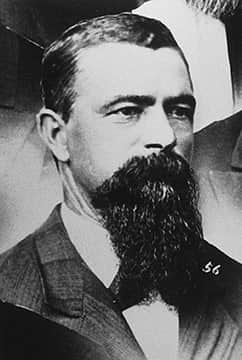
When Southern Pacific Railroad detective Leonard “Len” Harris took two bullets to the abdomen during a train holdup in Santa Cruz County, it ended the life of one of the West’s most dedicated and respected law officers. The 1894 murder of Harris marked the tragic end of one peace officer’s remarkable career. Len Harris had served as a lawman for more than 40 years, a lifetime of unflinching bravery and dedication to duty.
Born in upstate New York about 1827, Harris first arrived in California during the Gold Rush to try his luck in the mining districts. He moved to Sacramento in the mid-1850s and was hired as a constable with the sheriff’s office. In 1860, Harris took the job of warden at the Sacramento County jail, and during the ‘60s he saw duty as a deputy sheriff and then an undersheriff. He regularly escorted convicted criminals to San Quentin Prison, near San Francisco, but he didn’t like the mundane job. In the early 1870s, he returned to Sacramento to join the city police force and before long had found his true calling — detective work.
In the mid-1870s, Harris was assigned to the Sierra section of the transcontinental railroad where vagrant criminals were robbing trains, stealing supplies, and burning bridges and the wooden snow sheds on Donner Pass. Hoodlums also were assaulting and robbing rail crews after payday. Part of the violent campaign against Central Pacific was due to the railroad’s hiring of Chinese labor to construct the line after which many of the contracted Asian workers remained in the United States, often competing with American citizens for employment. Railroads also were vilified because of its stranglehold on commercial shipping and long distance transportation. Because Harris was a sworn Deputy Sheriff in addition to his position as a railroad detective, he made it his business to help enforce the law in mountain communities like Truckee, as well.
In June 1876, a Chinese woodcutter was shot and killed, while others were threatened and their homes burned by several Nevada County residents. Harris arrested two of the men without mishap in Truckee, but he had to track down the third suspect in the rugged west slope region south of Dutch Flat. Months later, Harris and his colleague Det. Burke investigated a suspicious derailment east of Truckee and arrested three Washoe County men who had placed rocks on the rails in hopes of scoring a hit on the train’s money box. One of the culprits, Indian Tom, was sentenced to 18 months room and board at San Quentin. Two years later, four hoboes were kicked off a train at Tunnel 13 near Schallenberger Ridge south of Donner Lake. The furious foursome went ballistic, breaking up a telegraph station and setting fires. Det. Harris took the case and within a week had resolutely tracked down the men for punishment and incarceration.
Det. Harris frequently worked with Truckee Constable James Reed in solving local crimes. In the spring of 1880, unknown vagrants walking the tracks between Reno and Summit Station at Norden went on a rampage stealing merchandise, tools and anything of value from Southern Pacific. The loot somehow seemed to disappear without a trace. Finally, someone tipped off Harris and Reed that they might find a stash house east of Truckee. The two lawmen crawled through a hole in a wall to surprise a dozen men lazing about amidst a room full of stolen property, mostly railroad ties. The band of thieves was taken to the Nevada County jail to spend the next month.
Over the years, Harris earned a stellar reputation as a smart but tough detective, willing to take on the most violent criminals. In September 1881, he single-handedly took on the notorious Sontag and Evans gang in Stanislaus County. Outgunned, Harris stood his ground until a shotgun blast by one of the robbers caught him in the neck. The detective dropped in his tracks, but his pluck spooked the gang and saved the day. The throat wound was serious, however, and Harris lingered for many months between life and death. At the time, doctors thought that Harris would be permanently disabled, but he fought his way back to health. Although his right arm remained partially paralyzed, he eventually recovered enough mobility to return to his duties with the railroad.
Len Harris’ final act of bravery occurred on May 15, 1894, when he helped foil a plot to rob the Wells Fargo express office on the South Pacific Coast Railway in Santa Cruz County. Anthony Azoff, an unemployed sign painter, had decided to hold up the Boulder Creek train depot by enlisting an old buddy, onetime Southern Pacific trainman George Sprague. After Azoff divulged his plan and arranged a rendezvous near Boulder Creek on the evening of May 14, Sprague secretly contacted S.P. and reported Azoff’s scheme. The railroad immediately dispatched their two best detectives, Harris and William Kelly, to the office of Santa Cruz County Sheriff Jesse Cope.
Harris explained to Sheriff Cope that an informant had alerted the Railroad Company about a possible robbery attempt planned for the following evening at the Boulder Creek station. The law officers quickly developed their own plan for a stakeout to thwart the bandits. On the same afternoon that Azoff and Sprague were making their way toward Boulder Creek, Harris, Kelly and local Constable Isaiah Hartman were hiding inside an empty box-car that had been placed on the tracks in front of the depot. Thanks to the information provided by Sprague, the lawmen had the element of surprise and advantage in firepower. Now all they had to do was wait. Stay tuned for part two.
Tahoe historian Mark McLaughlin is a nationally published author and professional speaker. His award-winning books are available at local bookstores or at www.thestormking.com. You may reach Mark at mark@thestormking.com. Check out his blog at www.tahoenuggets.com.


