


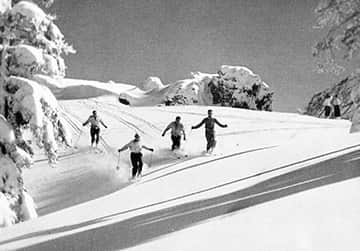
Seventy-five years ago in December, the Sugar Bowl ski resort opened for business. Northern California’s first true alpine ski area, Sugar Bowl was much larger than any other nearby operations and its chairlift, the first in the Sierra, enabled a skier to sit down for an enjoyable ride up the mountain. The chairlift accessed towering Mount Disney and Mount Lincoln with challenging slopes and big vertical drops. With exceptional terrain and an annual snowfall of 500 inches, “The Sugar Bowl” was an immediate hit with serious alpine skiers as well as Hollywood glitterati.
Editor’s Note: Read Part I.
A December 1939 press release for its grand opening boasted: “With a ski school under the supervision of [Austrian] Hannes Schroll and featuring the Arlberg Technique [parallel skiing], and with an open-air ice rink in front of the Lodge among its other new facilities, the Sugar Bowl takes its place this winter among this country’s and Europe’s most complete and modern winter resorts.”
The Sugar Bowl Lodge and chairlift were about 1.5 miles away from Southern Pacific Railroad’s special loading platform for passengers at Norden, so transporting guests to the resort was a problem. Two new Ford station wagons equipped with half tracks on the rear axle and skis on the front were employed to haul guests. These proved impractical in deep, fresh snow, so horse drawn sleighs were utilized for a while until the resort bought Army surplus tractors known as Weasels.
In 1953, Schroll and his brother-in-law, Jerome Hill, installed a new gondola called the Magic Carpet, which whisked skiers to the lodge in quick, efficient style. This aerial tramway was the first of its type in use on the West Coast. Hill, who had inherited the fortune of his father James Hill, founder of Great Northern Railroad, financed the deal himself. The cars were detachable and carried six passengers.
Winter access to Sugar Bowl had always been limited to in-house transportation, and the lack of cars, noise and congestion preserved its old world charm. As long as most of their clientele arrived by train the system worked well, but after World War II, America’s love affair with the automobile took off. Undeterred, Sugar Bowl refused to build a road into the resort and instead became the first resort in the U.S. to ban automobiles. To accommodate their motoring guests, in 1963 a three-story private garage was built along Highway 40.
Silver Belt debuts in 1940
Ski Director Hannes Schroll was smart about generating publicity and in April 1940 Sugar Bowl hosted its first annual Silver Belt race, a giant slalom run that began near the top of Mount Lincoln at 8,383 feet and then plummeted 1,300-vertical-feet down the steepest terrain at Sugar Bowl, through gullies, cliffs and bumps.
Each year, many of the champions and top-ranked skiers of the day competed, hoping to take home the 3-foot-long, silver-studded belt with a silver buckle. The inaugural Silver Belt race was won by Friedl Pfeifer and Gretchen Frazer, two of America’s best skiers at the time. Frazer went on to make two U.S. Olympic ski teams and became the first American to win an Olympic alpine medal when she earned a silver in 1948 at St. Moritz, Switzerland. Pfeifer, who started his own ski school in Sun Valley, Idaho, and won the U.S. national title in the slalom in 1940, later fought with distinction and was seriously wounded with the 10th Mountain Division ski troops. Both Friedl Pfeifer and Gretchen Frazer are honored members of the U.S. Ski Hall of Fame.
Over the years, the winners of the original Silver Belt race series (1940 to 1975) read like a who’s who of champions, including Ski Hall of Fame members Alf Engen, Buddy Werner and Jean Saubert. The winner’s list also includes notable Tahoe skiers like Dodie Post who won in 1949, Babette Haueisen (1955), Starr Walton ((1957 and 1960), and Eric Poulsen (1969 and 1970).
Nunn breaks boundaries
Jerry Nunn, a remarkable woman and strong skier who became one of the country’s first female ski patrol members and first woman expert in avalanche control, learned to ski at nearby Soda Springs. As a high school junior in 1939, she had joined her Sacramento school’s ski club with other friends, and on weekends they would all take Snowball Express train excursions up to Donner Pass.
From the start, Nunn was always concerned when she found a skier down and injured. She would stay with the victim and send others for help. By March 1940, Nunn was asked to join the all-male squad. Jerry Nunn accepted, and at the age of 18, most likely became the youngest ski patroller (regardless of gender) in California.
Jerry Nunn went on break other barriers. She was already the only woman on the Soda Springs Ski Patrol, but when Sugar Bowl opened in December 1939, Jerry signed up to patrol there to improve her skiing. She also was the first female patroller at Squaw Valley, and one of only three women that made the Olympic Ski Patrol for the 1960 Winter Games.
Mecca for powder hounds
Today, Sugar Bowl has been expanded and improved in virtually every way. The vast, spectacular terrain provides skiers and snowboarders with an endless variety of challenges: “From heart-pumping chutes, endless bumps and jumps, to corduroy cruisers, gentle rollers, and terrain parks.” With some of Tahoe’s finest off-piste skiing, the resort is a Mecca for powder hounds.
In 2004, Sugar Bowl decided to revive the historic Silver Belt race, but with a modern twist. Organized by local champion Daron Rahlves, the new Silver Belt Banzai race has no slalom gates, but is a ski cross where skiers and snowboarders go head to head, trying to out maneuver and out run the other. Racers compete in men’s and women’s divisions for $10,000. The contest has few rules, but skiers/riders must stay on course and finish in the top three to advance. Ski cross competition is an up-and-coming sport that made its debut in the 2010 Vancouver Winter Olympics.
Sugar Bowl is the jewel of Donner Summit, and the most historic of all northern California ski areas. Since 1939, this classic, European-styled resort has catered to skiers who like their powder deep, their friends close and their mountain experience extraordinary. Happy birthday.


