


By Mark McLaughlin
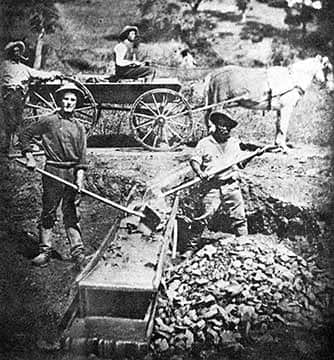
In one of the largest voluntary migrations in human history, the California Gold Rush attracted adventurous men and women from around the world.
Crazed by the lure of instant wealth, they jammed aboard cramped sailing ships or endured fatiguing overland treks in order to dig placer gold in the Sierra foothills. These daring gold seekers came by the thousands despite the daunting and life-threatening difficulties of the journey. Some died before reaching the gold diggings, and many more perished after they arrived. Conditions were so harsh and unwholesome in the primitive mining camps that during the second half of 1849, one-fifth of the 90,000 immigrants perished.
The physical challenges of reaching and surviving the Sierra gold fields were difficult enough, to say nothing of the financial hardships, but for some of these optimistic opportunists, racial prejudice would prove the greatest obstacle to their success. African-Americans, Mexicans and Chinese all suffered from racist mining laws and physical abuse. Caucasian miners were newcomers to California also, but that only increased their paranoia.
During the summer of 1848, reports were slowly trickling in that there was “gold excitement” in California, but Eastern newspapers downplayed the early news of a major gold strike. The region had only recently become American territory due to the United States’ 1848 victory in the Mexican-American War, and most American’s were still skeptical about the sparsely settled wild country. But as more evidence poured in from California, most newspapers quickly jumped on the bandwagon. Articles and editorials incited tens of thousands to uproot and head west to stake their own claim to riches.
Behind the golden veneer of California Mania there were darker and more sinister politics at play. The vast real estate ceded to the U.S. after the conflict with Mexico had opened a Pandora’s Box of fear and hostility in certain regions of the nation because it resurrected the heated controversy of institutional slavery in new territories.
The Republic of Mexico had outlawed slavery in 1829 and the province of California had no history of it. But in a nation increasingly characterized by sectional animosity over the issue, the proposed admittance of California as a free state was problematic due to the Missouri Compromise of 1820, which legalized slavery south of the specific latitude 36 degrees 30 minutes. (Lake Tahoe is at 39 degrees latitude.) The federal government’s attempt at balancing the apportionment of new territories as free or slave pleased no one and eventually led to America’s Civil War.
The first African-Americans to reach the California diggings were free African-American crewmen aboard U.S. merchant ships, especially from New England whalers. But when Texan Thomas Green arrived in 1850 with 15 slaves to work his claims, white miners ran them out of the mining district. In general, Sierra miners were against slavery and refused to work side-by-side with them. Green was forced out, but within the year became a California state senator and author of a new tax on foreign miners.
As experienced Mexican and Latin American miners arrived by the thousands, incidents of slave expulsion declined. But the race issue refused to die. At the 1849 constitutional convention in Monterey, delegates spent more time debating the rights of African-Americans than any other topic. By 1850, there were an estimated 960 African-Americans in the Golden State, living primarily in Sacramento, San Francisco, Los Angeles and Marysville.
Although California joined the Union as a free state on Sept. 9, 1850, some slaveholders did not voluntarily free their slaves. In 1852, the state legislature passed a harsh Fugitive Slave Law ensuring possession of “slaves to owners returning to the southern states.” California also limited voting to adult, white male citizens and denied African-Americans the right to have their children attend public schools with whites, and lax law enforcement made it possible for slavery to exist in many parts of the state virtually until the end of the 1850s. The state also passed the much-hated testimony law where African-Americans (or any other minority) could not testify or bear witness in a court of law against a white person. Petitions to the state Legislature by free African-Americans and their white allies finally succeeded in convincing lawmakers to repeal the racist testimony law in 1863.
Many of the African-American miners were abolitionists from the North and knew and collaborated with white abolitionists whom they had met in the freedom movement. This was especially true in the Sacramento River region, a hotbed of abolitionism in the 19th Century. A few African-Americans had struck it rich in the mines, while many others established successful businesses such as hotels, laundries and restaurants.
The free African-American community in Sacramento was strong, organized and relatively wealthy, which led them to finance and support the abolitionist movement and the Underground Railroad in California and throughout the country. The lack of equal civil rights, and often human rights, during the 1850s brought African-Americans together in four Colored Conventions. The sense of community and racial pride instilled by these conventions helped generate California’s first African-American churches, library and the Mirror of the Times, a weekly newspaper for African-Americans.
In the aftermath of the bloody Civil War, three federal civil rights amendments abolished slavery, extended citizenship to African-Americans, and in 1870, outlawed racial restrictions on voting. When the nation’s state legislatures were asked to ratify the voting rights amendment, California’s Assembly and Senate overwhelmingly rejected the proposal. The 15th Amendment was a direct challenge to California’s whites-only voting restriction in the state’s constitution.
In March 1870, President Ulysses Grant proclaimed that the required number (three-fourths) of state legislatures had ratified the voting rights amendment, but despite the president’s announcement, California Attorney General Joseph Hamilton ordered county clerks to refuse African-American voter registration until Congress enacted the enforcement legislation to back it up.
At first, William Brown, a white Sacramento County Clerk, followed the obstructionist orders from his Democratic Party leadership and turned away all African-Americans trying to register to vote. As clerk of the state Capital, Brown’s actions carried great weight. But the political furor to withhold the right to vote eroded, and Brown soon reversed his position.
On April 9, 1870, Brown registered Henry Vantes and Robert Christopher, the first African-American residents on Sacramento’s voter list. William Brown’s decision to support African-American suffrage risked his political career, but his principled stand represents a heroic act for justice and equality.
Tahoe historian Mark McLaughlin is a nationally published author and professional speaker. His award-winning books are available at local stores or at thestormking.com. You may reach him at mark@thestormking.com. Visit his blog at tahoenuggets.com.


