


By Mark McLaughlin ·
Larry McCaffrey ·
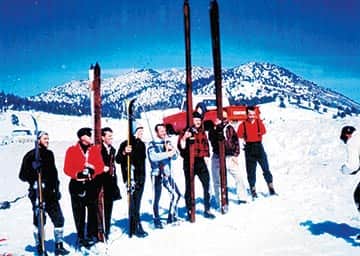
In the spring of 1964, an unusual ski race was held at the snow-covered meadows off the Mount Rose Highway. Some contestants were riding old-fashioned, long wooden skis and holding a single braking pole, while others sported modern alpine equipment. The competition was to determine if the venerable longboard skis of yesteryear were still the fastest way down the mountain, despite decades’ of advancements in composite technology and ski manufacture.
The alpine skiers in this good-natured contest were among the best in the world. Olympian Billy Kidd was there after his recent triumphant return from the 1964 Winter Games at Innsbruck, Austria, where he garnered a silver medal in the men’s slalom. It was the first Olympic medal ever won by an American in alpine skiing. Tahoe City’s Jimmie Huega took home the bronze in the slalom at the 1964 Games to become the second American.
When Kidd showed up at Mount Rose he was packing those same downhill skis that he medaled with at Innsbruck. Lake Tahoe native Dick Dorworth also showed up to represent alpine skiing. In 1963, Dorworth had set a new world speed skiing record of 106.8 mph in Portillo, Chile, thereby becoming the first American to establish a name for himself in this extreme sport. Dick’s good friend Steve McKinney (another Tahoe local) would later set world records of his own, eventually topping out at nearly 125 mph.
Their longboard competitors were two older men from Plumas County, the epicenter for America’s first organized ski racing clubs. Representing the longboarders were Bill Burrell, with towering skis about 11 feet long, and Johnny Redstreake. Redstreake was an undefeated snowshoe champion who hauled in his own hefty, secretly waxed speed burners.
Reno-based Sierra ski journalist William Berry also was there to witness this classic competition. The event was organized by Reno sports writer and avid skier Don S. (Snowshu) Thompson, who, at age 84, still takes Tahoe ski history to heart. Don admires the legendary skiing mailman John “Snowshoe” Thompson, but is no relation.
The Mount Rose race rules were modified to eliminate poling out of the starting gate so skiers just dropped into an immediate tuck and prayed for smooth sailing down the quarter-mile track on spring, corn snow. After a few practice runs, it was time for Kidd and Dorworth to take on Redstreake and Burrell in head-to-head contests.
Kidd took the lead out of the gate, but Don Thompson told me that about halfway down the track Redstreake sailed right past Kidd to take the race.
In 2007, Thompson visited Billy Kidd where he was Director of Skiing at the Steamboat ski area in Colorado. The two of them got to talking about those Mount Rose races and Kidd laughed: “…a win at the Olympics on new skis and a loss to 50-year-old ones in the same year.”
In a 2006 e-mail, however, Dick Dorworth, remembered the contests somewhat differently, writing: “Bill Kidd and I ran head to head on a straight track up to about 60 mph with guys from the Alturas Snowshoe Club. They were impressive. We could beat them, but not by much, with our 1964 state of the art downhill gear.”
After half a century, history can start to get fuzzy even for those who participated, but it’s safe to say that the results at Mount Rose proved once again that over distance, properly waxed longboard skis ride faster than shorter, modern skis.
Father of Skisport
Nearly a century before the Mount Rose races, the real Snowshoe Thompson had learned the same lesson. As a skier, John “Snowshoe” Thompson established a remarkable legend that still impresses long after his death in 1876. He not only delivered mail, medicine and supplies throughout the Sierra on his skis, historians credit Thompson as the Pioneer of American Skiing and the Father of Skisport.
In the 1850s, mail sent by ship from the East Coast took months to arrive and the overland routes were shut down by deep snow in the Sierra. Communities in western Nevada were cut off in winter. To remedy this problem, Thompson stepped into the breach and promised to carry the mail back and forth between Carson City, Nev., and Placerville, Calif. It was a bold decision, but Thompson was up to the task.
Tall and strong, he made himself a pair of skis and took on the dangerous prospect of crossing the High Sierra alone in winter. During the mid 1850s, Thompson skied twice a month carrying a heavy mailbag over the mountains, a distance of 90 rugged miles fraught with the perils of blizzards and avalanches. His efforts earned him the moniker “Snowshoe.”
In the late 1860s, Thompson read newspaper articles about outrageous speed skiing (90 mph) happening in Plumas and Sierra counties. In 1869, he decided to find out for himself what the so-called longboard racers were all about. The historic skiing contest between Snowshoe Thompson and the skiers from Plumas County provides rare insight into Thompson’s personality and confidence.
The race was held on Feb. 22, 1869, at the La Porte racecourse about 50 miles north of Truckee. Right from the start, trouble lurked for the intrepid mailman. Thompson had short skis – 7.5 feet long – while local racers rode polished boards up to 13 feet long. The boys from Plumas stabbed the snow with their single poles to quickly propel themselves forward from the starting line and then immediately dropped into an aerodynamic tuck for maximum speed down the course, Thompson stood up and held his pole horizontally for balance.
Unaware of the secrets of doping (waxing) skis for a fast glide, Thompson never had a chance. He was soundly beaten and eliminated from competition on the first day. Thompson did not take his loss lightly. Thompson returned home and told the Alpine Chronicle newspaper: “I went to La Porte expecting to see some scientific snow-shoe [ski] racing, but I was disappointed. It was nothing but ‘dope racing,’ and is unworthy of the name snow-shoeing. It is nothing more than coasting down hill on a sled.”
Thompson challenged the longboarders to a variety of contests including head-to-head downhill racing and cliff jumping. The winning side would get $1,000, but there is no evidence that anyone ever signed up. The boys from Plumas knew better than to try and take on the Iron Man from Alpine County at his own game.
Tahoe historian Mark McLaughlin is a nationally published author and professional speaker. His award-winning books are available at local stores or at thestormking.com. You may reach him at mark@thestormking.com. Check out his blog at tahoenuggets.com, or read more Sierra Stories at TheTahoeWeekly.com.


