


By Mark McLaughlin ·
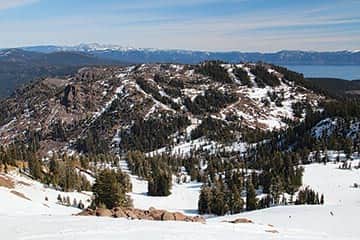
Don’t look now, but the 9 inches of snow that reportedly fell at the base of Squaw Valley on April 25 was the third biggest 24-hour storm total in all of 2015. At the upper mountain, near 8,000 feet, the 12 inches deposited by the quickly moving cold front tied for fifth place all season.
These numbers clearly illustrate how deplorable last winter was snow-wise in the Tahoe Sierra. Thank goodness for resort investment in expanded snowmaking systems and state-of the-art grooming machines that made many ski days quite enjoyable. If this had happened a decade or two earlier, we would have been toast. And, ski areas that did not have snowmaking or enough of it in 2015 didn’t have a chance.
The April 2015 snow survey was the lowest in a century and the worst of record. Out of five monthly measurements of the water content (January to May), the early April survey is critical for forecasting runoff because statistically it represents the maximum water content in the Sierra snowpack. These data are crucial for water management in California and western Nevada.
At the majority of survey sites located in the Truckee and Lake Tahoe basins, new record low snow water measurements were set. Four of the snow course locations in our immediate area date back to 1910 and are the oldest in the United States thanks to Dr. James Church, a University of Nevada, Reno professor who established them in his early efforts to predict runoff in the Truckee River.
Two of the upper elevation courses, Ward Creek No. 2 and Donner Summit set new minimum records for water content. This year, the Ward Creek site was snow free on April 1 for the first time since the course was established in 1913. Out of nine courses in the Tahoe Basin, Mount Rose was the only one with snow in the April snow survey.
There are four century-old snow courses in the area, and only Mount Rose (1910) had measureable water content, coming in at third all time after 1926 and 1931. Mount Rose’s high elevation above 9,000 feet made a big difference this year when mostly rain fell below 7,500 feet.
This winter’s generally higher snow level is reflected in measurements across Nevada and the eastern Sierra where a total of 86 out of 126 snow survey sites indicated no snow on the ground on April 1. Of these, 23 sites were snow free for the first time based on course data ranging between 25 to 102 years old. It wasn’t just us. This spring, record low snow conditions prevailed from Arizona to Alaska.
On April 20, Randall Osterhuber, manager at the Central Sierra Snow Laboratory near Donner Pass, informed me that as of that date he had measured a seasonal snowfall total of 114 inches. That does not include the April 25 storm, but even if we generously add another foot of snow to the first total for that, 126 inches is still 27 inches less than 1881, whose paltry 153 inches has ranked No. 1 as the least snowy winter since measurements began in 1879.
Of course, we won’t know the final outcome until Sept. 30 at which point the 2015 water year ends in the Sierra (Oct. 1 to Sept. 30), but statistically it is unlikely that the lab will pick up another 28 inches of snow between now and then. We’re making history here folks; just not the good kind.
The length of the current drought at four years is well within the natural variability expected in our erratic Western climate, but this year’s lack of snowfall is extreme and unprecedented. Unfortunately, there has been a trend for significantly drier than normal Januaries in the past decade. Normally the wettest month of the year, in January 2015 virtually no precipitation fell. Even during January 2011, a Top 10 snowfall winter, the month was below normal in precipitation.
Exceptionally warm temperatures were also prevalent during winter 2015. The mild conditions mitigated the effectiveness of snowmaking at resorts and accelerated melting of the little natural snowfall that we had. At South Lake Tahoe, January’s temperature averaged nearly 9 degrees above normal. At the Central Sierra Snow Lab at 6,900 feet near Donner Pass, the station measured a measly 1.4 inches of snow that month, compared to the January average of 81 inches.
In San Francisco, the month of January in 2015, 2014 and 2013 all rank in the top five driest since records began in 1850. Since 2005, January precipitation is off about 30 percent, a significant deviation from the average. It’s difficult to reach seasonal norms with snowfall and precipitation when January is dry as a bone. This trend is both unusual and worrisome if it continues.
Skiers and boarders get fired up about the quality and depth of the snow. Hydrologists and anyone who relies on Sierra snowmelt are more concerned with how much water is in the pack. Many people are familiar with the media coverage of monthly snow surveys carried out by California’s Natural Resources Agency and Nevada’s Natural Resources Conservation Service, where teams of snow surveyors manually poke a hollow aluminum pipe into the snowpack to measure its all-important water content.
The Sierra Nevada snowpack is California’s most valuable natural resource, and not because of the popularity of winter sports. When all that frozen precipitation melts it supplies more than half of the Golden State’s total water supply. The Sierra range occupies only 12 percent of the state’s land area, but nearly 70 percent of the state’s population relies on its runoff. The Sierra snowpack is a key asset that sustains one of the largest economies in the world by providing high-quality water to millions of people, as well as to industry, recreation, fisheries and farmers.
Yes, hydrologists still use the old fashioned, monthly snow surveys to measure water content, but this critical science has advanced remarkably since Dr. Church’s first primitive probes more than a century ago. It’s worth visiting the history of its evolution and future. Stay tuned for Part II to see where it’s headed in the 21st Century.
Tahoe historian Mark McLaughlin is a nationally published author and professional speaker. His award-winning books are available at local stores or at thestormking.com. You may reach him at mark@thestormking.com. Check out his blog at tahoenuggets.com, or read more Sierra Stories at TheTahoeWeekly.com.


