


During the late 1860s, the town of Truckee went through an economic boom as a logging and railroad center. The financial gains from lumber production and railroad operations provided jobs and boosted the local economy, but along with the transient workers came increased lawlessness and street violence. Truckee’s saloons, dance halls, poker parlors and active red light district behind Commercial Row on Jiboom Street lured unsavory characters of all stripes.
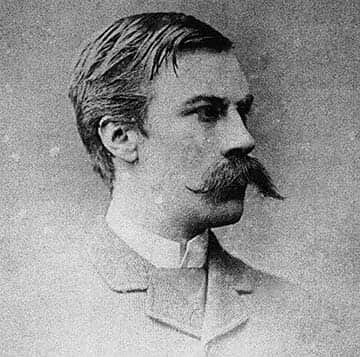
Armed criminals and thieving scoundrels prowled Truckee’s streets and outskirts. Truckee Constable Jacob “Jake” Teeter had his hands full trying to enforce the law. Officer Teeter preferred a wooden pick ax handle instead of a gun, saying that it was “quicker to use and less likely to misfire.” He wasn’t afraid to confront the bad actors that drifted in and out of town, but was generally considered fair and even-handed in his adjudication of justice.
Jake Teeter’s often-courageous confrontations with criminals are the stuff of legend. In September 1877, he surprised three men while they were dividing up stolen loot from a town merchant. One of the gang pulled a pistol on the officer, but Teeter quickly hit him in the head with his 3-foot long club. Dazed and bleeding, the crook managed to get to his feet, still holding his gun. Teeter’s next blow, however, was more persuasive and the man fell to the ground unresponsive, losing the revolver in the process. Teeter calmly picked up the gun, stuck it in his waistband, and ordered the other two accomplices to surrender. The incident was witnessed by a crowd of locals who cheered Teeter on as he marched his prisoners to the Truckee jail.
Despite Officer Teeter’s popularity, there was an element of the community that found him troublesome. Truckee’s local vigilante movement, known as the 601, preferred to deal with miscreants in their own fashion. That usually meant escorting undesirables out to the so-called Hooligan Rocks where they would painfully tar and feather the criminals and then force them out of town with the threat of a hanging if they returned. The 601 membership was secret, but it included many of Truckee’s upstanding citizens and leading businessmen who wore masks to hide their identity during these extralegal activities. There were times when the 601 vigilantes broke into the jail to fulfill their version of justice, but not when Teeter was on duty. His strong adherence to lawful justice would ultimately lead to one of Truckee’s most sensational gunfights.
Constables were elected by the people and over the years Teeter and another town gunman named James Reed often competed against each other for the office. By all accounts, the men had a seemingly professional relationship, but underneath tension simmered between them.
It was widely believed that Reed was an active member of the infamous 601s and the racist Caucasian League. Backed by many of Truckee’s citizens, the 601 had been against Central Pacific Railroad employing thousands of low wage Chinese construction laborers who later settled in the community. The 601 members had no tolerance of the Chinese culture and believed that the main problem was bad immigration law. Enforcement usually meant threatening Chinese residents and transient railroad workers with violence if they didn’t leave town. The same treatment went for any other characters deemed undesirable by the 601, but over time vigilante actions became highly focused on ethnic Chinese.
Jake Teeter was strongly against the illegal acts of the 601 and actively protected jailed prisoners and others at risk from vigilantes. On June 21, 1876, alleged members of the 601 set fire to a wooden bunkhouse while Chinese laborers were asleep inside. The woodcutters had been hired by Truckee pioneer Joseph Gray. As the terrified workmen fled the smoke and flames, the 601 were waiting for them with a barrage of gunfire and most were wounded by the hail of bullets. One worker, Ah Ling, was killed by a shotgun owned by Deputy James Reed. Teeter arrested Reed and six others in the so-called Trout Creek Outrage, but they were all acquitted for lack of evidence. The encounter put Reed and the 601 on notice that Teeter wouldn’t back down.
It is believed that their political feud grew more personal during the 1890 campaign for Constable, which Teeter won by a narrow margin. The animosity led the two men to stop speaking to one another, no small feat for two well-known lawmen in a little railroad town like Truckee. One year after the election, Reed and Teeter suddenly ran into each other in Hurd’s Saloon, located in the Capitol Building in the middle of Truckee’s Commercial Row.
It was a chilly evening on Nov. 6, 1891, Teeter had been drinking at the bar when Reed walked through the door with some friends. Teeter said something to the new arrivals and heated words were exchanged before a scuffle broke out between Teeter and Reed. Before they were separated, Deputy Sheriff Reed had disarmed his boss, the town constable. Enraged, Teeter went home to re-arm himself returning to the saloon with two loaded pistols.
Reed had spent the time wisely and had packed his own six-shooter. Both lawmen were known for their handgun skills. When Teeter returned to the saloon, he approached the bar and then advanced on Reed without a word. At a distance of 10 feet, he fired at Reed, but amazingly missed. Maybe it was the whiskey Teeter had been drinking that night that corrupted his aim, but Reed didn’t hesitate and he quickly pumped four slugs into his adversary at close range. Critically injured, Jake Teeter was promptly cared for by Truckee’s two physicians, but died at 10:30 the following morning.
James Reed turned himself in to Deputy Constable C.W. Long, but he wasn’t jailed. He retained Truckee’s leading attorney Charles McGlashan as his representation. McGlashan also harbored anti-Chinese sentiments and was actively complicit in expelling Celestials. The following day, the coroner’s inquest determined that Reed had shot Teeter in self defense and an eight-man jury and the coroner signed off on his release. The killing spawned several theories as to the possible motive for Jacob Teeter’s death, but ultimately the town of Truckee lost an honorable family man, a respected Constable and professional lawman. His grave at the Truckee Cemetery is marked by a large head stone.


