


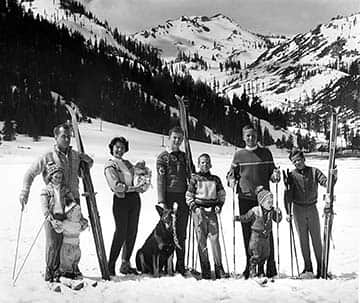
On July 25, 2015, legendary Squaw Valley ski pioneer Wayne Poulsen would have turned 100-years-old. To celebrate this remarkable man, a large crowd of family and friends gathered at the Poulsen family’s Squaw Valley estate to reacquaint and reminisce about the inspiring life journey of Wayne and his wife, Sandy.
Wayne was born in California, but grew up in Reno where he was a noted ski champion. As a teenager at Reno High School he had jumped in the 1931 Olympic tryouts at Olympic Hill (later renamed Granlibakken) near Tahoe City. Poulsen made many trips from Reno to Olympic Hill, which gave him ample time to marvel at the distant mountain peaks lording over the meadows of Squaw Valley. On a summer fishing trip in 1932, he entered the valley for the first time. After further exploration, he decided to acquire and develop Squaw Valley as “a mountain community dedicated to skiing as a way of life.” In 1938, he took an option to buy land in the valley from Southern Pacific Railroad.
As a student at the University of Nevada in Reno, Poulsen actively promoted skiing and winter sports. He organized and directed the first Nevada Winter Carnival and was later co-founder of the Pacific Coast Intercollegiate Ski Union. After his graduation, Poulsen coached the Nevada Wolf Pack ski team. In 1939, the team went undefeated and was proclaimed Pacific Coast champs.
Poulsen earned a pilot’s license and when the United States entered World War II, he joined the U.S. Air Force as a flight instructor. Due to a previous ski injury, Poulsen could not be trained as a combat pilot, but his exceptional flying ability earned him a position as a lead pilot for Pan American World Airways, a military contractor for the Armed Forces. His position with Pan Am kept him based in the Bay Area, as opposed to Europe or the South Pacific.
During the war, Wayne had the opportunity to join Marti Arrougé, his friend and Wolf Pack ski team member, who had landed a temporary job as a ski instructor at Sun Valley, Idaho. While teaching there, Wayne met an attractive young student named Gladys “Sandy” Kunau. The couple hit it off right away, spending their days on the slopes and dancing at night in the Sun Valley Lodge. Years later, Sandy liked to joke that she let her skiing ability improve slowly so Wayne would have to spend more time teaching her the techniques.
In some ways, they seemed an unlikely match. Wayne was happiest exploring the rugged Tahoe-Sierra back country, searching for the best locations to develop ski resorts. He was a fearless, talented skier who pushed boundaries in everything he did. Sandy, however, was raised as a debutante in a world of comfort and privilege. Her family lived in a penthouse at a fancy New York City hotel with rooms that overlooked Central Park. After high school, Sandy entered Smith College, a private women’s college in Massachusetts, where she enjoyed weekend ski trips in New England.
Among Sandy’s wealthy friends was Kathleen Harriman, daughter of Union Pacific Railroad tycoon Averell Harriman, who had developed Sun Valley ski resort during the 1930s. In 1941, Kathleen suggested that Sandy take a ski trip to Sun Valley on her father’s railroad line. The idea intrigued Sandy who was tired of the hard, icy conditions on the slopes of New England. Kathleen told her that the snow at Sun Valley was deep and soft. Sandy had recently seen the romantic movie, “Sun Valley Serenade,” starring Sonja Henie, a world-class ice skater and Olympic champion. The stunning alpine scenery drew Sandy like a powerful magnet, so she packed her things and bought a train ticket for Idaho.
Sandy spent that winter at Sun Valley skiing with Wayne and by springtime they were engaged. Wayne told Sandy about Squaw Valley, a remote alpine valley tucked into the Sierra Nevada near Lake Tahoe, and that when they got married they would live and raise their family there.
The Poulsens were married in August 1942 at the Santa Monica oceanfront home of Hollywood actress Norma Shearer, whom Marti Arrougé had married just two weeks before. The romantic magic of Sun Valley depicted in the movie must have been true; at the resort both Poulsen and Arrougé met their future brides.
When he first told Sandy about living in Squaw Valley he didn’t own anything there, but true to his word, in 1943 he purchased the land. Wayne whisked Sandy away from her upscale lifestyle in Manhattan and moved her into a tent in remote Squaw Valley. They spent the summer in the valley, bathing in the frigid waters of Shirley Canyon and eating fresh trout Wayne caught. It was tough going in the early days, but Sandy had no complaints. She often recalled how peaceful the undeveloped valley was and that although the couple had virtually nothing in the way of material possessions, they were full of hopes and dreams. The Poulsens purchased two surplus army barracks and converted them into a home that could withstand the severe Sierra winters. It was the first house built in Squaw Valley and survives today as Graham’s Restaurant.
In 1948, Wayne Poulsen took on Alex Cushing as his business partner to finance the construction of the ski area, but the relationship did not work out. Cushing went on to develop the valley as a resort while the Poulsens began a successful career in real estate selling the land they owned there. Sandy was with her husband every step of the way. She birthed eight children and raised them in the pioneer spirit.
Wayne Paulsen loved Sandy and Squaw Valley and lived his life defending its natural beauty. He died in 1995 after a lifetime of impressive accomplishments in skiing and aviation. Sandy, the “First Lady of Squaw Valley,” passed in 2007. After a love affair that lasted 53 years, it’s difficult to separate the achievements of the couple. In 2005, the U.S. Board of Geographic Names officially designated a peak in Squaw Valley as “Poulsen Peak” commemorating Wayne Poulsen, ski pioneer and founder of Squaw Valley. Wayne and Sandy Poulsen were the heart and soul of Squaw Valley and although they are gone, their legacy is secure.


