


By Mark McLaughlin
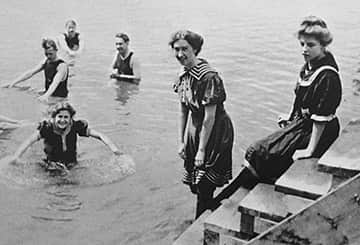
Swimming near the Tahoe Tavern resort, circa 1920s.
[blockquote2]
“Huddleston’s estimated swim in Lake Tahoe had taken
22 hours and 53 minutes. She lost 12 pounds of body weight in the ordeal.”
[/blockquote2]
[one_half]
[dropcap1]M[/dropcap1]ost visitors gape in awe at first sight of Lake Tahoe. It takes time for the mind to absorb the sheer size of this magnificent alpine lake. Suspended high in the Sierra Nevada, Lake Tahoe is an aquatic jewel, 22 miles long and about 12 miles wide.
Tahoe is beautiful, but the cold water, choppy surface and high elevation also make it one of the most challenging swim holes around. Big Blue has always captured the imagination of athletes and attempts to swim across the lake started nearly a century ago. Early tourists at Tahoe splashed and played in the shallow waters, but no one strayed far from shore because it was commonly believed that the clear, cold water would not support a human body. That erroneous perception came from the fact that the bodies of drowning victims were rarely recovered. Water temperatures near freezing prevent tissue decomposition and the buildup of organic gases. Bodies that sink into the dark depths of Tahoe rarely float back to the surface.
During the Great Depression, tourism at Lake Tahoe was slow. To drum up business, in 1931 the Tahoe Tavern Hotel offered $700 cash ($11,000 today) to the first person to swim across the lake from Nevada to its hotel near Tahoe City. Myrtle Huddleston, a world-class swimmer and mother of a teenage boy, decided to take on the Tahoe Tavern’s challenge and earn some money.
Huddleston had taken her first swimming class in 1926 at the age of 30 in the interest of losing weight. The widow from Long Beach turned out to be a natural in the sport of open water long distance swimming. Just six months after her first lesson, she entered the Wrigley Ocean Marathon with the hope of swimming across the Catalina Channel and winning a $15,000 purse to help pay for her son’s education.
In February 1927, Huddleston began the swim accompanied by two escort boats. She became lost for three hours when fog set in and the lights on her escort boats blacked out. In the hours after midnight, she was repeatedly attacked by a barracuda, which left bite marks and cuts on the left side of her body. Fifteen hours into the swim, a lack of food began to take its toll, so she swigged down a half pint of whiskey. After 20 hours and 42 minutes she collapsed 20 yards from shore, but she had become the first woman to swim the more than 20-mile crossing. It was an incredible feat of perseverance and resolve.
In 1928, Myrtle won an ocean-swimming championship at Del Ray Beach, Fla., when she swam for more than 31 hours. A few months later, she set another world record by swimming 50 hours nonstop in a Chicago pool, breaking the men’s record by more than four hours and earning $5,000. Over the next two years, she set more world records by swimming 60 hours and later staying afloat for nearly 88 hours. She had one setback in 1929 when she failed to swim across the English Channel.
It was about 8 a.m. on Aug. 24, 1931, when Myrtle Huddleston slipped into the chilly water near Deadman’s Point, Nev., on Tahoe’s East Shore. Tahoe City was about 11 miles away as the crow flies. Huddleston’s skin was coated with a thick layer of specially prepared grease to help ward off the effects of swimming in the bone-chilling, 60-degree water.
[/one_half]
[one_half_last]
At first the lake was calm, but shortly after noon the southwest wind grew blustery. When white caps appeared, the crewmen in the escort boats positioned their crafts to block the waves, but she was still blown 7 miles off course. Hour after hour, she battled the brutally cold waves that threatened to break her will. Complicating matters further, her goggles leaked water nearly blinding her, and she also suffered from nausea and pain in her arm.
Finally, late in the day, the wind subsided and when the water’s surface grew calm again, Huddleston renewed her attack. Sometime after midnight, Huddleston increased her stroke, pulled away from her rowboat escort and disappeared into the darkness. Huddleston had no idea that she was swimming alone in water nearly 1,000 feet deep. Fortunately, another boat found her just before dawn, feeling ill and discouraged. She had been swimming for more than 20 hours.
The high altitude and cold water was sapping her strength and the detour had added miles to her grueling swim. She was ready to give up. At this point, her son Everett, sitting in a rowboat, called out, “Mother, hold fast. We are only two miles from shore.” His encouragement renewed her vigor and she resumed her quest. Soon Huddleston could hear cheers and laughter emanating from the large crowd assembled on the Tahoe Tavern pier.
Just before 7.a.m., Huddleston emerged from the icy water. She laughed when she saw a medical stretcher next to an ambulance waiting near the beach for her. “What’s the bier for?” she asked calmly as she walked woozily into the hotel to claim her $700 in prize money. After the presentation, she said, “Catalina was easy compared to this!”
Huddleston’s estimated swim in Lake Tahoe had taken 22 hours and 53 minutes. She lost 12 pounds of body weight in the ordeal, but later said that despite the hardships of cold water, altitude and wind, she felt no ill effects from the swim. Her impressive feat stood unbroken for 21 years. She had taken the sport of marathon swimming by storm, but the effort took a toll on her body and she died at the young age of 39. In 2013, Tahoe-based extreme marathon swimmer Karen Rogers helped organize the Myrtle Huddleston Honorary Swim in Lake Tahoe in honor of that 1931 effort.
The first man to successfully cross the width of Lake Tahoe was William Long, a 27-year-old long-distance swimmer from Van Nuys, who pulled it off on Aug. 16, 1952. Strong southwest winds carried him off course, too, but he managed to stroke the swim in 12 hours. Another record was set on Aug. 8, 1955, when Fred Rogers, a 29-year-old bartender from San Francisco, swam from Cave Rock, Nev., to Meeks Bay, Calif., a distance of 9 miles, in just 6 hours and 46 minutes.
[/one_half_last]
Tahoe historian Mark McLaughlin is a nationally published author and professional speaker. His award-winning books are available at local stores or at thestormking.com. You may reach him at mark@thestormking.com. Check out his blog at tahoenuggets.com, or read more Sierra Stories at TheTahoeWeekly.com


