


By Bruce Ajari
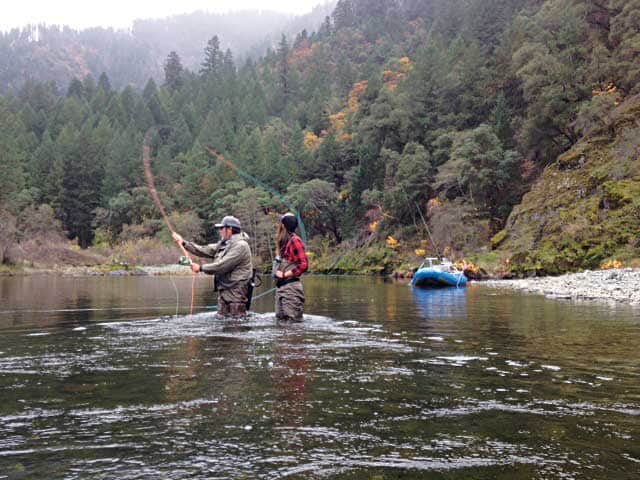
[dropcap1]O[/dropcap1]n a trip on the Trinity River west of Redding last year, my daughter helped me refine my two-handed casting that I had learned during a class in Oregon with World Champion Spey Caster Travis Johnson. My daughter even went through the class with me.
She had the good fortune of learning her Spey casting earlier from the late Bill Lowe, a terrific instructor and all around great guy. She has since become a great teacher herself.
Both she and I had the good fortune to have additional instruction from Jamie Lyle, Dax Messett and Simon Gawesworth. All wonderful, world-class Spey casters.
Working with her on the Trinity helped refine my two-handed casting. Being a single-hand casting instructor myself, her ability to relate to a client, her dad in this case, impressed me. It is so different from the conventional casting that good instruction is essential.
Spey casting was developed on the River Spey in Scotland in the mid-1800s. Generally, it is a powerful technique used for larger rivers for steelhead and salmon. Some anglers also fish the surf with these Spey rods.
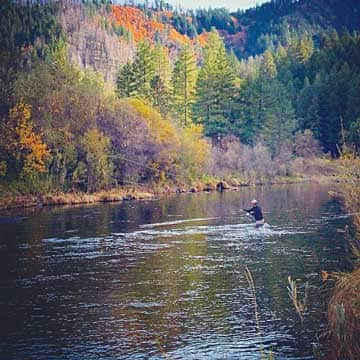 Original rods were 22 feet in length and made of wood. Today’s Spey rods are around 12 to 15 feet in length and made of graphite.
There was some new terminology that you have to understand before you can learn to cast. The term anchor point and D-Loop were two important ones to understand. Unlike conventional casting, one is watching the end of the fly line where it enters the water in front of the angler, the anchor point. Power is supplied by creating a D-shaped loop on the backcast before starting the forward stroke, the D-Loop.
New Spey casters such as me tend to over think the process and make the cast too mechanical. Once you trust the motions and watch the anchor point, the cast seems effortless and you will be astounded by the results. A good Spey cast is a thing of beauty.
While the Trinity River is not a big river, there are good spots to use the Spey rod. As such, it is a good river for a beginning Spey caster to learn. During my visit, we were able to fish about four days with my daughter and some of her guide associates. During that time, I saw my casting dramatically improve. Spey casting is addictive
FISHING REPORT
(See TROA.com for water levels.)
Boca | Inflow is at 16 cfs and the outflow is 78 cfs. Fishing has been fair. Fly-fishers have been catching some fish near the inlet with nymphs, streamers and dries.
Donner | Fishing has been fair to good. Kokanee fishing has been good. Nightcrawlers and Powerbait seem to be the main bait for shore anglers. Mackinaw fishing has been good. Fly-fishermen are catching some fish with streamers.
Lake Tahoe | Fishing has been fair to good for mackinaw. A guide is highly recommended if you are fishing for mackinaw for the first time. Toplining and shore fishing is fair. Most shore fishermen use inflated nightcrawlers.
Little Truckee River | The flow has been lowered to 16 cfs for habitat improvement work. Please fish in alternative waters.
Martis Lake | Zero kill. Catch and Release only with barbless artificial lures or flies. Fishing is the best early in the season and again the fall. With the warming water, the fishing here is slow. Try fishing it again in the fall.
Prosser | Fishing has been fair. Anglers using bait, lures and flies have all caught fish. Fly-fishermen have done well near the inlet areas. Bass fishing has been fair.
Stampede | Fishing has been fair. The ramp is not usable for larger boats. Nightcrawlers, Powerbait and lures have all produced from shore. Fly-fishermen have been doing well near the inlets with nymphs and streamers. The Kokanee fishing has been fair for those getting out. Smallmouth bass fishing has been fair.
Truckee River | Not flowing out of the lake at Tahoe City. The flows through Truckee are at 9 cfs. The flow from Boca downstream to the state line is running at 100 to 111 cfs. Flows are too low for this river now. Please target alternative water and other species such as bass or carp.
Davis and Frenchman | Fishing has slowed. It will improve when temperatures begin to cool.


