


Editor’s Note: Parts I & II are available at TheTahoeWeekly.com.
Suspense is building across the West Coast to see what El Niño has in store for Tahoe this winter. According to at least one metric, this El Niño is already the strongest one of record since reliable data collection began in 1950. Officials are warning of floods and mudslides in Southern California, while Tahoe Sierra resort operators and snow-starved skiers and riders are dreaming of endless powder days. Odds are good that we’ll get both.
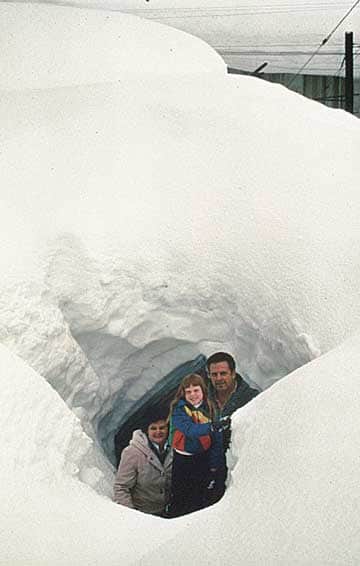
Southern Pacific employee’s home at Donner Pass, circa April 1983 | Courtesy Mark McLaughlin
Strong El Niño’s like the one brewing in the Pacific now pump enormous amounts of heat and moisture into the lower atmosphere through evaporation. The process provides fuel to the atmospheric heat engine, speeds up tropical jet stream winds and provides the raw material for increased storminess and rainfall, particularly in the Western Hemisphere.
[blockquote2]
“By the end of end of February, more than 44 feet of snow had fallen on Donner Pass; the snowpack there was 15 feet deep. Nearby Sugar Bowl was closing in on 30 feet.”
[/blockquote2]
The winters of 1983 and 1998 have been the only two seasons to date that were driven by rare very strong El Niño conditions. But as I write this, the current ENSO event has already exceeded those years by at least one water temperature metric. Both winters were exceptional when it came to snowfall and precipitation in Northern California, but 1982-83 proved to be a monster.
Just for comparison, the Donner Pass snowpack was 11 feet deep on Christmas Day. By New Year’s Day, mountain highways were clear for everyone to enjoy some of the best early season ski conditions in memory. Alpine Meadows reported a base of 10 to 15 feet while the Sugar Bowl ski area boasted 12 to 18 feet of white gold.
A strong ridge of high pressure dominated for the first half of January, blocking the active Pacific storm track. Sunny days and warmer temperatures gave locals hope that the fierce storms had abated. But heavy snow returned during the third week of the month, dashing all hopes for some relief.
At South Lake Tahoe, movie actors Robin Williams and Walter Matthau, along with country singer Jerry Reed, were trying to finish up scenes for the comedy flick, “The Survivors,” directed by Michael Ritchie.
“The Survivors” was supposed to have been filmed in Vermont, but a lack of snow there brought them to Lake Tahoe where four major storms blasted the film crew over six weeks.
Deep snow covered the ground at Camp Richardson where scenes were being shot. In his role as an unemployed man, Williams wore khaki attire that quickly got wet in the snow. As heavy snow continued to fall during the shoot, the comedian muttered, “Now I know what it’s like to be a dog.”
During late January and February, all of the statistical indicators of El Niño started to decline. Water temperatures dropped 9 degrees and equatorial wind directions were beginning to shift back to normal. NOAA announced that observations indicated that “this El Niño event may have passed its peak.” But scientists were fooled when sea surface temperatures inexplicably surged upward.
As February transitioned into March, the weather turned from bad to worse as a series of vigorous cold fronts slammed Northern California. A deep, low-pressure cell stalled 300 miles west of San Francisco, which funneled a flow of moist, unstable air across California from Feb. 25 to March 3.
With a low freezing level between 4,000 and 5,000 feet, the Sierra Nevada was buried with snow. Twin Lakes (south of Lake Tahoe) reported 12 feet of new snow with another 11 feet added to Echo Summit’s tally above South Lake Tahoe. Up to 9 feet fell in the upper elevations around Lake Tahoe.
By the end of end of February, more than 44 feet of snow had fallen on Donner Pass; the snowpack there was 15 feet deep. Nearby Sugar Bowl was closing in on 30 feet. Resort managers were frustrated, however, because the persistent bad weather, high winds and hazardous driving conditions were keeping skiers away from the slopes.
At South Lake Tahoe near Kyburz on Highway 50, a series of massive mudslides ripped down the mountainside, burying the roadway and temporarily plugging the nearby South Fork of the American River. The wall of earth, boulders and trees up to 3 feet thick blocked the road, the main route for tourists driving from Sacramento to South Lake Tahoe.
One Department of Transportation heavy equipment operator at the scene said, “I’ve never seen anything anywhere near this big and I’ve lived here all my life. There’s a mountain in that slide. I can’t imagine how we’ll clean it up.” Engineers projected that the road would remain closed until after Memorial Day weekend.
Incredible as it may seem, March turned out to be the biggest snow month of the winter. Mid-month an atmospheric river of subtropical moisture surged into the state. When snow levels rose to 7,000 feet, the sloppy mixture of rain and snow added even more weight to overloaded structures in the mountains.
North Lake Tahoe applied for disaster aid after it was determined that scores of homes and businesses had suffered extensive damage in snow-clobbered communities like Alpine Meadows and the Serene Lakes area near Donner Pass.
County Supervisor Larry Sevison represented the Sierra district. He said, “I’ve lived here for 25 years, and this is about as bad as I’ve seen it. It’s the density of the snow that’s causing the problems; it’s so much heavier than it’s ever been.”
On the last day of March 1983, 65 inches of snow fell at Twin Lakes (south of Lake Tahoe) in a 24-hour period. The total was 2 inches shy of the 67 inches that fell the year before on Jan. 4 and 5, 1982, at Echo Summit.
That dynamic snow burst at Echo Summit in 1982 still ranks as second greatest 24-hour snowfall recorded in the United States. On Jan. 1, 1997, Squaw Valley reported 68 inches in 24 hours, but measurements from resorts are usually not included in official statistics.
During March, Norden picked up another 13 feet of snow as did Twin Lakes. At Donner Pass, the snow depth was 18 feet on March 28. Everyone had had enough, but the Storm King was far from done.
Stay tuned.
Tahoe historian Mark McLaughlin is a nationally published author and professional speaker. His award-winning books are available at local stores or at thestormking.com. You may reach him at mark@thestormking.com. Check out his blog at tahoenuggets.com or read more at TheTahoeWeekly.com


