


It’s been 100 years since Charles Hatfield was hired by San Diego’s city council to end a crushing four-year drought that was bringing the region to its knees. Hatfield was famous for producing moisture during severe western droughts. In Dec. 1915, San Diego’s leaders promised to pay Hatfield $10,000 if he could generate enough precipitation to break a four-year dry spell that had dried up local reservoirs.
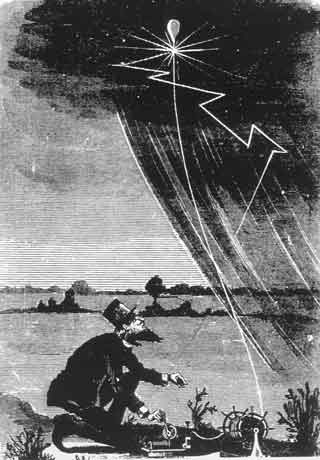
Rainmakers used electricity to coax water from the clouds. | Courtesy Harper’s Illustrated
In his contract Hatfield stated: “I will produce enough rain to fill the Morena Reservoir to overflowing, between now and next December [1916], for the sum of $10,000. I will deliver the first 30 inches of rainfall at no charge (San Diego averages about 10 inches of rain per year). But you will pay me $500 per inch, for the next 20 inches. Should I fail to deliver as promised, I ask for no compensation whatever.” It was a bold, brash statement but Hatfield would be good to his word, and then some.
[blockquote3]
“Rising waters throughout the region began washing away bridges, marooning passenger trains and flooding homes.”
[/blockquote3]
[one_half]
Hatfield was a pluviculturist, a term coined by a Stanford University professor to describe the type of pseudo-scientific quackery regarding weather modification that was popular in the decades around the turn of the 20th Century. These weather wizards traveled the country, boasting about the efficacy of their proprietary brews, strange machinery and artillery firepower used to bring rain. Each flimflam artist took a different approach; whether unleashing fusillades of cannon fire into the atmosphere, stirring up chemical concoctions that wafted into the air, or cranking dynamos to send electric charges up long, metal wires suspended by balloons.
In the late 19th Century, Professor Charles M. Hatfield was the best known of America’s rainmakers. Born in Kansas about 1875, the former sewing machine salesman had no formal education beyond ninth grade, but by 1902 Hatfield was studying weather records and finding work as a respected rain engineer in Southern California.
During a dry spell in 1904, he approached some Los Angeles businessmen with a proposal to guarantee 18 inches of rain by April 1905 in exchange for $1,000. Hatfield seemed to take a big risk betting his reputation on this contract, but when 18 inches had fallen by the deadline and the money paid, the public and press began to take him much more seriously. The following year, he earned $250 from Grass Valley-based South Yuba Water Company when he delivered a 4.5-inch deluge.
Part of Hatfield’s successful reputation was based on fortuitous rains that seemed to follow his treatments, as well as his simple, down-to-earth approach. Many would-be rainmakers were conmen trying to separate desperate farmers from their hard-earned cash. Hatfield, however, had a marketing advantage over most of them. He came across as honest and a straightshooter. Unlike other flamboyant shysters who relied on flashy pyrotechnics and other outlandish methods meant to dazzle their clients, Hatfield was modest. He said, “I do not make rain. That would be an absurd claim. I simply attract clouds and they do the rest.”
It seemed that Hatfield believed that his approach worked. In reality, as someone knowledgeable about weather and climate, he calculated that it would probably rain anyway within the time parameters of the contracts he offered.
Hatfield erected tall towers topped by large, wooden containers filled with a noxious, gas-producing concoction. He claimed that certain chemicals, when stimulated by electricity and released into the atmosphere, could increase rainfall, similar to how fertilizer applied to crops boosted production. Although Hatfield said that the odor was mild, one farmer observed, “These gases smell so bad that it rains in self-defense.” Hatfield told reporters, “I have nothing to do with bombs, dynamite or explosives of any kind whatever.” His low-key approach stood out in stark contrast against his competition.
[/one_half]
[one_half_last]
By the time Hatfield cut the deal with the San Diego Chamber of Commerce just before New Year’s 1916, he had been disparaged as a fraud by the U.S. Weather Bureau. After negotiations with civic leaders, Hatfield withdrew his commitment to produce 30 inches of rain, but promised to fill the city’s depleted reservoir system for $10,000. Although a formal agreement was never drawn up or signed by the town council, in January 1916 Hatfield built a tower near the Morena Reservoir and soon his brew was wafting into the sky. The first heavy rain storm hit on Jan. 10, followed by days of persistent showers that led to even more intense downpours that lasted much of the month. No one had ever seen such rain, but Hatfield continued to work his magic in the mountains 60 miles east of San Diego. Near Hatfield’s tower, nearly 13 inches of precipitation fell in just four days.
The unusual tempest temporarily halted a Panama-California Exposition being held in Balboa Park. The weather also forced officials to cancel opening day races at the new Agua Caliente Race Track in Tijuana. Rising waters throughout the region began washing away bridges, marooning passenger trains and flooding homes. Despite the deluge, Hatfield placed a telephone call to City Hall from his remote location at Morena: “I just wanted to tell you that it is only sprinkling now. Within the next few days I expect to make it rain right…just hold your horses until I show you a real rain.”
Meanwhile, San Diego water engineers watched nervously as torrents of water poured into regional reservoirs at Morena, Chollas, and Upper and Lower Otay lakes. Operators warned that despite huge releases through relief gates, several dams were at risk for failure due to the unprecedented inflow. Their worst fears were realized when the Lower Otay Dam collapsed and water surged out of the mountains toward the ocean, sweeping away everything in its path. San Diego was isolated except for U.S. naval ships that ferried people and emergency supplies. Fortunately, due to the sparsely populated countryside, less than 20 people died.
San Diego picked up 300 percent of normal rainfall in January 1916, but refused to pay Hatfield his $10,000 until he ponied up for the nearly $4 million in damages he caused. A lesson was learned, however. When San Diego hired a cloud seeder in 1948, the city took out damage insurance. As a wise man once said, “Timing has a lot to do with the outcome of a rain dance.”
[/one_half_last]
Tahoe historian Mark McLaughlin is a nationally published author and professional speaker. His award-winning books are available at local stores or at thestormking.com. You may reach him at mark@thestormking.com. Check out his blog at tahoenuggets.com or read more at TheTahoeWeekly.com.


