


In contrast to the High Sierra where the annual snowfall averages 35 feet or more, communities located in western Nevada usually escape the worst of the weather. The towering range protects valleys from the intense winter storms that barrel in from the Pacific Ocean. Heavy snow accumulation in the mountains creates a winter wonderland ideal for sports enthusiasts, and the deep snowpack provides crucial water supplies for residents, ranchers and farmers. It’s a magical combination of sun, snow and water that makes life in the Far West so attractive.
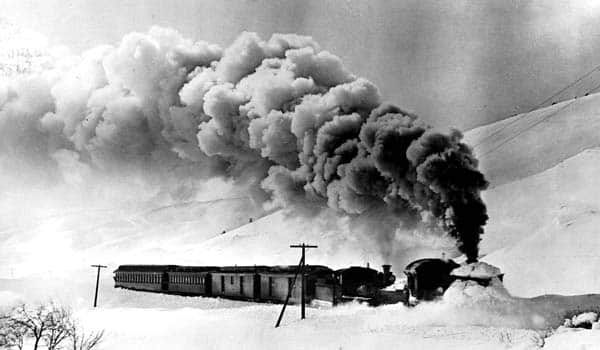
Virginia & Truckee snowplow, January 1916. | Courtesy Nevada Historical Society.
This benevolent climatic profile is a real winner for Nevadans who live close to the mountains, but rarely have to deal with severe weather. There are occasions, however, when a combination of abundant moisture and cold temperatures deliver a healthy dose of snowfall to the nation’s most arid state. It was 100 years ago, during the winter of 1915-16, when a series of powerful Alaskan-bred cold fronts produced Reno’s snowiest month of record.
[blockquote3]
“It was 100 years ago, during the winter of 1915-16, when a series
of powerful Alaskan-bred cold fronts produced Reno’s snowiest
month of record.”
[/blockquote3]
January 1916 dawned cold and gray and Truckee; Tahoe residents welcomed the New Year with song and revelry. There was a soft, light snow falling in the Sierra, but along the California coast, 75-mph winds were sowing death and destruction. Flying debris and torrential rain killed three people in San Francisco and closed schools and businesses throughout the Bay Area.
Barreling east, the potent rainstorm ascended the Sierra where it transitioned into a raging blizzard. Snow pummeled the mountains and the Donner Summit snowpack quickly jumped to 10 feet deep. Southern Pacific trains managed to bully their way through the drifts, but all Western Union, postal and telephone lines between Reno and San Francisco were snapped silent by the shrieking wind.
For a brief time, snow levels jumped to 6,500 feet, which raised water levels in the Truckee River 10 inches in 24 hours. Heavy rain and floodwaters destroyed the season’s first commercial ice crop at Boca, but only minimal damage occurred at other downstream locations. For early 20th Century Sierra residents, the ice harvest played an integral part in the economic cogwheel of trains, logging and winter sports.
Over the next several days, the storm slowly moved east and then stalled in a position to channel frigid air into western Nevada where snow levels lowered to the valley floor. Both Carson City and Reno picked up about a foot of snow. The storm eventually cleared, but 48 hours later another strong system blasted the region, dumping an additional foot of snow on the Biggest Little City. Four to six feet of new snow buried locations around Lake Tahoe.
On Jan. 10, Southern Pacific Railroad suspended all freight traffic as crews prioritized crowded passenger cars struggling to cross Donner Pass. In communities along the eastern Sierra front, automobiles proved worthless in the deepening snow. In a throwback to an earlier era, country physicians making house calls exchanged their cars for horses in order to navigate the badly clogged roads. Snowfall totals were phenomenal in western Nevada. Nearly 3 feet of new snow blanketed Carson City, with an additional 5 feet in Virginia City. Amazingly, crews for the Virginia & Truckee Railroad (V&TRR) managed to keep trains running on schedule. A short-lived break in the weather was no bargain as temperatures plummeted to below zero on Jan. 12.
The respite didn’t last long, however, and on Jan. 15 another powerful cyclone roared in. The bitterly cold air entrenched over the region chilled the abundant moisture arriving with the new Pacific system and snow literally cascaded out of the sky. Railroad officials in Truckee noted snowfall intensity at 8 inches per hour, while old timers declared it the worst storm since 1890, a Top 10 winter for Sierra snowfall.
Southern Pacific passenger trains were running six to eight hours behind schedule. Each train was forced to crawl behind a Rotary snowplow as it churned through the drifts. After an avalanche west of Blue Canyon tore out 300 feet of track, most train travelers became convinced that it was safer to wait to cross the mountains. Up north, drifts and avalanches in the Feather River Canyon blocked all Western Pacific train traffic.
In Reno, the latest storm dumped about 30 inches of snow, with nearly 2 feet of that total falling in less than 13 hours. For the first time in five years, the normally reliable V&TRR couldn’t get through Washoe Valley, isolating the state capital Carson City from Reno for several days. It took a wedge plow powered by four locomotives and an army of men with shovels to break the blockade. In Virginia City, where the snow was 7 feet deep, butcher shops ran out of fresh meat, butter and eggs.
Skies cleared on the 19th and temperatures slid to well below zero again. Thermometers in Tahoe City nibbled at minus 4 degrees, but Reno sank to 11 below. The following morning, temperatures in Reno plummeted to 17 degrees below zero, just two degrees shy of the all-time low set in January 1890.
The storms of January 1916 caused frequent blockades on local railroads and shut down mining and business operations throughout the region. Nearly 20 feet of snow fell on Tahoe City that month, which isolated the community from the outside world for two weeks. Twelve feet of snow buried Truckee, but once trains began running again, the town’s popular winter carnival was a resounding success.
Mountain folk take extreme weather as a challenge and are mostly prepared for it. It’s to be expected in the higher elevations. It was tougher down below for the city slickers in western Nevada. Snowfall that month in Gardnerville (south of Carson City) exceeded 4 feet with 52 inches recorded. Only 6 more inches were tallied for the rest of the winter. Fortunately, supplemental feeding delivered by ranchers reduced livestock losses out on the range.
Reno’s exceptional 66-inch monthly snowfall exceeded the previous high mark from January 1890 by 12 inches and the city finished the season with a new record of 6.8 feet. Not bad for a town that averages only 22 inches of snow a year.
The 1916 monthly snowfall record stood for 89 years until January 2005, when a total of 79 inches recorded by the National Weather Service office in the hills just north of Reno reset Nevada’s record books.
Tahoe historian Mark McLaughlin is a nationally published author and professional speaker. His award-winning books are available at local stores or at thestormking.com. You may reach him at mark@thestormking.com. Check out his blog at tahoenuggets.com or read more at TheTahoeWeekly.com.


