


Let’s start with Champagne because it was the first and sets the stage for all the others produced in Champagne, a region, with a cool climate, in northeastern France, about 90 miles from Paris.
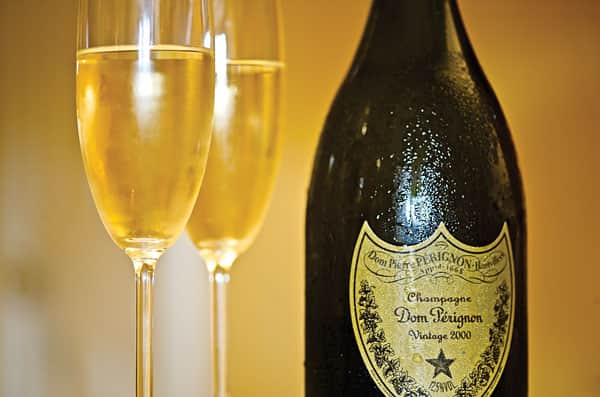
2000 Dom Perignon | Courtesy LVMH
Black Pinot noir and Pinot Meunier and white Chardonnay grapes are used most. (Yes, Chardonnay is the minority grape in this region.) Until the early 1800s, well after Dom Perignon’s death, the bubbles were there by accident. The Dom actually spent most of his career trying to eliminate them because the pressure in the bottles caused them to explode in the cellar. That being said, since then Champagne has been made in the traditional method by making a still wine and adding more yeast to each bottle for a second fermentation. Then, after aging and expelling the used yeast, sugar is added from a level of zero, called natural, in varying amounts from brut (dry) to doux (sweet). The most common is brut that usually displays a citrus and biscuit flavor profile.
The cost Champagne has skyrocketed in recent times with an entry-level offering starting at about $30 and more. The ceiling is well into four figures for a vintage Champagne of an exceptional year.
[blockquote3]
“The grapes and winemaking are the same as Champagne, as are the flavors and textures.”
[/blockquote3]
Sparkling wines
U.S. Sparkling Wines come in many quality levels, but the better brands are quite similar to Champagne. Most quality U.S. Sparklers come from Northern California and Oregon, with lower quality examples coming from pretty much anywhere. The grapes and winemaking are the same as Champagne, as are the flavors and textures.
Here’s the best news in bubbles: You can get a fine entry level brut, such as a Scharffenberger Brut, for less than $15. In fact, the best vintage bottlings rarely approach more than $100. Lower quality wines made in various bulk methods can start at a few bucks.
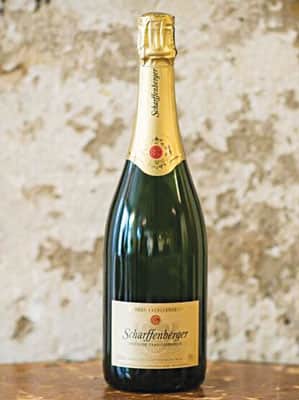
Scharffenberger Brut | Courtesy Scharffenberger Cellars
Spain’s cava
Cava may be white or rose. Its denomination of origin is Spain. It is made mainly in Catalonia, a north-east triangular region that shares a border with France.
It has to be made in the traditional method to be called Cava. It is made usually from macabeu, xarel lo and parellada grapes. Expect less refined bubbles and an earthier, spicier flavor.
The cost can be quite attractive. Even the best are available for around $25, while good starters can be found for less than $10.
Italy’s Prosecco
Prosecco is an Italian white wine. The name is derived from an Italian village near Trieste in northern Italy.
It is made from the grape Glera, formerly called Prosecco, in the Charmat method where the wine undergoes secondary fermentation in large tanks. There is also little to no aging as the aromas and flavors of this bubbly are overpowered rather than enhanced by yeast aging. Expect more florals and fruits on the nose and palate.
For better quality Prosecco, look for the DOCG band (which in English means controlled designation of origin) around the bottle, indicating quality assurance for an Italian food product. Those designated bottles usually start at around $20. For those bottles without the bands, the costs start at less than $10.
Obviously, there are other Sparklers but this primer covers the most important and hopefully adds joy to your wine journey.
Lou Phillips is a Level 3 Advanced Sommelier and his consulting business WineProwest.com assists in the selling, buying and managing wine collections. He may be reached at (775) 544-3435 or lou@wineprowest.com. Visit TheTahoeWeekly.com for more wine columns.


