


As fly-fishers, we are very much in tune to what insects the fish are eating. Ernest Schwiebert’s book, “Matching the Hatch,” written in 1955, was the standard on what fish eat and how to match them with flies.
Fly-fishers know the aquatic insects in their home waters. Hatches in the East and West are quite different. However, anglers in each of these regions have similar hatches within their respective areas.
[blockquote3]“Knowing when an insect typically emerges and is available to the trout allows the fly-fisher to carry the proper flies to imitate them.”[/blockquote3]
Hatch cycles can be slightly different for the same species given temperature, elevation and type of water. For example, locally the same insect, such as the Green Drake Mayfly, hatches on the Truckee sometime around mid-June. This same hatch happens a little later on the Little Truckee, between Stampede and Boca reservoirs.
The hatch cycles for various insects occur about the same time each year. Variables occur due to how much water a stream has in it each year. On a normal year, the hatches occur at the normal time. However, when there is a lot of water, the hatch cycle is generally later in the season due to the cooler water temperatures generated by increased flows. Conversely, on a low-water year, hatches can be accelerated due to the early warming of water because of no runoff.
The timing of these hatches can be days to weeks, early or late, depending on the snowpack that exists. The more fly-fishers fish in local water, the more aware they become of the timing of hatch cycles.
Experienced fly-fishers know the sequence of what insects hatch during any time of year. As a result, they are usually well prepared to deal with these fluctuations in the hatch cycle.
Knowing when an insect typically emerges and is available to the trout allows the fly-fisher to carry the proper flies to imitate them. Because of these fluctuations in the hatch cycles, an angler should be prepared with a variety of early season patterns. Nymphs, streamers, emerger and adult fly patterns are all necessary. Size, shape and color are the key factors to consider when choosing the fly imitation that is appropriate.
Some anglers, like myself, restrict their angling to one form, such as dry fly-fishing. This is the emerging or adult stage of the insect.
As a result, we only look for fish that are actively feeding on the surface. Large fish can be caught early in the season using this method on our local waters if one is in tune to the local hatch cycles.
FISHING REPORT
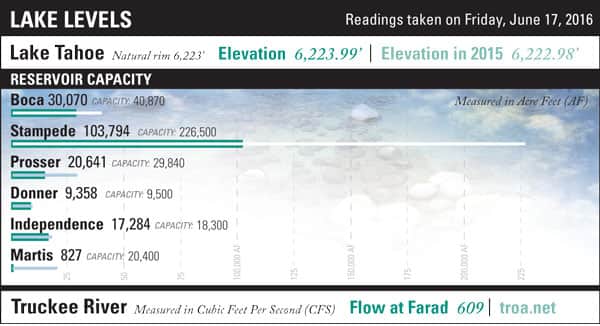
Boca | Inflow is at 340 cfs and the outflow is 245 cfs. Powerbait, nightcrawlers and lures are all working. Fly-fishers have been catching some fish near the inlet with nymphs, streamers and dries.
Donner | Fishing has been fair to good. Kokanee fishing has been good, although the fish are small. Nightcrawlers and Powerbait seem to be the main baits. Mackinaw fishing has been good. Fly-fishers are catching some fish with streamers.
Lake Tahoe | All tributaries are closed to all fishing from July 1 to Sept. 30. Fishing has been fair to good for mackinaw. A guide is highly recommended if you are fishing for mackinaw for the first time. Toplining and shore fishing is fair. Most shore fishermen use inflated nightcrawlers.
Little Truckee River | The flow is at 340 cfs. Be prepared to share the water with a lot of anglers. The river has been busy so far this season. With the water at this level, nymphs are your best bet. Hatches are similar to the Truckee River.
Martis Lake | Zero kill. Catch and release only with barbless artificial lures or flies. Fishing is the best early in the season and again in the fall. There are still a few nice fish in this lake. Smallmouth bass are now also part of the fishery, as well.
Prosser | Fishing has been fair to good. Anglers using bait, lures and flies have all caught fish. Fly-fishers have done well near the inlet areas. Bass fishing has been fair.
Stampede | Fishing has been fair to good from shore. The ramp is available to launch most boats. Nightcrawlers, Powerbait and lures have all produced from shore. Fly-fishers have been doing well near the inlets with nymphs and streamers. The Kokanee fishing has been fair to good. Smallmouth bass fishing has been fair.
Truckee River | The river is not flowing out of the lake at Tahoe City. The flows through Truckee are at 412 cfs. Fishing has been fairly good. Carpenter ants are out and about. Termites have been flying, as well. Ant, Baetis, Caddis imitations, PMD and streamers are your best bet. This water is special-regulation, artificial-only with barbless hook. Catch-and-release fishing is encouraged in this section, but an angler may keep two fish with a minimum size of 14 inches during the regular trout season.
Davis and Frenchman | Boat, shore and fly anglers are catching fish. Reports from Davis are only fair. Damselflies are beginning to show. Blood midge and Callibaetis imitations are also good. Frenchman fishing has been very well. Try the same hatches as in Davis.


