


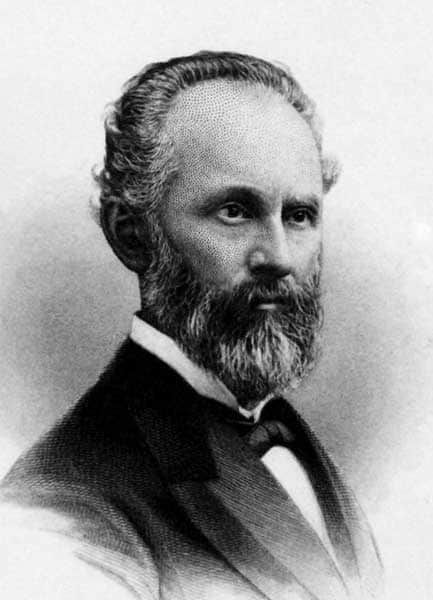
Elias “Lucky” Baldwin wasn’t just lucky. He knew how to make money, lived a life of risk and adventure and left a scandalous trail of marriages, divorces and affairs in his wake. One of his biographers called him a “Comstock plunger, real estate promoter and glamorous libertine, who loved most, after a sharp trade, to squeeze three girls at once.”
At Lake Tahoe he is best remembered for the legendary Tallac Hotel that he operated near South Lake Tahoe in the late 1800s. Baldwin’s legacy lives on today at the Tallac Historic Site, a stretch of century-old, beachfront estates near Baldwin Beach that is free and open to the public for bike rides, strolls and swimming a few miles south of Emerald Bay.
In the summer of 1879, Baldwin visited a Tahoe hostelry near Emerald Bay owned by Ephraim “Yank” Clements. Baldwin walked beneath the unspoiled stands of old growth timber and strolled along the sandy beach. The demand for tunnel supports for the Comstock mines had already taken a terrible toll on the majestic Sugar Pine forest that once cloaked the mountains in the Tahoe Basin, but here the trees stood tall.
The next year in November he bought Yank’s 2,000 acres, which included a three-story, 40-room hotel, saloon, horse barns and a general store, all along one mile of lakefront. After the purchase, Baldwin announced; “My land acquisition will save this vast forest from the beauty-destroying ax of the woodsman so that the magnificent pines and cedars may be admired by generations to come.” His upscale hotel and casino would also boost Tahoe’s reputation as a “destination resort” for travelers looking for luxury accommodations rather than the rustic backwoods fare common at that time. Baldwin developed it into one of the classiest resorts in the country.
“Comstock plunger, real estate promoter and glamorous
libertine, who loved most, after a sharp trade,
to squeeze three girls at once.”
Ironically, Baldwin’s moniker “Lucky” came from a windfall of more than $2 million dollars realized from his investments in those very Comstock mining operations that had decimated the Tahoe Basin. Back in 1866, Baldwin had a safe full of Hale & Norcross mining shares. He was speculating in Nevada mines like everybody else in San Francisco and Virginia City. At the time, the stocks were worth less than he had paid for them, but he didn’t want to sell at a steep loss.
That spring, Baldwin was invited by a group of British sportsmen to accompany them on a big game hunting expedition in India. Before he left, Baldwin instructed his broker to sell the mining shares if they ever reached the price he originally paid for them. While he was away, miners digging in the depths of the Hale & Norcross discovered a rich vein of silver. The stock soared in value, but the broker was unable to sell the rising stock as ordered because Baldwin had taken the key to the safe with him. When he returned to San Francisco, Baldwin’s mining shares were worth a fortune and the nickname “Lucky” was his for life.
Born in Ohio on April 31, 1828, Elias Baldwin demonstrated moneymaking capabilities early. As a 13-year-old boy, he decided that he had had enough of school and secured a job at a livery stable. He worked there long enough to buy a horse. When he was just 18, he won $200 by betting on his own horse in a South Bend race. He parlayed those winnings into $2,000 and used the money to elope with his girlfriend.
In 1853 he moved to San Francisco where he bought a hotel, refurbished it and then quickly re-sold it for a $5,000 profit. As Baldwin’s profits grew from his various investments, he decided to build the finest hotel in the West. Work on the Baldwin Hotel at Market and Powell streets began in 1873. The bold entrepreneur spared no expense in the construction and appointments of the opulent hotel and theater and it opened to rave reviews in 1877.
After his first visit to the San Gabriel Valley in Southern California, Baldwin bought the Rancho Santa Anita, a 6,000-acre spread. The tight-fisted Baldwin was a shrewd businessman, but Harris Newmark, who owned the ranch, drove a hard bargain, too. Baldwin offered Newmark $150,000 cash for the ranch, but Newmark demanded $175,000. Baldwin refused and walked away, but soon returned with the $175,000. This time, Newmark told him that the price had risen to $200,000. Baldwin was livid and again stormed out of the office. Newmark called after him and told him that the ranch would cost $225,000 the next week. Grumbling expletives, Baldwin paid Newmark’s price of $200,000.
One of Southern California’s early real estate promoters, Baldwin later subdivided sections of his property for sale and printed brochures extolling the virtues of the mild weather: “Epidemics, diseases, poisonous insects, tornadoes, cyclones, earthquakes and thunderstorms are practically unknown.” When one customer hesitated to pay $200 for an acre of land, Baldwin snorted, “Hell! We’re giving away the land; we’re selling the climate!”
After Baldwin purchased “Yanks” hotel in 1880, he re-named it the “Tallac House” for the 9,785-foot mountain to the southwest. Tallac is the Washo word for “Great Mountain.” Baldwin’s new resort soon became the pride of Lake Tahoe. E.J. Baldwin was known more for his fondness for fast horses and young women than protecting the environment, but he saved the towering trees along the beach by building a sawmill on his property at Fallen Leaf Lake. The mill provided lumber for new construction, thus preserving the original forest in the area around the hotel.
Over the next eight years the facilities were expanded and improved. Baldwin and his partners added another steamer to the growing Tahoe fleet. Named for the resort, the Tallac was billed as the “handsomest steamer on the Pacific Coast.” The five-star hospitality at the Tallac House was an anomaly at Lake Tahoe in the late 1800s. Consider the comments of a female correspondent for the San Francisco Bulletin who arrived at North Lake Tahoe in 1886. She reported that Tahoe City had a permanent population of about 25 people, but after encountering some Tahoe locals during the course of a week she wrote: “The inhabitants were a queer class of people—old hunters, miners, and inn keepers of the ‘early days.’ Their knowledge of the inclinations and desires of tourists is exceedingly limited.”
Mark McLaughlin explores local history
Aug. 5 | Historic bus tour
Aug. 8 | Logging history talk


