


The Tahoe Sierra is one of the most popular recreation areas in California, a region where summer thunderstorms are not uncommon. Residents and visitors alike should be aware of thunderstorm activity while enjoying the mountain lifestyle.
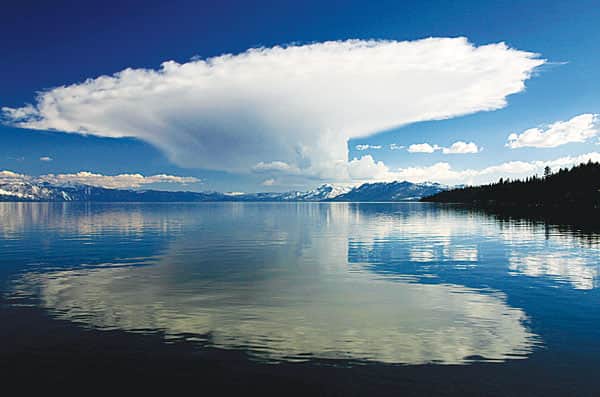
Be aware of changing Tahoe weather. | Mark McLaughlin
It may seem obvious that exposure to lightning on mountain peaks and ridges can be deadly, but the greatest fatalities occur during more mundane leisure activities such as fishing, camping, boating and golf. Lightning can strike from 10 miles away, so if you hear thunder less than 30 seconds after seeing the bolt or flash, it’s time to take shelter and protect yourself.
[blockquote3]
“… when the rogue thunderstorm stalled over the area,
creeks that were normally a trickle or even dry
at this time of year exploded into destructive
torrents of mud, rock and timber.”
[/blockquote3]
A lightning strike is powerful and impressive, but flash floods surpass lightning as the top weather-related killer in the U.S. Flash floods are especially lethal in the arid West where normally dry canyons, gullies and streambeds can suddenly become filled with raging torrents of muddy water spawned by distant thunderstorms. Unsuspecting hikers and campers have little warning to take cover and little time to escape.
Sixty years ago, on July 20, 1956, the weather was hot and sticky in the Truckee-Lake Tahoe region. In Reno, the temperature peaked at only 91 degrees, but the humidity reached a sultry 69 percent. The hot, muggy air fueled an already unstable atmosphere and generated severe thunderstorms over the eastern Sierra. The morning shift at the National Weather Service did forecast scattered afternoon and evening thundershowers, but was unsuspecting of the drama and destruction about to occur later that afternoon.
By 5:30 p.m., a towering thunderhead had developed over the eastern slopes of Mount Rose and the Carson Range. The ominous cloud cluster was feeding on daytime heating and a juicy atmosphere loaded with water vapor.
The main storm cell initially drifted south where peripheral showers dampened Carson City with a quick shower, but soon the prevailing airflow drove it north toward the Reno area where it drenched Mount Rose and nearby Peavine Mountain with heavy rain. Years of clear-cut logging, excessive grazing and forest fires had stripped the soil of vegetation and reduced its capability to absorb moisture. Most of the torrential rain pounding the denuded mountain slopes rushed downhill toward the unsuspecting neighborhoods below.
Reno had grown rapidly since World War II and as the city expanded, local flood channels had been incorporated into housing subdivisions. The demand for housing led developers to build homes in high-risk, flood-prone locations. Due to poor civil planning and environmental degradation, the city had tipped the odds against itself. The watersheds of Mount Rose and Peavine Mountain drain directly into the Reno area and when the rogue thunderstorm stalled over the area, creeks that were normally a trickle or even dry at this time of year exploded into destructive torrents of mud, rock and timber.
Jagged lightning bolts seared the dark sky, while bursts of rain and hail pelted the area. Motorists on the Mt. Rose Highway were caught exposed when the deluge struck. Matt Wackowicz, his wife and their three children were visiting from Sacramento and headed to their Lake Tahoe motel when they came upon several cars stalled in the muddy water of Galena Creek overflowing the highway. There were 16 people in six cars caught in this dangerous predicament, peering into the pouring rain and wondering what to do.
Suddenly large rocks and broken tree trunks began battering the sides of their automobiles. Wackowicz grabbed the two youngest children and told 10-year-old Fred to run for it. The thick flow of debris oozing across the road pinned his wife’s door shut, forcing her to climb out the driver’s window. Seconds later a stronger surge flipped the car over, trapping Fred inside. Fortunately, the young boy managed to escape through a broken window and scurry to safety in a nearby tree. The rest of his family struggled through the slurry of mud, water and debris.
Reno resident William Boyatt heard Wackowicz’s shouts for help and he jumped in to lend a hand. At that moment a wall of water 10 feet high crashed down upon them. The flow was so fierce three cars were swept into the steep ravine below — luckily all empty. Matthew was still carrying his two children when he lost his footing and fell into the maelstrom, followed by Boyatt. Mrs. Wackowicz saw her family being swept away and in a burst of hysterical frenzy, leapt in after them.
Although six of the motorists were injured and required hospitalization for their injuries, the rest had made it to safety and could only watch helplessly as boulders the size of automobiles and logs up to 40 feet long crashed down the mountainside. The force of the flood washed out more than a quarter-mile of the highway in just minutes. Search parties were on the scene in less than half an hour. Armed with pitchforks, shovels, probes and flashlights, the rescue units searched the silt-filled canyon for the missing victims. Despite their efforts, no one was found.
Tragically, Mrs. Wackowicz, William Boyatt and the two children did not survive the disaster. Hours later Matt Wackowicz was discovered battered and incoherent wandering near the Callahan Ranch. Incredibly, he had tumbled nearly 2 miles down the mountain in a rampaging torrent and lived to tell about it.
For years, Reno City Engineer Elliott Cann had initiated efforts to get federal aid in solving the flood threat. The Nevada State Journal had been advocating a flood control plan for the Mount Rose and Peavine watersheds since 1946. Ironically, the day before this disaster, Nevada Sen. Alan Bible was in Washington, D.C., ironing out House and Senate differences in the Washoe Project Bill, which included major flood protection for the affected area. Today, those areas are much safer.
Reno recorded less than half an inch of rain during the storm, but damage from the flood totaled tens of thousands of dollars. Despite sandbagging by more than 150 firemen, policemen and other city workers, hundreds of homes and businesses near Peavine Mountain were damaged. Water and mud from the Peavine flood reached all the way into downtown Reno. When it comes to flash floods in the mountains or desert, the sage advice of old timers still rings true: “When storm clouds gather over the hills, head for higher ground.”
Tahoe historian Mark McLaughlin is a nationally published author and professional speaker. His award-winning books are available at local stores or at thestormking.com. You may reach him at mark@thestormking.com. Check out his blog at tahoenuggets.com or read more at TheTahoeWeekly.com.


