


American technology and innovation has been impressing people around the world for generations. And, of course, there is always that Yankee competitiveness that has kept the United States on top of the economic heap for more than a century.
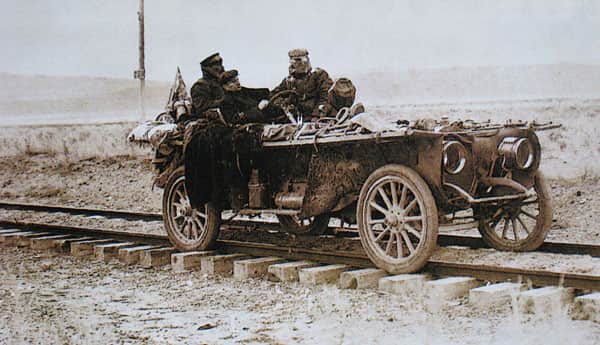
The American Flyer in Utah. | National Automobile Museum
One story that exemplifies American know-how and the country’s can-do spirit is the 1908 Great Race. The automobile as a reliable form of transportation was in the early stages of development at the beginning of the 20th Century, a time when rural residents used horses to travel. Most had no faith in the newfangled horseless carriage. In order to prove them wrong, automakers and the media organized an epic endurance contest to prove the mettle of the new cars. In 1907, the New York Times and a Paris newspaper, Le Matin, began promoting a long, challenging auto race billed as “the toughest race ever devised.”
[blockquote3]
“For two months, the German team fought off
the Americans for the lead. Drivers and mechanics
were exhausted and their vehicles were so
beat up that they wobbled down the road.”
[/blockquote3]
The New York to Paris race was an unprecedented automotive odyssey of more than 22,000 miles that would take nearly six months and span three continents. The race started in February so that entrants were forced to drive across the United States during winter, a feat never previously accomplished by automobile. The next leg of the race went on to Alaska, for an attempt to drive over the frozen Bering Strait, toward Siberia, Russia, and eventually Paris. It was a crazy idea and hardly anyone really believed it could be done, but 17 men representing four countries dared to try.
On Feb. 12, 1908, a quarter of a million people crowded Times Square to cheer the start of the Great Race. Lined up were six automobiles, representing the best technology yet produced by the world’s superpowers of the day: France, Italy, Germany and the United States. France entered three cars, while the other countries each ran one. All the cars had been modified for the race – Germany’s vehicle was designed and built with huge gas tanks and other innovative adaptations. The American-made car, a Thomas Flyer, was a last-minute entry and had few modifications.
The racers bolted out of New York City, but quickly ran into trouble with snowstorms in upstate New York and across the Midwest. One of the French cars made it only 44 miles before it bogged down and dropped out of the race. France lost another vehicle in Iowa due to mechanical breakdown.
The Flyer was the first to reach Chicago, but the other three competitors arrived within a few days.
The Thomas Flyer crew maintained their lead as they raced across the country. Along the way enthusiastic crowds gathered to cheer and attempt to write their name or initials on the car. The crew spent all day driving as fast as they could and long nights working on repairs. In Wyoming, the best wintertime route turned out to be the Union Pacific Railroad tracks. In Utah, the Americans followed an old emigrant wagon trail until they were forced onto the railroad ties of Southern Pacific. In Goldfield, Nev., cowboys and miners fired their six-shooters as the Flyer sped through the Silver State.
The Americans reached San Francisco first on March 24 to great fanfare. It had taken them 41 days, 8 hours and 15 minutes to drive nearly 4,000 miles from Times Square, but there was no time to celebrate. The crew immediately set about preparing the vehicle for the perils of crossing Alaska and Siberia. On March 27, the Flyer was loaded onto a ship for its journey to Valdez, Alaska, which it reached on April 8.
Meanwhile, the Italians were still 12 days from San Francisco with the French 250 miles behind them. When the trailing Germans ran into serious mechanical difficulties near Utah, they loaded their disabled vehicle onto a train bound for Seattle to catch a ship sailing for Valdez. It was a bad decision that would come back to haunt them in France where the judges would penalize them 15 days for failing to drive across the Western U.S.
The Flyer was greeted in Valdez by cheering crowds and a marching band, but the snow was so deep that the car couldn’t even be driven off the dock. It was obviously impossible to drive through Alaska Territory toward the Bering Strait, so the race organizers sent a telegram ordering the American’s back to Seattle. The Flyer was the only racecar to reach Alaska.
On April 14, the French and Italian teams sailed from Seattle for Japan, followed by the German crew five days later. The detoured Americans finally returned to Seattle on April 21, where the Flyer was loaded aboard a steamship bound for Kobe, Japan. During the 18-day sea voyage, the Flyer crew learned that the race committee had awarded them a 15-day credit for having gone to Alaska.
After crossing Japan during the middle of May, the Flyer reached Vladivostok, Siberia, where it had rained for 17 out of the previous 20 days. The road was a quagmire of mud. After 100 miles of constantly getting bogged down, the Americans abandoned the road for the Trans-Siberian Railroad tracks. At this point, the Flyer was ahead of the Italians, but behind the German team, who had repaired their vehicle and skipped Japan. The French pulled their last car from the contest and the Great Race was now down to three automobiles.
For two months, the German team fought off the Americans for the lead. Drivers and mechanics were exhausted and their vehicles were so beat up that they wobbled down the road. By now, the Italians were so far behind that they were effectively out of the race.
The German car rolled into Paris on July 26, four days before the Americans. In an all-out burst of fanatical driving, the U.S. team roared into Paris on July 30, but not before being stopped and ticketed on the way in by a French policeman for a broken headlight violation.
Germany’s victory celebration was short-lived, however, as the 15-day penalty for taking the train in the U.S., and the 15-day credit to the Thomas Flyer for reaching Alaska catapulted the Americans into first place.
The Great Race took 169 days of fierce competition and incredible endurance to win and it convinced many skeptics that automobiles were indeed as good as a horse. The original Thomas Flyer is part of the National Automobile Museum’s Harrah Collection in Reno, Nev. For more information on the Museum, visit automuseum.org.
Tahoe historian Mark McLaughlin is a nationally published author and professional speaker. His award-winning books are available at local stores or at thestormking.com. You may reach him at mark@thestormking.com. Check out his blog at tahoenuggets.com or read more at TheTahoeWeekly.com.


